Making Children More Resilient To Optimize Their Chances Of Success At School
Building community resilience means empowering communities to withstand various socioeconomic and climate shocks

- Français
- English
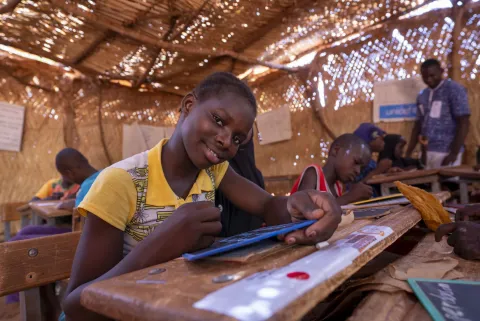
"My name is Estelle; I'm 11 years old. I'm in fifth grade in Tamasgo, and I like math. When I grow up, I want to become a doctor to treat people."
Estelle attends Tamasgo Primary School in Torodo, Zorgho Commune, Plateau Central Region. I her school, water flows abundantly.
"As water is available in our school, we wash our hands with soap when we come out o the toilets. At lunchtime, we wash our hands before and after meals. This protects us from diseases," says Estelle, showing that she understands how useful water is.

Tamasgo Primary has a vegetable garden, and every lunchtime, a hot meal is served to the children. With water now available, Laurent, a 12-year-old fifth-grade student, and his classmates maintain the vegetable garden to improve the quality of school meals.
"Every morning and evening, my friends and I take care of our garden by watering it. We grow cabbages, tomatoes, onions, and other vegetables. We water the vegetables every day, so they grow," says Laurent.
Building community resilience means empowering communities to withstand various shocks. In Zorgho, Burkina Faso, UNICEF helps communities cope with socioeconomic and climate shocks. "These are climate shocks. That’s why we talk about water management in a Sahelian environment, which is essential in building resilience,” emphasizes Moustapha Harouna, Chief of Water, Hygiene and Sanitation at UNICEF Burkina Faso.

Access to safe drinking water and quality nutrition in schools is a determining factor for the students’ health and success. As part of the Sahel Resilience Partnership (SRP) funded by the German Cooperation Agency, UNICEF, WFP, and GIZ have improved water availability for agricultural production, school meals nutritional quality and community food and nutrition security.
"We are in a school environment because it's about supporting children's learning, which is impossible without decent access to water, sanitation and good nutrition. The system that has been put in place provides communities with safe drinking water and a school garden, which helps strengthen the quality of school nutrition," explains Arouna.
In the Commune of Zorgho, UNICEF has equipped 12 sites with various water supply infrastructures: 1 solar pumping station of 1.95 to 3KWc for a flow rate of 2 m3/h to 5 m3/h, 1 metal structure tank of 10 m3, 1 laundry space with 3 taps for students, 1 community standpipe with 3 taps, 1 tap for the school canteen, 1 tap for the school garden, along with a chlorination system.
"Access to water increases student attendance. When there's no water in the school, children go out to the village when they are thirsty, they miss some classes, and maybe they'll go do water chores at home. Now that there's water in the school, children have all the time they need to focus on their learning," explains Arouna.

At each site, WFP has created a 0.25-hectare school garden, developed a 3,000- to 18,000-m³ reservoir and a 2-hectare lowland, produced 112.5 tons of compost, reclaimed 4 to 20 hectares of degraded land using the half-moon technique, treated 45 ravines, built 8 crossing structures, and supported women in building 270 improved stoves.
The Sahel Resilience Partnership is implemented in Burkina Faso, Mali, Mauritania, and Niger. In Burkina Faso, the programme was launched in April 2024 in Fada N'Gourma, East region, and targets populations in the regions of Boucle du Mouhoun, Cascades, Centre-Est, Centre-Nord, Est, Hauts-Bassins, Nord, Plateau Central and Sahel.
Accompanied by UNICEF Representative John Agbor and Didace Kayiranga of the World Food Programme (WFP), Mr. Roger Baro, Burkina Faso's Minister of Environment, Water, and Sanitation, visited on 24 March 2025 the water supply infrastructure and vegetable gardens of two primary schools in Tamasgo de Torodo and Zinado.
"With UNICEF, we initiated a project that provides drinking water to 12 schools. These 12 systems provide drinking water for students, water for the nutritious garden, and water for the communities, with the WFP focusing on the nutritious gardens and the canteen. All of this was made possible thanks to funding from German cooperation. It's a win-win partnership that accelerates educational opportunities in the Central Plateau region," says Mr. Baro.

UNICEF and WFP thank the German Cooperation for its continued support for the well-being of the people of Burkina Faso.
"I would like to express my sincere thanks to the German Cooperation for its support to this important resilience programme in Burkina Faso and beyond. I also call on the municipality to implement a sound management system to ensure the sustainability of these investments made by the State thanks to this German funding," said Arouna.
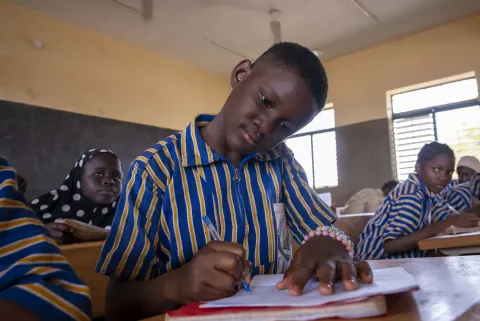
The living conditions of the people of Zorgho are improving, which, in the long term, will strengthen their resilience to potential shocks. At the Tamasgo school, like other schools in the municipality, learning conditions have improved which can contribute to the children's academic performance. Thus, Laurent will be able to achieve his dream for the future.

"I get good grades in dictation and arithmetic, and I like science. I dream of becoming a doctor when I grow up to treat my grandmother, my relatives, and my acquaintances for free," he concludes.