BURKINA FASO: Government, UNICEF and Japan inaugurate eight general education and technical and vocational training schools
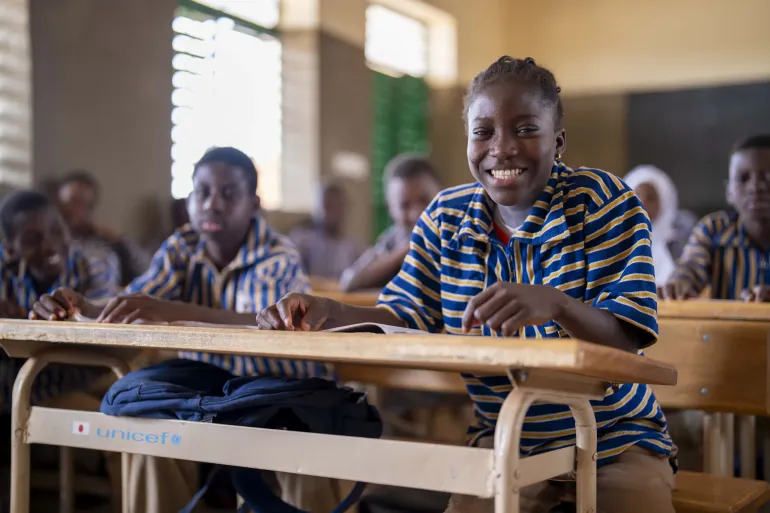
Since 2022, Burkina Faso and Japan have partnered with UNICEF to build and equip 26 schools, expanding access to safe, inclusive and quality learning for more than 50,000 children and adolescents over the next 15 years.
- Français
- English
Download multimedia package here
OUAGADOUGOU, 19 May 2026 – The Government of Burkina Faso, UNICEF and the Japan International Cooperation Agency (JICA) have inaugurated five general education schools and three multi-purpose schools. The investment amounts to USD 8,700,000, equivalent to JPY 1.3 billion or CFAF 4.8 billion. The inauguration ceremony was chaired by Prime Minister Rimtalba Jean Emmanuel OUEDRAOGO.
“These investments represent one of the essential building blocks for improving the education offer and creating a safe, inclusive and stimulating learning environment. Education is a key pillar of cooperation with Burkina Faso, and I can assure you of Japan’s readiness to support Burkina Faso in its development efforts,” said His Excellency NAGASHIMA Jun, Ambassador of Japan to Burkina Faso.
The municipalities of Ouagadougou and Koubri in the Kadiogo region are hosting two schools, while the municipalities of Bingo, Ramongo and Koudougou in the Nando region are receiving six schools. Built under the second phase of a broader programme funded by the Government of Japan and implemented by UNICEF, the eight schools are expected to serve around 10,000 students over the next 15 years.
In Burkina Faso, only five per cent of young people aged 16 to 35 currently benefit from technical and vocational education and training. The national ambition is to increase that share to 60 per cent by 2050. Delivering the Prime Minister’s inaugural address, the Minister of State, Minister of Territorial Administration and Mobility, Mr Emile ZERBO, underscored the Government’s strategic vision:
“This educational offer is no longer an alternative, but an absolute necessity for consolidating our growth and our economic sovereignty.”

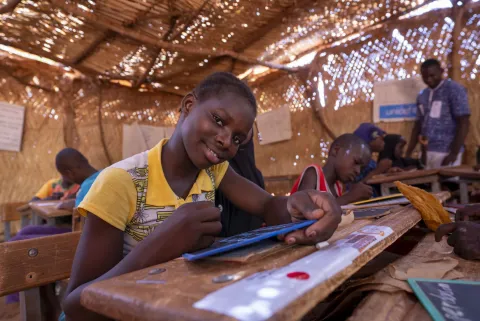
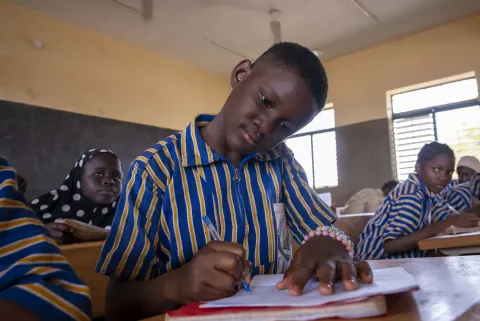
The schools are equipped with modern training materials, appropriate furniture and computer rooms. They also include autonomous water points, inclusive sanitation facilities, and separate latrines for girls and boys. All schools are built within primary school compounds, thereby facilitating the transition of learners from primary to lower secondary education.
With schools equipped with laboratory materials, computer and technical equipment, the Ministry of Secondary Education and Technical and Vocational Training (MESFTP) is providing thousands of children and adolescents with opportunities to pursue studies in areas such as civil engineering, electricity and mechanics.
“At a time when Burkina Faso faces major challenges, including limited school infrastructure, demographic pressure and the impact of the security crisis, investing in education is both urgent and essential. This project reflects the strength of the partnership between the Government of Burkina Faso, the Government of Japan and UNICEF. We thank the people of Japan for helping expand education opportunities for thousands of children and adolescents,” said Chantal Umutoni, UNICEF Representative.
Funded by more than USD 21.6 million from the Government of Japan (JPY 3.4 billion or CFAF 12.2 billion), the eight schools inaugurated in 2026 build on the 18 other institutions completed in 2023 in the Kadiogo and Nazinon regions.
The 26 schools include 26 administrative blocks, 152 classrooms, 114 latrines, eight autonomous water points and 19 sports grounds. Over the next 15 years, they are expected to provide better learning conditions for 50,000 children, half of them girls. In addition, 234 teachers and 780 community members have been trained in the use of technical equipment, participatory school management and climate change adaptation to help deliver quality education for children in Burkina Faso.
Media contacts
About UNICEF
UNICEF, the United Nations agency for children, works to protect the rights of every child, everywhere, especially the most disadvantaged children and in the toughest places to reach. Across more than 190 countries and territories, we do whatever it takes to help children survive, thrive, and fulfil their potential.
For more information about UNICEF and its work, please visit: www.unicef.org
About Japan
Since 2013, Japan has contributed to UNICEF through the diversified areas such as education, nutrition, water and sanitation, health and coronavirus control.
For more informations, please contact :
UNICEF : Ndiaga SECK, Chief Communication, [email protected], +226 05255898
MESFPT: Viviane TIENDREBEOGO, Director of Communication and Press Relations, [email protected], +226 70 26 29 04
JICA : https://www.jica.go.jp/burkinafaso/french/activities/index.html
Embassy of Japan to Burkina Faso: https://www.bf.emb-japan.go.jp/itprtop_fr/index.html