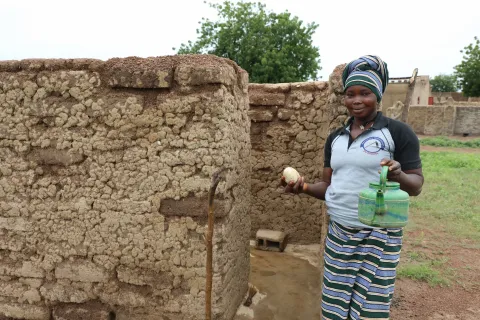
In Naton, Women Save, Build Businesses and Champion a Cleaner Village
Through Village Savings and Loan Associations (VSLAs), women in Naton are strengthening their financial autonomy and decision-making power while helping sustain improvements in household hygiene and sanitation

- Français
- English
One by one, the women stand, step forward and hand over their passbooks, announcing the number of shares they wish to contribute. Seated behind a simple table made of wooden sticks, Ebou collects each passbook, repeats aloud the number of shares declared, stamps the corresponding boxes and places the passbook beside a blue metal cash box.
Ebou Néa is the Secretary of the Yissono Village Savings and Loan Association (VSLA) in Naton, in the municipality of Pouni, Sanguié Province, Nando Region. A mother of three in her fifties, she approaches the role with seriousness and determination, helping meetings run smoothly, maintaining the group’s records and ensuring that collectively agreed commitments are respected. Her organizational skills and sense of responsibility have earned her the trust of the other members.
“Being a VSLA secretary requires a great deal of discipline. You have to be available, know how to listen, and above all be honest with the members,” she explains.
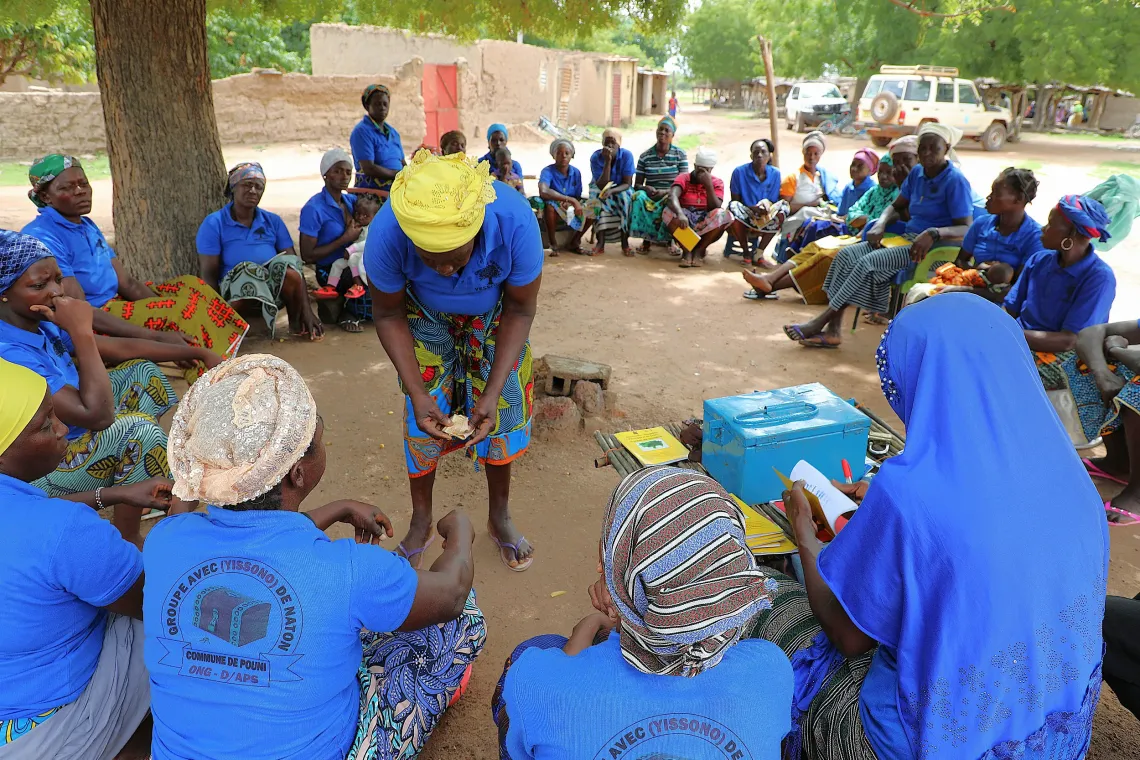
For Ebou, the VSLA is much more than a place to save. It is a space where women support one another and gain access to resources to expand their income-generating activities. Members contribute between 500 and 2,500 CFA francs in shares each week, as well as 100 CFA francs to a solidarity fund that supports members during important family and social events.
“In the past, some people struggled to find money to start or strengthen their activities. Today, our group has 27 members, and thanks to savings and loans, many women are able to invest and improve their living conditions,” she says.
Alongside her role in the VSLA, Ebou runs her own small businesses to help cover household expenses and improve her family’s living conditions.
Before joining the Yissono group, Ebou spent her time on household chores and had no income-generating activity. In November 2025, after some hesitation, she joined at the encouragement of her cousin. Her cousin explained the benefits of the savings and loan system promoted by the Association for Peace and Solidarity (APS), a non-governmental organization implementing Community-Led Total Sanitation (CLTS) activities with UNICEF support under the ASWA III Programme. The savings groups were introduced to help women sustain improvements in household hygiene and sanitation.
“My first loan was 10,000 CFA francs. I bought chili peppers, dried fish, and other spices to resell in the market. Thank God, it worked. I made a small profit and told myself, ‘Why not continue?” she recalls.

Within a month, Ebou had repaid her first loan and taken out another for 25,000 CFA francs to expand her business. She began buying and processing African locust bean seeds into soumbala, a popular local seasoning, which she packages and sells at the village market.
She also began baking and selling wheat-based cakes, which quickly became popular with village children, especially on market days. This success encouraged her to keep developing her business. “I am very happy and I feel useful within my household. I am financially independent and can contribute to my family’s expenses without much difficulty,” she says proudly.
Other women in Naton are also using VSLA loans to diversify their livelihoods and meet household needs.
Solange Nébié, a 62-year-old widow, was already raising pigs when she joined her savings group. Rising feed costs, however, had made it increasingly difficult to feed her livestock throughout the year.
In December 2025, she joined the Relwende VSLA and began contributing five shares a week, each worth 500 CFA francs. Three months later, a loan of 50,000 CFA francs enabled her to buy sorghum and red millet to brew and sell dolo, a popular traditional local beer. “Selling dolo is very profitable. Besides generating income, the spent grain I collect after brewing is used to feed my pigs. In addition, the yeast produced during the brewing process provides another source of income. A calabash of yeast sells for 3,000 CFA francs at the market,” she explains.

For Bénéwendé Tondé, a mother of three and a member of the Sougri Nooma VSLA, access to loans has helped her invest in her weaving business.
With her second loan of 25,000 CFA francs, she recently bought weaving thread to fulfil a large order from a choir in the city of Koudougou. “Where else could I have found the money to complete such an order?” she asks. “Getting loans from wealthy individuals in the village depended entirely on their goodwill, and sometimes we had to endure their moods and whims. The savings and credit system is truly a blessing for us women. It helps us enormously while preserving our dignity.”

Naton’s VSLAs are also opening up opportunities for women with disabilities.
Yvonne Dahourou, a mother of two, is a skilled hairstylist who lives with a physical disability that limits her mobility. She offers a range of hairstyles, including traditional African braids, twists, cornrows and box braids. “I manage to get by and I’m doing well. Thanks to the savings I have accumulated in my group, I will be able to take out a loan next school year to buy school supplies for my children,” says Yvonne.

For Isabelle Sian, VSLA Supervisor and Monitoring Officer at APS, the groups’ economic benefits complement their original sanitation objective. Introduced to help women sustain the achievements of CLTS and improve household hygiene and sanitation, the VSLAs are also helping members develop small businesses and strengthen their livelihoods.
Women are helping this approach grow by setting up new groups and financing the equipment themselves. “Naton now has nine VSLAs entirely managed by women. To date, the savings generated by these nine groups have mobilized more than 10 million CFA francs during this first nine-month cycle,” Isabelle states.

Under the ASWA III Programme, UNICEF implemented Community-Led Total Sanitation (CLTS) in 67 villages across Burkina Faso’s Nando Region. Five of these villages, including Naton, piloted an approach that combines CLTS with Village Savings and Loan Associations whose members are predominantly women.
The growing role of women in Naton reflects ASWA III’s focus on gender transformative approaches. This programme priority seeks to improve social norms and promote inclusive, sustainable water, sanitation and hygiene (WASH) services for all.