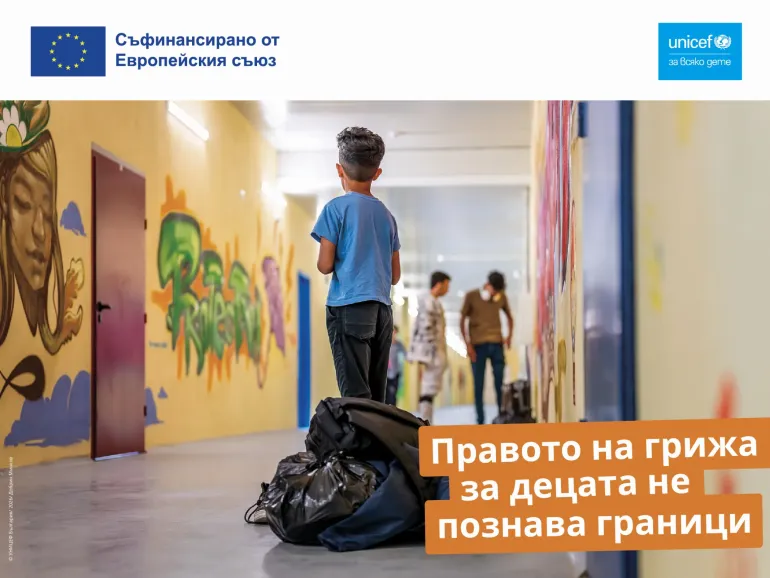
The Right to Care Knows No Borders
UNICEF Bulgaria and partners launch a campaign to promote foster care for unaccompanied children
- Български
- English
Sofia, 29 October 2026 – UNICEF Bulgaria, together with the State Agency for Refugees, municipalities, and partner organizations, is launching a national communication campaign to promote foster care for unaccompanied children seeking protection in Bulgaria.
The campaign is part of the pilot project for Bulgaria,“Establishment of Alternative Social Services for Unaccompanied Refugee Children in Bulgaria”, co-funded by the European Union and implemented by the State Agency for Refugees under the Council of Ministers in partnership with UNICEF Bulgaria, the International Organization for Migration (IOM), and the municipalities of Burgas, Ivaylovgrad, Malko Tarnovo, and Tundzha.
The national campaign is also supported by the Agency for Social Assistance, which manages and implements activities aimed at strengthening, promoting, and developing foster care nationwide, in partnership with municipalities, as an alternative family-based care option for children at risk.
The campaign’s key message is that every child, regardless of where they come from or the path their life has taken, has the right to care, protection, and the opportunity to grow up in a family environment. Around the world, millions of children are forced to leave their homes due to conflict, violence, poverty, and crises, and unaccompanied children are among the most vulnerable of all.
In 2025 alone, 573 unaccompanied refugee children sought protection in Bulgaria. These are children who arrived in the country on their own, without a parent or responsible adult, and who need safety, care, stability, and the opportunity to grow up in an environment as close as possible to a family one.
"As the institution responsible for implementing the national asylum policy, it is important for us to give these children hope and a future. We can achieve this by building a sustainable model of social support, not only within the framework of a single project and not through fragmented efforts. Real results will come when we collectively build on the care currently provided to unaccompanied children in the Safe Zones of the State Agency for Refugees and expand it with alternative social services and family-type care in the future. The positive examples of refugee children who have successfully built their lives here, as well as the first foster families who have welcomed unaccompanied children seeking protection in Bulgaria, even though they are fewer than we would like, give us confidence that this is possible," said Dimitar Ivanov, Chairperson of the State Agency for Refugees under the Council of Ministers.
According to data from the Agency for Social Assistance, in 2025 the Child Protection Departments across the country worked on 174 cases of unaccompanied children for whom child protection measures were undertaken. Most of these children, 155, received support through residential care services, including family-type accommodation centres, crisis centres, and transitional housing. A further 15 children were placed with relatives, whilst 4 children were placed with foster families.
In the context of the implementation of the European Pact on Asylum and Migration, which establishes the best interests of the child as a guiding principle in all decisions and procedures concerning refugee and migrant children, the development of quality family-based services and alternative care for unaccompanied children is more important than ever.
"No child should have to face the challenges of migration alone. When an unaccompanied child arrives in Bulgaria, they need not only protection, but also care, stability, and human support. Family based foster care gives children the opportunity not to face the future alone," said Mio Nemoto, Representative of UNICEF in Bulgaria.
The initiative encourages more people to become foster parents and provide safe, supportive, and specialized family care for children in need of protection, including unaccompanied refugee and migrant children who have experienced loss, separation, violence, conflict, or forced displacement.
Unaccompanied refugee and migrant children remain among the most vulnerable children at risk and often require additional support tailored to their experiences of trauma, their cultural and linguistic backgrounds, and their adaptation to a new environment. The campaign draws public attention to the need for specialized foster care for these children, ensuring that every child has the opportunity to grow up in a safe family environment and receive the support they need to thrive.
Through the campaign, the partners will encourage public support for foster care and demonstrate that behind every statistic there is a child in need of safety, trust, and a chance for a new beginning.
About the Project
The project “Establishment of Alternative Social Services for Unaccompanied Refugee Children in Bulgaria” is co-funded by the European Union and aims to expand access for unaccompanied children to quality care, protection, and family-oriented services in Bulgaria. The project is based on the principle that every child, regardless of their origin or migration status, has the right to grow up in a safe and supportive environment as close as possible to a family one. More information about the project is available here.
Media contacts
About UNICEF
UNICEF, the United Nations agency for children, works to protect the rights of every child, everywhere, especially the most disadvantaged children and in the toughest places to reach. Across more than 190 countries and territories, we do whatever it takes to help children survive, thrive, and fulfil their potential.
For more information about UNICEF and its work, please visit: www.unicef.org
Follow UNICEF on X (Twitter), Facebook, Instagram, and YouTube