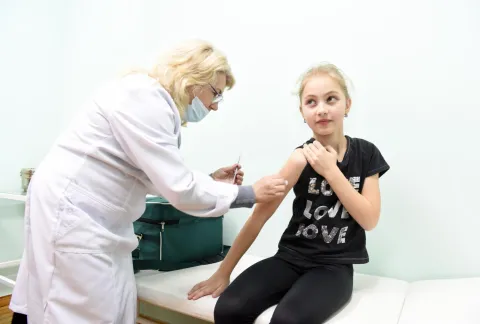
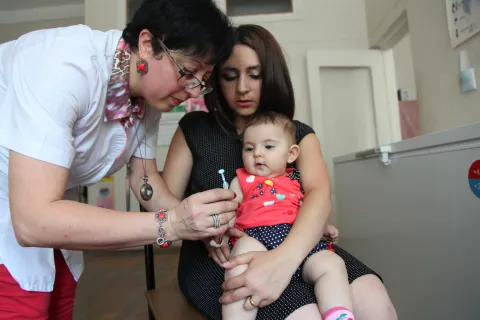
Childhood immunizations in Europe and Central Asia remain below critical levels while Bulgaria shows progress
Vaccine complacency across Europe and Central Asia is threatening child health, reveals new data from UNICEF and WHO
- Български
- English
COPENHAGEN/GENEVA/SOFIA, 15 July 2025 – While childhood vaccinations against measles, whooping cough, and other diseases remain below pre-pandemic levels in many countries across the WHO European Region, Bulgaria is showing a positive trend, according to new data from WHO and UNICEF.
According to the latest 2024 estimates, Bulgaria’s immunization coverage is among the highest in the region:
Six-component vaccine (against diphtheria, tetanus, pertussis, hepatitis B, haemophilus influenzae type B infections, and poliomyelitis):
- 1st dose: 95.6%
- 2nd dose: 94.9%
- 3rd dose: 94.2%
Combined vaccine against measles, mumps, and rubella:
- 1st dose: 94.2%
- 2nd dose: 90.5%
Despite this progress, as many countries in the region, the coverage with the third dose of the six-component vaccine and the second dose of the combined measles, mumps, and rubella vaccine still remains below the recommended 95% threshold needed to achieve herd immunity.
“When parents have access to accurate information and support, they prioritize their children’s health. Vaccination is not only a right, but a vital protection for every child,” said Christina de Bruin, UNICEF Representative in Bulgaria.
Globally, 89 per cent of infants worldwide received at least one dose of the diphtheria, tetanus and pertussis vaccine, and 85 per cent completed all three doses. That’s 171,000 more children receiving at least one vaccine and one million more children fully vaccinated in 2024 compared to 2023 – modest progress amid growing global challenges.
Regional Context
The coverage of childhood vaccines in 53 countries in Europe and Central Asia remained almost the same in 2024 compared to 2023, revealing stagnated recovery of pre-pandemic levels. Between 2019 and 2024, coverage of key vaccines declined from:
- 92% to 91% for the second dose of the combined measles, mumps, and rubella vaccine;
- 95% to 93% for the third dose of the diphtheria, tetanus, and pertussis (DTP) vaccine (administered in Bulgaria as part of the six-component vaccine);
- 95% to 93% for the third dose of the polio vaccine (administered in Bulgaria as part of the six-component vaccine);
- 92% to 91% for the third dose of the hepatitis B vaccine (administered in Bulgaria as part of the six-component vaccine).
In 2024, more than half of the countries did not reach the 95% threshold, and nearly one-third reported vaccine coverage below 90%.
“Last year alone, nearly 300 000 people got whooping cough in our Region – more than a three-fold increase on the previous year. Meanwhile, over 125 000 caught measles in 2024, twice as many as 2023. These are not just numbers – it’s hundreds of thousands of families in anguish because their children are sick, and it could have been prevented,” said Dr Hans Henri P. Kluge, WHO Regional Director for Europe.
“In many ways, vaccination has been a victim of its own success across Europe and Central Asia,” said Regina De Dominicis, UNICEF Regional Director for Europe and Central Asia. “Today’s generation has not witnessed the devastating impact of vaccine-preventable diseases – leading to complacency and making it easier for misinformation to take hold. Last year’s surge in measles cases – the highest reported in nearly three decades – is a reminder that unless governments invest in strong community health systems and address inequities in access to health care and information, more children will face preventable illness, lifelong complications, or even death.”
Looking Ahead
Encouragingly, progress is being made with newer vaccines, including those against rotavirus, Haemophilus influenzae type B infections, and pneumococcal disease. However, low human papillomavirus (HPV) vaccination coverage—especially among boys—remains a serious challenge across the region.
New HPV Vaccination Programme in Bulgaria
In response to this challenge, on 14 July 2025, the Bulgarian Ministry of Health launched a new national programme providing free HPV vaccination for girls aged 10 to under 15 and boys aged 10 to under 14. Nearly 150 girls and boys were vaccinated within the first 24 hours of the programme’s launch. Vaccines are administered by general practitioners, paediatricians, and obstetrician-gynaecologists.
The programme is part of broader efforts to improve access to vaccines and raise awareness among parents and young people.
More information about the programme can be found at this link.
Renewed efforts
“As we plan the next phase of our work across Europe and Central Asia, one thing is clear: vaccines must stay at the top of the agenda. The work is not yet finished. We need urgent, united action to close the gaps in coverage and stop preventable diseases from making a comeback. Every country has a role to play, even those with high vaccination coverage,” concluded Dr Kluge.
UNICEF and WHO work together with health authorities across the Region to identify, understand and address inequities in immunization coverage at the local level. Ongoing projects, supported in part by the European Union, include triangulation of data sources to identify who is not being reached with routine vaccinations and behavioral insights research to identify barriers to high uptake, which can include lack of active screening, reminders or information to address common misconceptions, as well as other factors.
Countries that do not currently have measles cases or outbreaks must be proactive in planning and preparing to prevent the virus from spreading within and beyond the country. Countries currently experiencing outbreaks must continue their efforts to vaccinate all susceptible individuals, intensify case finding and contact tracing, and use epidemiological data to identify gaps in vaccination coverage so that the programmes can ensure affected communities are protected and future outbreaks can be prevented.
Media contacts
About UNICEF:
UNICEF works in 190 countries and territories. We save children’s lives. We defend their rights. We help them fulfill their potential. And we never give up. Because we are UNICEF – for every child!
Follow us on: Facebook, X and Instagram.