Early learning changes Agatha’s life
Small steps towards social inclusion of children with disabilities in Belarus

- русский
- English
Limited access to services. Stigma. Social exclusion.
These are far too often a reality for the estimated 5.1 million children who live with disabilities in the Region. We follow 3-year-old Agatha through her daily routine at a UNICEF-supported Early Childhood Intervention (ECI) Centre in Minsk, to see how care and support are changing children’s lives in Belarus.

Agatha, age 3, is one of at least 30,000 children living with a disability in Belarus.
Diagnosed with cerebral palsy and partial atrophy of the optic nerve when she was 8 months old, Agatha is now learning to crawl and discover the world around her with the help of her mother and UNICEF-trained specialists at the ECI centre in Minsk.

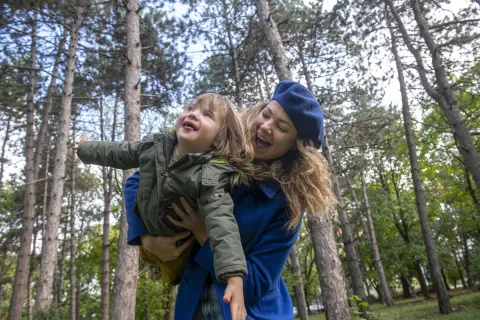
Agatha starts her mornings at home with exercises on a fitball which helps her develop balance. Her mother, Ekaterina, is always there to support, guide and be a source of cheer. When Agatha was born, most of her muscles were stiff, so many of her activities are aimed at making them work. “Right now, it is much better, the only part that is still quite stiff is her right hand,” says Ekaterina.

Agatha loves watching music videos. They allow her to focus her eyes and increase her attention. The rattling sounds of chains, just like the music rhythms, stimulate her senses and develop curiosity. Agatha is never alone – her puppy Ella is always up for some cuddling.

Some fathers cannot cope with the reality of having a child living with a disability, and often leave mothers alone to deal with the complex needs of the child. That is not the case with Agatha’s father. He is very supportive of his daughter and wife - and works weekend shifts to provide for his family.

Agatha attends an Early Childhood Intervention (ECI) Centre in Minsk. Today, she is learning to differentiate between colours. She is also learning to turn around while she crawls.
UNICEF supports 28 ECI centres in Belarus to help develop the motor functions and cognitive skills of children with disabilities. Parents participate in the classes and families receive holistic support plans.

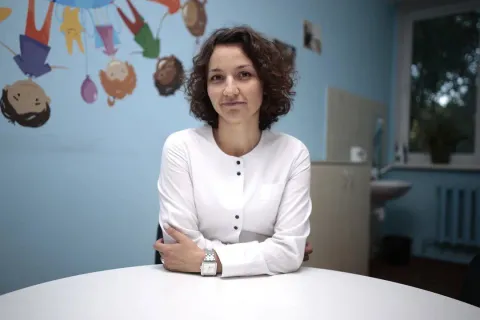
“The ECI centre is one of the few places where Agatha feels at home and communicates openly with others. The specialists here also give helpful recommendations, and as a result, I see Agatha happy,” says Ekaterina while her daughter shares a laugh with Svetlana and Olga, two ECI specialists.

Despite significant improvements in her development, Agatha still has limited options to go to kindergarten, as few kindergartens in Belarus are ready to accept children with disabilities. To address this, UNICEF works on a comprehensive support system for families with children living with disabilities, helping the Government to develop legislation on the national ECI system and piloting inclusive education classes in kindergartens and schools across the country.

In the afternoon, Agatha continues her routine with Sveta, an enthusiastic coach who provides sessions for children with disabilities in a swimming pool. Sveta taught Agatha to hug – first, to be able to hold her body above water, and then as a way to express her feelings.

Swimming helps stimulate Agatha’s cognitive and physical development. Sveta sings nursery rhymes and splashes around, while the girl’s rolling laughter echoes around the pool. Thanks to the ECI and swimming classes, combined with the support of her parents, Agatha is developing more quickly compared to children who do not have access to these services.

Tired but happy, Agatha heads home for a nap and quality time with her father. It not only takes a devoted family, but a comprehensive support system and an inclusive society to raise a happy child.
For many children with disabilities in Belarus, being accepted is still a challenge. But with more services and inclusive classes becoming available, harmful attitudes in society are starting to change - which is absolutely critical for children living with disabilities to reach their full potential in life.