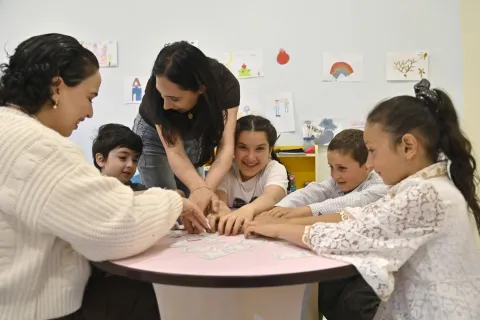
Information that saves lives. Children learn about explosive ordnance after conflict escalation
Over 380 children continue to learn in the 10 temporary education and recreation centers established by UNICEF and Red Cross

- Հայերեն
- English
“This is a very serious issue, guys. Listen carefully so that you know what to do later on,” David, 8, calls out his friends in class and starts to read. “You should not touch a mine with your hands. That’s right, isn’t it, Ms Stepanyan? We should not touch it.”
David first came across a mine in his native village in Nagorno-Karabakh. He tells his friends that he wandered around as he was playing in the yard with other children and found himself near a building where there were unexploded missiles. At first, he thought they were toys. “I was lucky, my father ran up to me and grabbed my hand,” recalls David, who moved to Jermuk from Nagorno-Karabakh as a result of the military escalation.

David is joined in this class by other children who, like him, fled the conflict in Nagorno-Karabakh, as well as children from Jermuk. For the past several weeks, they have been learning about explosive ordnance together and how to behave when you encounter one. Delivered by UNICEF in partnership with Red Cross across the 10 newly set up temporary education and recreation centers, this programme aims to raise awareness about mine risks among school-age children and potentially save lives in the future.

“The main emphasis of these sessions is to instil and model correct actions and behavior that will keep them safe in the future, especially in situations when a child may find himself in a minefield or in front of explosive ordnance. Having local children take part in the programme has helped other integrate in the community. In addition, we strive to address psychosocial issues as well. Some children lost not only their homes as a result of the conflict, but also a family member or a relative. Others have a fear of resumption of the war.”

“I used to be very sociable and cheerful. When we had just moved to here, I didn’t want to do anything, I didn’t want to talk to anyone. I was very sad. Now I feel better. These sessions helped me a lot. I had heard about volunteering before, but I never had the opportunity to volunteer. Now I have realized that it is a very important job. I want to know more and pass on this information to others around me. Maybe that way I will be able to save lives.”
“As the military escalation subsided, at UNICEF, we set out to teach children about unexploded ordnance but do so in a way to also ensure recreation needs and facilitate their integration in Armenia. So we established temporary education and recreation centers in 10 regions, provided materials for learning and games. We also trained 20 teachers that are now working in these centers, providing necessary support to over 380 children. Unfortunately, we have learned that disasters come without warning, so we must prepare today. Hence, we must teach our children safe behaviors and what to do in case of natural and man-made disasters and hazards.”
The centers were provided with a number of learning materials, including “The Nagorno-Karabakh Conflict: Risk Awareness and Safe Behaviour“ handbook, while the hosting schools were provided with a set of “Warning, mine area“ posters.
Milena Shelunts, 6, is happy to come to the center in Jermuk․She likes the various challenging games on protection from explosive ordnance. But above all, she likes to talk about her dreams and her love for her siblings.

“My house is left in Nagorno-Karabakh. I miss it a lot. We were the last to leave our village. I like it here. The children are very nice, and we play a lot. I do not think about our house when we play. I learn something new here, then I go home and teach it to my sister and my brother. My brother will go to the army this autumn. I tell him all I have learned about mine risks, it is very important for him.”
“Due to the events of 2020, a large number of people moved from Nagorno Karabakh to Armenia. Most of them plan to return, but due to the conflict, there is a high risk of explosives in those areas. Emphasizing the safety of those displaced from Nagorno-Karabakh, as well as the need to respond quickly to the needs of children, in partnership with UNICEF, we put together this programme very quickly,” noted David Hakobyan, Disaster Management Department, Armenian Red Cross. “This programme is important not only in terms of safety and risk prevention, but also in terms of wellbeing, as most displaced persons need psychosocial support.”

Along with Milena, Ani Arsenyan, 6, also enjoys coming to the center. She is always accompanied by her mother, Narine Khanoyan. According to Narine, she could hardly find a better way to ensure that Ani spends quality free time in the community.

“I have noticed that children have opened up here and communicate more openly. They use their time very rationally, they learn to beware of mines and the basic safety rules, which is really important. Here they also learn teamwork, discipline. They have learned so much that even I, at my age, do not know,”
Along with Ani and Milena, Mikayel Hovhannisyan, 12, is also excited to learn and play at the center.
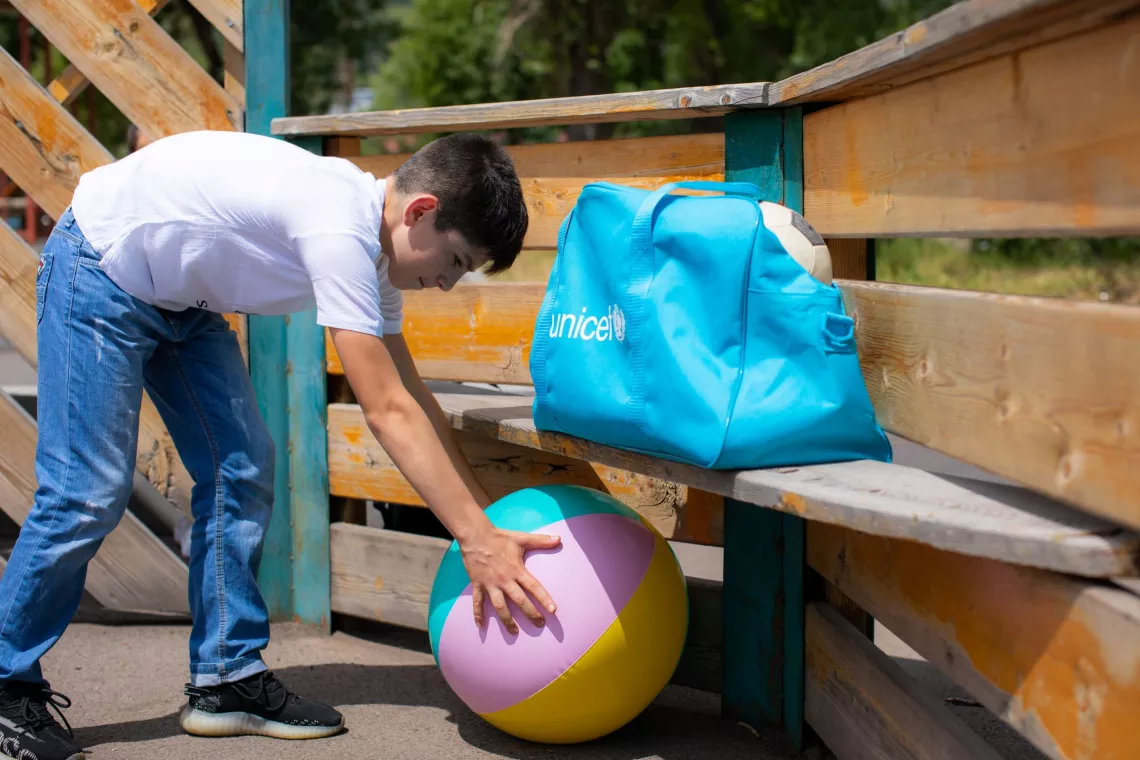
“You may think that these lessons are about “don’ts”, but that’s not the case. We often talk about our dreams here and learn to help other people. I want to become an architect. My grandmother says I need to understand how the mines work, so that besides being attractive, the buildings that I built in the future are also safe.”