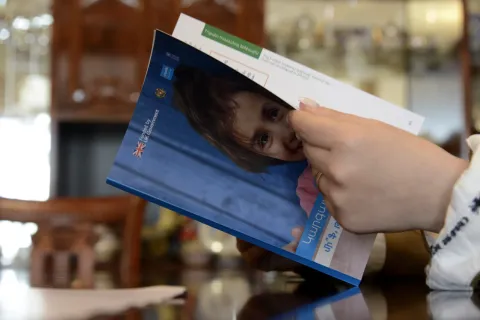
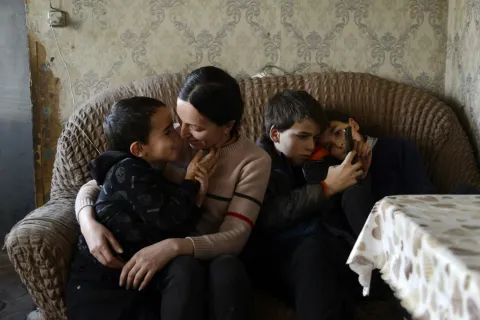
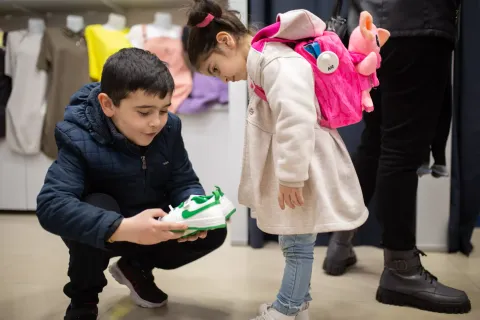
Family friendly policies are more than the right thing to do. They are a strategic decision that pays off for businesses, families, women and children. World Bank Armenia and UNICEF
Employers have the opportunity—and responsibility—to eliminate the difficult choice thousands of parents face between earning a living and nurturing their children.
- Հայերեն
- English
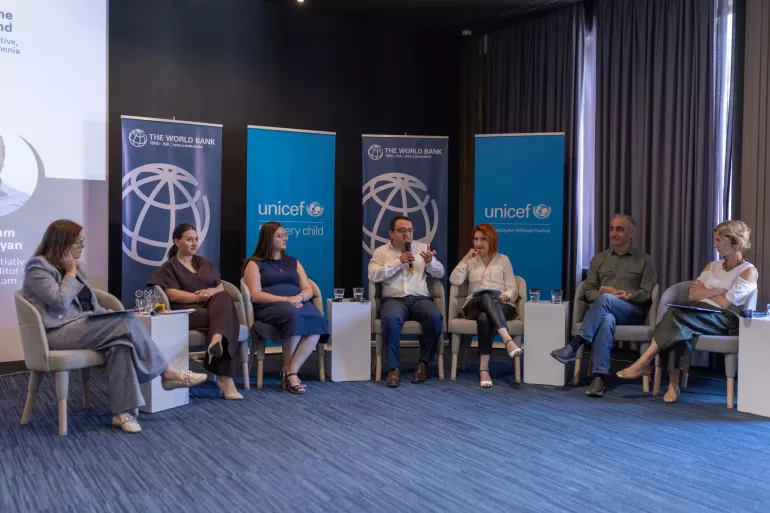
YEREVAN – On 25 June 2025, the World Bank in Armenia and UNICEF office in Armenia hosted a panel discussion aimed at addressing barriers to women's employment in the country and creating an enabling environment for family-friendly policies. The event served as a platform for policymakers, representatives of civil society, private sector and media organizations to look into existing policies, services and social norms and discuss the next steps required to advance an ecosystem of family friendly policies in Armenia.
According to a survey, referenced in the World Bank's Armenia Gender Assessment 2024 (Source: 2023 Life in Transition Survey IV, EBRD 2023), 68 per cent of women and 69 per cent of men in Armenia think that a woman should do most of the household chores even if the husband is not working. Additionally, 69 per cent of women and 87 per cent of men think that the man should earn the money, and the woman should take care of the children and do household tasks. Despite existing social norms and challenges, the case is clear: data has shown time and again that societies only stand to gain from investments into family friendly policies that encourage an equitable child-care burden for mothers and fathers alike, as well as greater participation of women in the labor market. On the other hand, when fathers are given the space and encouragement to bond with their babies from the very beginning—even before birth—they are more likely to stay actively involved throughout their children's lives. This not only benefits the child but also contributes to fathers’ own psychological well-being, self-esteem, and life satisfaction. Similarly, businesses that invest in their employees’ well-being, see higher productivity, stronger retention, especially of women, improved profit, and ability to attract best available talent.
As stated by Tatevik Stepanyan, Deputy Minister of Labor and Social Affairs in her welcome remarks, the government has embarked on a comprehensive package of policies, including national strategies on employment, demography, and on gender, that will create an ecosystem around families to improve gender roles in the family and ensure equitable access to employment. “While Armenia has improved its position in the WEF Gender Gap report, there is still a lot to attain, especially with regard to education and breaking away from negative social norms around both men and women.”
The panel discussion, led by Carolin Geginat, World Bank Country Manager for Armenia, and Christine Weigand, UNICEF Representative in Armenia, featured Sophie Bostanchyan, Head of Division on Human Trafficking and Women's Issues under Equal Opportunities Department, Ministry of Labor and Social Affairs; Tamara Sargsyan, Head of General Education Department, Ministry of Education, Science, Culture and Sport; Armen Martirosyan, Co-founder of “Papa’s club”/ Founding Director at Health Fund for Children of Armenia; Astghik Baghdasarova, Head of PR and Marketing Department, "Fami Group" LLC; and Gegham Vardanyan, Media Initiative Center, Editor of media.am.
The discussion evolved around the key barriers to women’s employment in Armenia, such as restrictive social norms around care responsibilities, lagging access to care services, including early childhood interventions, and limitations in policies regulating parental leave. Together, panel members called for solutions to address these barriers through leveraging the power of media to advocate shifts in social norms, expanding access to and availability of care services, putting in place conducive policies at work, and considering further improvements in national policies and services for families.
One of the key challenges is the gender gap in labor force participation. Among the working-age population, only 50% of women are participating in the labor force, compared to a 72% participation rate among men. This difference indicates a misallocation of Armenia’s human capital potential,” stated Carolin Geginat, World Bank Country Manager for Armenia.
“Armenia stands at a critical turning point. With planned reforms under the 2024–2040 Demographic Strategy and various sectoral strategies, the foundations are being laid for greater women’s economic empowerment and family-friendly policies. But progress must be accelerated and will require coordinated action—with government, civil society, the private sector, youth, and communities all working together,” concluded UNICEF Representative Mrs Weigand. “UNICEF defines family-friendly policies based on time, services, and income. For caregivers, this means more paid parental leave, greater access to affordable, quality childcare and early childhood education, and strong social protection systems, including child benefits. However, policies are not enough, we must shift mindsets to value caregiving and promote equality at home and at work, with engagement of both mothers and fathers.”
Media contacts
About UNICEF
UNICEF promotes the rights and wellbeing of every child, in everything we do. Together with our partners, we work in 190 countries and territories to translate that commitment into practical action, focusing special effort on reaching the most vulnerable and excluded children, to the benefit of all children, everywhere.
For more information about UNICEF and its work for children, visit www.unicef.org.