
IMAGINE, LISTEN, ACT: Two Cohorts, One Shared Ambition for the Future
With the Higher Council for Youth, two Youth Foresight cohorts are opening the way to a more durable way of involving young people in the decisions that concern them.

- English
- Français
In Algeria, a first generation of young people trained in foresight methods learned to explore possible futures with other young people. A second cohort expanded the approach with children and youth around the future of education. From Algiers to M’Sila and Boumerdès, from a national session to summer camps, the contexts were nothing alike. The aspirations expressed were remarkably similar. What these journeys now make visible is a capacity that is beginning to extend beyond an individual journey — and a question that now sits with institutions.
Youth Foresight starts from a simple idea: young people should not only be consulted about decisions that have already been made. They should also have methods that help them explore coming changes, compare possible futures and formulate the solutions they want to help build.
In Algeria, this work has developed through the UNICEF Youth Foresight Fellowship — a UNICEF Innocenti programme, carried forward in the country by the Higher Council for Youth and UNICEF Algeria. The journeys of Aïcha Robei and then Ayoub Kaouane show how an individual experience can gradually become a shared capacity, passed on to other young people and applied in local, national and international spaces.
Foresight thinking is more than just planning ahead. It’s about unlocking creativity, embracing possibilities, and driving sustainable change for generations to come.
From an Individual Experience to a Transferable Capacity
A member of the Higher Council for Youth, Aïcha Robei joined Algeria’s first Fellowship cohort in 2023. During her journey, she deepened her understanding of foresight, child rights and research, and engaged other young people in exploring transformations that could affect their future.
Her work included six Youth Foresight workshops involving 185 young people. The discussions focused in part on youth participation and technology. They informed three recommendations: strengthen digital literacy and safe access to digital tools; create more opportunities for young people to contribute to policy development and decision-making; and foster innovation and the ethical use of emerging technologies while protecting children’s rights and privacy.
For Aïcha, the value of the journey was also personal. Foresight methods became a way to approach daily questions in both formal and informal spaces. This matters because foresight no longer remains confined to a programme or workshop. It becomes a way to ask questions, detect signals of change and open dialogue about possible choices.
“ Foresight tools became a way of living for me. I am applying them in all areas, in formal and informal spaces, with friends and family. ” Aïcha Robei
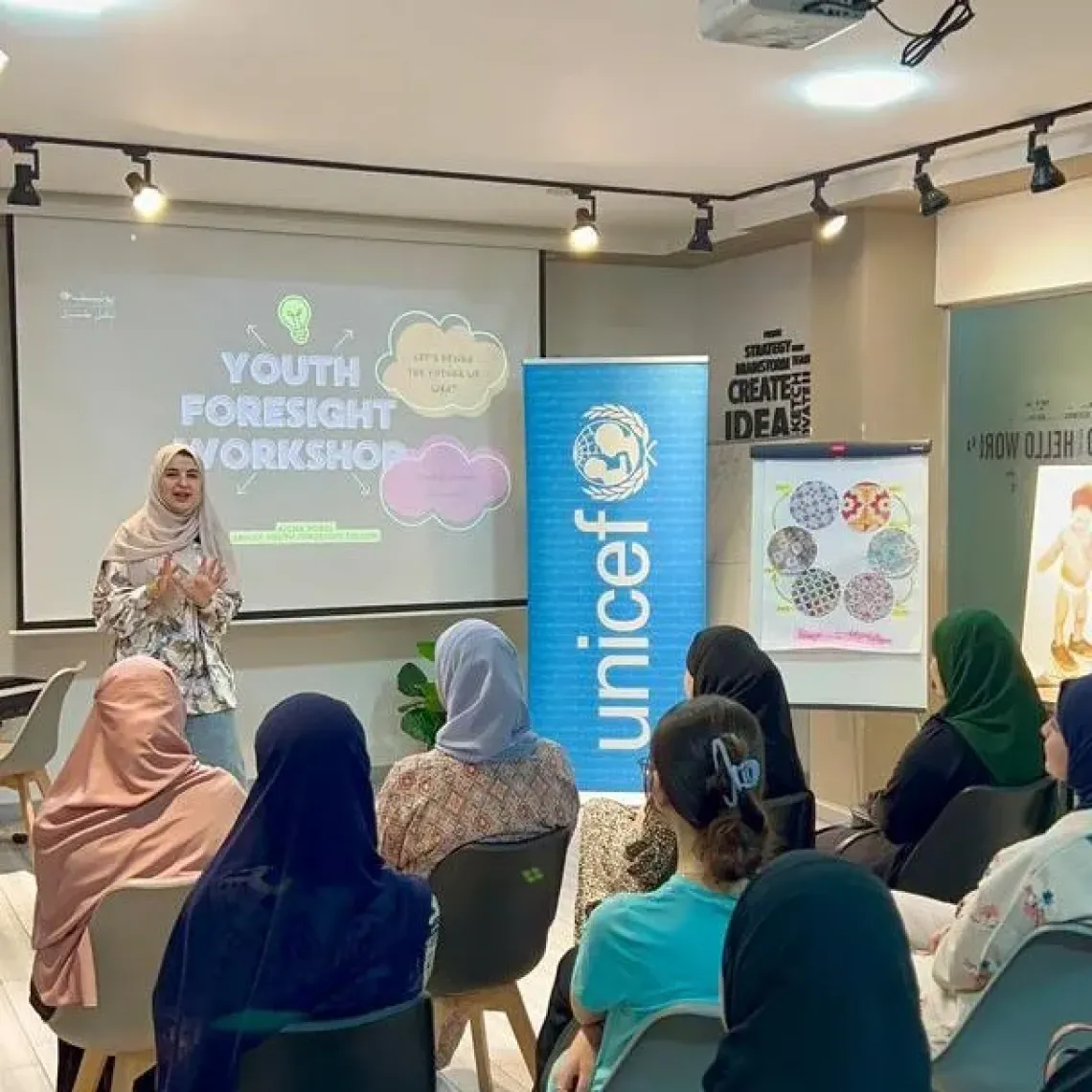
Aïcha then passed these tools on to others. In M’Sila, she led a workshop on youth participation and Youth Foresight perspectives, bringing together young leaders, mentors and organizations around the skills, knowledge and confidence needed to act in their communities.
Through the partnership between UNICEF Algeria and the National Body for the Protection and Promotion of Childhood, she also adapted the approach for ten Child Rights Ambassadors. The workshop supported critical thinking about future challenges, including climate change. Foresight was thus connected to reflections around the National Plan for Children 2025–2030.
“ I had the privilege to teach child ambassadors about foresight thinking. Empowering young minds with tools to envision and shape a better future is a responsibility I deeply cherish. ” Aïcha Robei
When Young People’s Voices Become Proposals
The workshops led by Aïcha contributed to the Young Visionaries Report. They helped bring forward the aspirations, concerns and proposals expressed by young participants. Aïcha describes the process as co-creation, with young people contributing to building and presenting their own visions of the future.
The exchange did not run in one direction. The foresight methodology came from a global UNICEF research centre; the findings generated in Algeria went into a global publication. That two-way movement is what distinguishes a national experience from a local project.
In September 2024, Aïcha was also designated by the Higher Council for Youth and UNICEF Algeria to join the Algerian delegation to the Summit of the Future in New York. This movement from workshops in Algeria to an international space reflects the Fellowship’s aim: connecting local experiences to wider debates while keeping young people’s voices at the centre.
“ I am thrilled to share that I had the privilege of working with inspiring young people in Algeria, co-creating their visions for the future and amplifying their lived experiences. These young leaders have ambitious ideas, and I couldn’t be more excited to present their insights in the Young Visionaries report. ” Aïcha Robei
Transmission Becomes Part of the Method
When the second cohort was launched, Aïcha welcomed the new Fellows by reflecting on how transformative her own experience had been. She highlighted the rigorous learning on foresight, child rights and research, as well as the opportunity to engage other young people and influence decision-making.
Her message to Ayoub Kaouane and the other young people in the new cohort made transmission part of the programme itself: embrace the journey, trust the process and take ownership of the project. This was no longer an individual journey being repeated. It was a method changing hands.
"As an alumnus of this fellowship, I know how transformative this programme and the journey can be, from the rigor of learning about foresight, child rights, and research, to engaging other young people and influencing decision-making." Aïcha Robei
Widening the Circle: New Audiences, Different Contexts

Ayoub Kaouane, 24, joined the following cohort through the partnership between the Higher Council for Youth and UNICEF Algeria. The programme helped him strengthen his skills in strategic foresight, participatory facilitation and youth engagement.
In 2025, he facilitated workshops in Algiers and Boumerdès. A national session at the Palace of the Raïs brought together young people aged 18–25 around the Three Horizons framework. Other interactive sessions in summer camps engaged children aged 8–14 and young people aged 18–25. Under the theme “Let’s Dream of Our Future… and Build It Together,” participants explored simple tools for thinking about the future, strengthened citizenship and dialogue, built initiative and confidence, and imagined the education they want for Algeria.
Across five workshops, Ayoub engaged more than 100 children and young people on the future of education and the role of extracurricular activities in developing life skills. The settings could hardly have been more different — a national institution in Algiers, summer camps, age groups far apart. What participants asked for converged: more hands-on learning, stronger exposure to workplaces, flexible learning spaces, protected time for extracurricular activities and mentorship opportunities.
Imagine meeting more than 100 youth and children and asking them: how do you see and want schools and education to be in 2050? That’s exactly what I did last summer.

The visibility of the project itself generated new interest. After sharing photographs from the workshops, Ayoub reported that many young people asked him how to get involved in programmes with UNICEF. This suggests an additional potential: a foresight initiative can become an entry point for broader youth engagement.
“ Hearing from children their dreams and ideas for the future of education was truly meaningful. But the story doesn’t end here... we’re working to make these young voices heard locally and globally. ” Ayoub Kaouane
Beyond the workshops in Algeria, Ayoub joined the Higher Council for Youth and UNICEF Algeria at the Leading Minds 2025 Conference in Nairobi, organized by UNICEF Innocenti. This participation also connected the Algerian experience to international exchanges on the future of children and young people.
“ The UNICEF Innocenti Youth Engagement and Strategy team created a space where trust in youth was real, not symbolic. I left Nairobi with renewed motivation to work even more on the future of education, knowing that this was not the end, but only the beginning. ” Ayoub Kaouane
A Practice That Is Beginning to Be Passed On

The two journeys came together during the celebration of Algeria’s National Children’s Day. Invited by the Ministry of Youth, Aïcha facilitated an education foresight workshop alongside Ayoub. In the presence of representatives from several ministries and UNICEF Algeria, children imagined the schools they love and wish to see in the future.
This shared activity reflects the continuity being built: an alumna reuses and transfers the methods she acquired, while a Fellow from the following cohort deepens them with new groups. The approach no longer rested on a single journey. It could be delivered by two people trained at different moments, in front of an institutional audience.
“ We engaged with children, helping them imagine the future of the schools they love and wish to see. It was truly inspiring to witness their creativity and aspirations as they envisioned the future of education in Algeria. ” Aïcha Robei
Practice Generated Institutional Interest
Taken separately, these moments look like activities. Taken together, they show something else. A national body for the protection of childhood opened the approach to its Child Rights Ambassadors. A workshop connected with work around the National Plan for Children 2025–2030. A ministry invited an alumna to facilitate a session at a national commemoration, in front of several government departments. The Higher Council for Youth and UNICEF Algeria jointly designated a young woman to represent Algeria in an international space. In M’Sila, organizations and mentors gathered around the method.
These different openings show that putting Youth Foresight into practice has progressively generated interest among several partners and institutions.
Consolidating the Method: Foresight and Participatory Research
Aïcha later joined a Youth Participatory Action Research training led by the Higher Council for Youth with UNICEF Algeria. Over five days, participants explored research fundamentals, data collection and analysis, and advocacy for evidence-based solutions. They were then expected to launch research projects on issues affecting Algerian youth and society.
This connection is central to the next step. Youth Foresight helps young people explore possible futures and express their aspirations. Youth PAR helps them study lived realities, collect data and turn findings into grounded proposals. Together, the two approaches can strengthen recommendations brought into dialogue with institutions.
“ We explored the fundamentals of research: how to study youth-related issues, collect and analyze data, and advocate for evidence-based solutions. ” Aïcha Robei
A Capacity That Already Exists Inside the Council
This evolution does not start from zero. Aïcha explains that, as a member of the Higher Council for Youth, she applies lessons from her experiences with UNICEF and global platforms such as the Dubai Future Forum. She has also used a participatory Unconference format to foster knowledge-sharing among university students and vocational trainees on technology, skills, jobs, the environment, research and entrepreneurship.
That detail changes what is at stake. Foresight is no longer only a method taught to young people by a programme: it is a way of working that a member of the Council draws on in the exercise of her functions, on subjects the original programme did not cover.
“ As a member of the Higher Youth Council, I am always committed to applying what I’ve learned from my experiences with UNICEF and my participation in global platforms such as the Dubai Future Forum. ” Aïcha Robei
This is where the difference lies between a successful experience and a durable capacity. Today, foresight is used in Algeria by a small number of young people who learned it and passed it on. The question that now arises is of a different order: whether it can become a documented method, transferable and drawn on regularly by the institution itself, in service of national priorities.
This ambition is now being considered through the next work plan between UNICEF and the Higher Council for Youth. Such a framework could help document the methods developed, strengthen institutional ownership and connect Youth Foresight more closely with youth-led participatory research. As the work plan is still under preparation, this is presented as a direction to be further consolidated with the partner.
The Next Step Is Collective
The journeys of Aïcha and Ayoub already point in that direction. The first cohort learned, tested and transferred. The second broadened the consultation and deepened the focus on education. Despite the diversity of ages, places and subjects addressed, a common aspiration emerges: to contribute more meaningfully to the discussions and decisions shaping the future.
The next step is no longer only about individual journeys. It also depends on the capacity of institutions to take up these methods, so that ideas expressed today can better inform tomorrow’s decisions.


