Meet Amani, UNICEF's Adolescent kit champion
At just 24, Amani took part to social entrepreneurship boot camp for young people, she was determined to fit in despite being the only one with a visible disability
- English
- Français
Being born with albinism and impaired vision has never been an obstacle for me,” she says. “It has made me stronger. I see my condition as a privilege, as it helps me to experience humanity from a different perspective
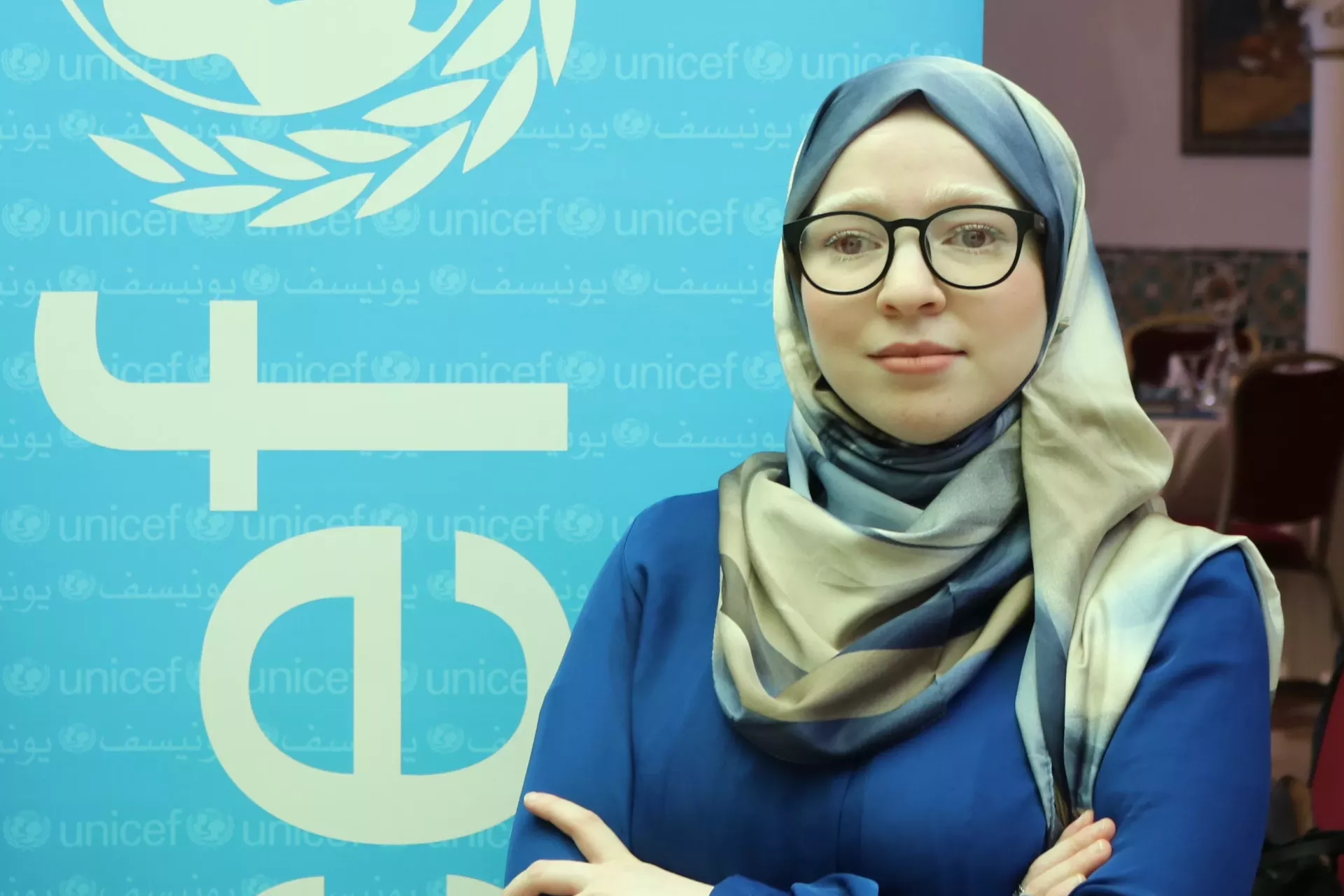
When Amani Bensekhria took part in a social entrepreneurship boot camp for young people, she was determined to fit in despite being the only one with a visible disability.
Amani, 24, has albinism and is visually impaired; she uses braille to read and write. “Only the first few minutes were a bit challenging, then it was fine,” she says. Not only did Amani fit in but she was a team leader, and her team came first with their entrepreneurial idea to produce gluten-free products.
The boot camp, organized by the Future of Development Association and supported by UNICEF, had 75 participants and took place in 2021. The boot camp, which fostered her leadership skills and confidence, motivated Amani to host her own radio show at university called ‘Let Me Talk’ and with a master’s degree in audio-visual communication.
Amani has used this ‘privilege’ to volunteer for the UNICEF Algeria country office, in particular supporting adolescents, including those with special needs. One of the challenges for adolescents is staying in in school or at least being engaged in learning activities. In Algeria, the secondary school completion rate is only 46.4 per cent, (girls 59.2 per cent, boys 34.6 per cent, urban areas 52.6 per cent and rural areas 35.5 per cent).[1] Those who continue with school often lack the soft skills critical for employment and success. Girls and young women are especially disadvantaged; around 32 per cent of girls and women compared to 20.4 per cent of boys and men are neither in education nor employment.[2]
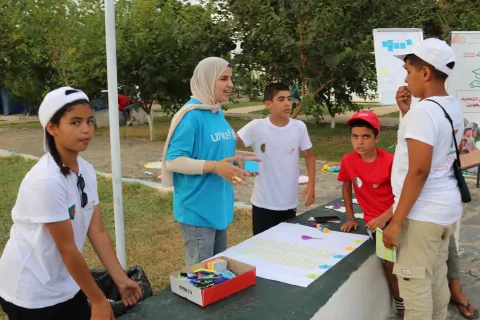
To help empower adolescents, UNICEF developed the Adolescent Kit for Expression and Innovation, a package of guidance, tools, activities and supplies to support those aged 10-18. Amani participated in the training to be a facilitator, and has facilitated sessions in her home city, Batna, in north-eastern Algeria and has also travelled to other parts of the country. Moreover, Amani volunteered to translate the kit, about 70 pages, into braille, a task that took her several months. “I’m proud to be able to do this work. The kit is a gift for all visually impaired adolescents around the world. And volunteering is my passion because it hasn’t only given me a voice, but it has also allowed me to serve people with special needs, to help them feel included, build their personalities and achieve their goals.”
She adds, “I believe that people with special needs are not just people with needs. They are people with vision and great capacities, and if given the opportunity they can make positive changes.”
Amani says some of the most memorable sessions that she has facilitated have been with young people who are blind or with impaired vision like herself. “They all were eager to participate, and we just had to adapt a few activities; so, for example, instead of drawing with crayons, the adolescents used slime.”
She remembers a 12-year-old boy who took part in a session where they had to reflect on three questions: ‘Who am I?’; ‘What do I have?’ and ‘What could I be?”. Amani says the boy told her it was the first time he had said to other people he was blind, and by doing so it had given him a chance to realize the many possibilities in front of him.
[1] The Algeria Multiple Indicator Cluster Survey (MICS), sixth edition, 2019.
[2] Idem