« Draw me your house »
How the UNICEF expression and innovation kit is empowering adolescents with disabilities in Algeria

- English
- Français
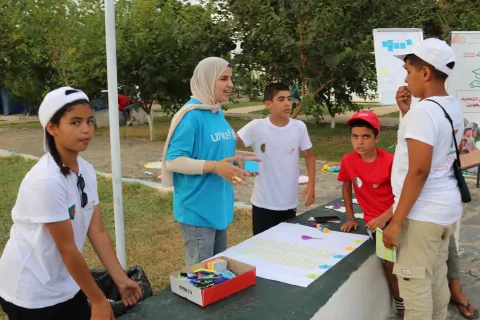
"This is my house, and inside I drew a heart, and inside the heart is my mum, and right next to the house is a car, because I want to be a taxi driver and take my mum wherever she wants to go," Adam, 12 years old with autism, proudly shows off his drawing. Like his classmates, he is expressing himself in front of the whole class as part of an exercise from the UNICEF Adolescent Toolkit for Expression and Innovation.
At the Psycho-Pedagogical Centre in Constantine, under the Ministry of National Solidarity, Family and Women's Affairs, teachers are offering a very different activity today: the adolescents sit in a circle with their eyes closed while their teacher asks them to concentrate before playing sounds on a telephone.
When asked, "What did you hear?" the faces of these young people with intellectual disabilities light up and all fingers are raised in enthusiastic participation. It's a bird!" says Malak, 12, with a big smile. In another class, the activity is carried out with modelling clay: Aya, 11 years old and visually impaired, impresses the teachers with the details of her construction, which is supposed to represent her house and what she likes.


She is usually a girl who finds it very difficult to express herself,' says Assia Sergouat, Malak's teacher, during a debate organised at the centre after a morning of activities using the adolescent kit.
The UNICEF Adolescent Kit offers us new techniques for activities with our students. If we adapt it well to children and adolescents with mild intellectual disability, it will enable us to promote their integration into society, which remains our primary objective,' explains this experienced teacher, who was trained at the Constantine Centre for the Training of Personnel for the Disabled (CNFPH).
To help adolescents take charge of their lives, UNICEF has developed the Adolescent Toolkit for Expression and Innovation, a set of tips, technical sheets and themed activities that support their psychosocial well-being, learning and positive engagement with the world around them.
In 2024, UNICEF in Algeria supported the training of 55 professional educators from the Ministry of National Solidarity's psycho-educational centres in the activities of the Adolescent Toolkit, a pilot training course that aims to "promote the empowerment of adolescents with disabilities through the acquisition of life skills such as communication and expression," explains Saada Berdjouh, President of the Future for Development Association (AFD) and UNICEF's partner in Algeria.


A first conclusive experiment in braille
The adolescent kit for expression and innovation was first translated into braille in 2021 by the young Amani, a member of the AFD, recalls Saada. ‘We immediately saw that the kit would be useful for blind or visually impaired children. We organized with the support of the Directorate for Social Action and Solidarity workshops for 1,600 adolescents in the wilaya of Batna and we achieved more than we had hoped for. This encouraged us to extend the experiment to more than 22 wilayas in Algeria,’ says Saada.
This success led to the adaptation of the kit for other forms of disability, including for adolescents with autism, continues Saada.
‘With the support of UNICEF in Algeria, we have extended the experiment to the training of trainers in the adolescent kit so that they can adapt it to their context,’ she explains.
‘It's a kit that allows you to acquire life skills that are not taught in school or in centres, such as communication and self-awareness, and I am very happy to see the results today. For example: One of the educators who was skeptical about the effectiveness of the kit told us that with Malak, her pupil who hardly ever spoke, there would be no results, and in the end look how surprised she was!’ she concluded proudly.