Guide: Planning activity sessions for adolescents
Adolescents benefit from space for creativity and fun, balanced by structure and routine as they are learning, playing and working together.

Adolescents benefit from space for creativity and fun, balanced by structure and routine as they are learning, playing and working together. Knowing what to expect, and what will be expected of them, helps them to focus and engage in activities, interact positively with each other, and feel confident and ready to take on challenges such as sharing their ideas or trying new skills. To make adolescents’ activity time supportive, safe and helpful, facilitators should plan it with a consistent sequence of steps, so that every session includes opportunities for adolescents to work independently, connect with others in their Circle and share their progress. These session steps should also include processes for facilitators to learn about each adolescent participant in a Circle, and to monitor and assess the entire Adolescent Circle’s progress as the adolescents participate in programmes or interventions and pursue their goals together.
What is a session?
A session is the period of time when an Adolescent Circle meets and participates in activities together. A session should follow a set of steps that is used routinely each time a Circle meets. In this guidance, eight steps are recommended. Sessions and steps should be adapted to each Circle’s particular needs. The duration and structure of sessions and session steps may change as adolescents work on different activities and phases together.
How long should a session last?
A session should usually last between one to two hours. For adolescents the ‘Starting our Circle’ or ‘Knowing Ourselves’ phases – which may include younger adolescents, or adolescents adjusting to a new context or environment – shorter sessions may be more appropriate for their attention span. Adolescents in the ‘Connecting’ or ‘Take Action’ phase may prefer longer sessions that give them an opportunity to work together on activities that require more time or discussion. Session times may also be adjusted to accommodate adolescents’ daily routines and responsibilities. For example, adolescents with other important responsibilities such as work, domestic chores, or studies may not have time to participate in long activity sessions. (See Investigate Adolescents Situations for strategies to understand and adjust programmes and interventions so that they are accessible for adolescents, especially those hardest to reach).
Planning a session: Eight session steps
Facilitators can use the following eight steps to plan a session for adolescents, adapting each step to your specific context and program. Eight steps may sound like a lot to include in one or two hours, but some steps take just a few minutes, while others – especially the Challenge step, which is the main activity of any session – take up most of the session time. Each of the steps serves an important purpose for the Adolescent Circle. As you start to plan sessions, understand how each step might work and how it might be helpful. Prepare to adapt the steps to adolescents’ interests and contexts, especially with respect to timing. As noted above, for adolescents in the ‘Starting our Circle’ and ‘Knowing Ourselves’ phases, shorter steps may be more appropriate; whereas adolescents in the ‘Connecting’ and ‘Take action’ phases may want more time for the last few steps. Be flexible – follow the routine created by the steps, but do not stick to it rigidly, if doing so makes activities less interesting or more limiting for adolescents. If you will not be including all eight steps, consider how you can achieve the same goals with different processes.
Eight session steps
Eight session steps
5 minutes (more if the adolescents want a ritual that takes longer).
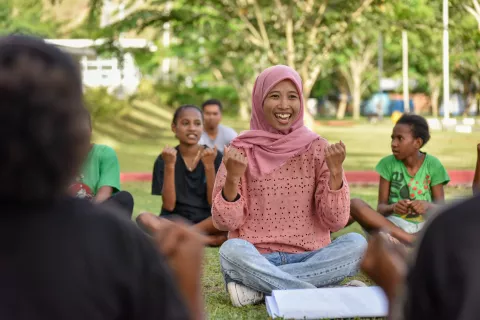
The Opening Circle is practiced at the beginning of each session and makes everyone feel welcome as they start their session together. It should be simple and easy, and give all adolescents in the Circle a chance to participate equally and actively. Opening Circles often involve physical activity to help adolescents feel alert and energized. Some Circles prefer to hold the same Opening Circle at the beginning of every session to provide a sense of ritual and predictability.
Examples:
- a song, a chant, a dance, a name game, an exercise routine,
anything else fun, simple, energizing and welcoming.
5-10 minutes depending on whether a thorough review and update is necessary.
During the Remind and Refresh step, adolescents review what they learned in the previous session. This includes discussing what activities they did in the previous session.
Examples:
- Adolescents share memories from the last session, including enjoyable moments, special achievements of adolescents in the Circle, or important things they learned.
- One adolescent can role-play the character of a ‘reporter,’ interviewing adolescents about what they remember or learned in the last session.
- Adolescent Circles working together on long-term projects (such the Taking Action cycle) review any progress they have made in their last sessions, and update Circle members who have missed sessions.
10-15 minutes
The Warm-Up is a short activity at the start of the session. The warm-up activity should engage participants in either energetic
or quiet activities. The warm-up should be simple and easy for
participants to follow.
Examples:
- Energizers – short, simple games - can be used in the warm-
up step to bring participants together in a fun and engaging way. See the Energizers in the Activity box for ideas!
5-10 minutes
The Explanation and Discussion step is a moment of transition between the Warm-up and the Challenge steps. Adolescents discuss what they experienced and learned during the Warm-up, and the facilitator explains what the adolescents will do during the Challenge step, which is the main activity of each session. The Explanation and Discussion step involves more talking than action. It should be adapted to adolescents’ interests and attention spans. Do not push adolescents to sit, talk and listen for a long time, especially if this will stifle their energy after the Warm-up activity. Give adolescents enough time to understand what they will be doing during the Challenge step, and a chance to ask questions if they need more clarification.
Examples:
- Summarize what was learned in the Warm-up activity then provide instructions for the Challenge activity. (Most Activity guides begin with these instructions).
20-60 minutes or longer
The Challenge step is the main activity of each session. It usually takes up the majority of adolescents’ time in any session. The Challenge step can be a simple activity that adolescents carry out and complete during one session. The Challenge step can be used to practice a skill they learned in a previous session, or to continue an individual or group project that they work on over the course of several sessions. For those that are in the ‘Starting our Circle’ and ‘Knowing Ourselves’ phases, the Challenge step might be different every day. Adolescents in the ‘Knowing Ourselves’ cycle might use the Challenge step to work on drawings, collages, or other individual projects they started in an earlier session. Adolescents working on group projects in the ‘Taking Action cycle’ can use the Challenge step to plan and work together.
Examples:
- The Activity box provides activities that can be used for the Challenge step in sessions for adolescents in the four activity phases.
- For adolescents in the ‘Starting our Circle’ phase, the Energizer cards also give ideas for simple, fun activities for this step.
- Facilitators and adolescents who are ready for a new kind of challenge can also use the Inspiration cards for ideas for activities to try together.
- Facilitators can also adapt or improvise new activities based on all of the guides and cards in the Activity box, or use the Activity Template to create new ideas.
10-20 minutes or longer if needed for more in-depth sharing and feedback.
The Sharing and Take away step is a time for adolescents to share what they have done during the Challenge step with others in their Circle and show, write or draw what they have taken away from their time together. This step provides facilitators with a valuable chance to assess adolescents’ learning and progress toward their goals. It may be helpful to hold longer, more in-depth Sharing and Take away discussions or learning assessments every few sessions instead of or in addition to at each session. The Sharing and Take away step can be connected with the Review step, which can also be helpful for adolescents who have already been working together as a group.
Examples:
- If adolescents are working on individual projects, they can look at each other’s work and share feedback using the Gallery walk tool. If they have been doing activities in small groups, they can tell each other what they did and compare experiences.
5 minutes unless adolescents want more time.
During the Review step, adolescents share their feelings and opinions about the whole session. This is a chance for facilitators check whether adolescents are enjoying the sessions, and whether adolescents feel that the sessions are helping to make progress toward their goals. As with the Sharing and Take away step, some Circles may want to take extra time for a more in-depth review process every few sessions, instead of or in addition to including it as a step in each session. The Reviewing progress toward group goals activity can be useful for this. The Reviewing group rules activity also helps adolescents to discuss what they can do to make sessions more fun and rewarding.
Examples:
- Ask adolescents to show how much did or did not enjoy a session by standing on a real or imaginary line that reaches from one end of the space to the other. One end of the line should represent ‘100% enjoyment’ and the other should represent ‘0% enjoyment.’
- Ask adolescents to share a one word description of how a session made them feel, either verbally or in writing.
- Adolescents can use the Emotion Cube to show how they feel at the end of the session.
5 minutes
The Closing Circle is practiced at the end of every session. It brings adolescents together to close their time together. It reminds all of the adolescents that they are equal and important members of the Circle, and that their participation in the day’s session was important. A closing ritual can be a song, a chant, a dance, a game, an exercise routine, or anything else fun, energizing and welcoming. It should be the same every day. Adolescents can invent their own closing circle ritual, and change it whenever they want. Some adolescents may prefer to have the same activity for both the Opening and Closing circle.
Example:
- Adolescents create a closing circle song and sing it at the end of every session.
Highlights
Knowing what to expect, and what will be expected of them, helps them to focus and engage in activities, interact positively with each other, and feel confident and ready to take on challenges such as sharing their ideas or trying new skills. To make adolescents’ activity time supportive, safe and helpful, facilitators should plan it with a consistent sequence of steps, so that every session includes opportunities for adolescents to work independently, connect with others in their Circle and share their progress. These session steps should also include processes for facilitators to learn about each adolescent participant in a Circle, and to monitor and assess the entire Adolescent Circle’s progress as the adolescents participate in programmes or interventions and pursue their goals together.