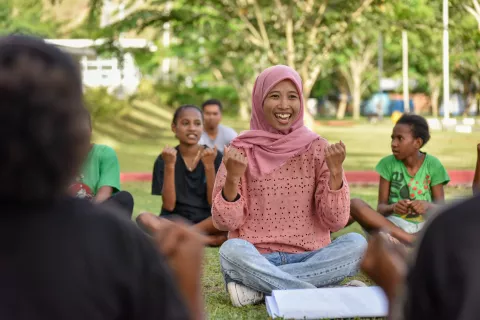
Tool: Keeping circles safe and strong
A resource for facilitators

Watch and listen to ensure that adolescents interact in positive ways and try to identify problems early on, before they become difficult to resolve. Take action to transform these situations into positive opportunities.
In any Circle, adolescents will occasionally disagree or argue. They may insult each other, speak insensitively, or treat each other unkindly. Adolescents need support to learn from these moments, so that they can resolve their conflicts and develop positive working relationships. Use the steps below to work with adolescents to solve their problems. However, remember that some challenges may require extra resources and support. Make sure to follow the last set of steps if problems continue or worsen.
Steps to work with adolescents to solve their problems
- Encourage them to join the others.
- Introduce them to other adolescents with similar personalities or interests.
- Encourage other adolescents to actively welcome them into their activities.
- Speak with them privately. If there is a problem, try to resolve it so that they can participate confidently in the circle. If not, support their choice to participate quietly or passively, remembering that this may be part of their adjustment or recovery process.
- Recognize the warning signs of severe mental health issues or emotional distress, and follow guidelines for linking adolescents to the appropriate services.
- Take action to stop their insults or unkind behaviour immediately, but try not to single them out or embarrass anyone involved. Do not react dramatically or escalate the situation.
- It may help to move the adolescents involved away from each other. Do this in a way that it doesn’t seem like they are being punished or scolded.
- Take time outside the Circle to talk privately with the adolescents involved. Try to find out what happened and what led to their behaviour. Ask each of them for their perspective.
- Work with them to brainstorm ways that they can change their behaviour and repair their relationship.
- Give them the opportunity to resolve the problem in their own way (if they want to).
- Encourage the Circle to be safe and include everyone, and ask the other members to share their own hopes for a safe Circle.
- Remember that if you don’t respond to unkind behaviour within the Circle, the adolescents will understand this as support.
- At every session if possible – When we can’t come to a session we let others in the Circle know why we aren’t there, and that they can still work on activities and projects without us. Try to pay attention and participate in activities
- Try to let them resolve the conflict themselves, using the skills they have developed.
- Get involved in a conflict if adolescents appear very angry or upset, seem stuck in their disagreement, and/or if it seems to be getting worse. Shouting, crying, insults or threats are clear signs that a conflict has become too difficult for the adolescents to handle, and that they need support.
- Give the adolescents involved in the argument a chance to calm down. It may be helpful to move them to different parts of the space so that they can take a break from each other. Ask one of them to help with a different task so that they can step away without embarrassment.
- Always inform the programme coordinator if there is a risk that the argument might turn into physical violence inside or outside the session.
- Follow up later to support the adolescents in addressing their conflict. In most cases it is best to start with a private, supported discussion between the adolescents involved. However, stronger Circles and more mature adolescents may want to include all of the Circle members in the reconciliation process.
- Recognize that conflicts are part of any relationship, and are an opportunity to learn. Remind adolescents that they should be proud of their ability to learn from conflicts, and not see them as weakness or failure.
- Keep an open line of communication with all of the individuals involved. Let them know that you are concerned.
- Consult them individually, outside the sessions if possible. Try to find out why they are behaving this way and ask all of them for their perspectives.
- Consider using the Reviewing group rules activity as a way to involve all of the adolescents in strengthening the Circle. Create new rules to help the Circle to work better together, and discuss how the members can support each other to follow the rules.
- Make sure the programme coordinator is aware of the problem. Consult them before developing any major response to the issue.
- Follow programme guidelines for the adolescents’ protection, if there are concerns about their health, safety or wellbeing.
- Consider informing parents and asking for their support.
- Try to keep adolescents informed if seeking support from their parents or other community members.
- Consider accessing outside services or support that might be helpful, such as counselling or mediation.
- Encourage adolescents to practice activities that reduce stress.
- Encourage adolescents to feel positive about receiving outside help, and to see it as a way of being cared for and valued by others.
- Recognize that facilitating adolescents is challenging, and that requesting extra support does not mean you have failed in your role.
Highlights
Watch and listen to ensure that adolescents interact in positive ways and try to identify problems early on, before they become difficult to resolve. Take action to transform these situations into positive opportunities.