Teen leads quest to give hope to adolescents living with HIV in Zimbabwe
A young person with a huge responsibility. A Zimbabwean peer counsellor speaks about her journey to positively transform the lives of young people living with HIV.

Debbie Chinochema, 19, a member of Community Adolescent Treatment Supporters or CATS, understands the impact of her work on young people living with HIV. She declares: “I want them to live their lives to the fullest and help them to be cheerful and ambitious.”
CATS are peer counsellors who provide information, counselling and support services to adolescents living with HIV.
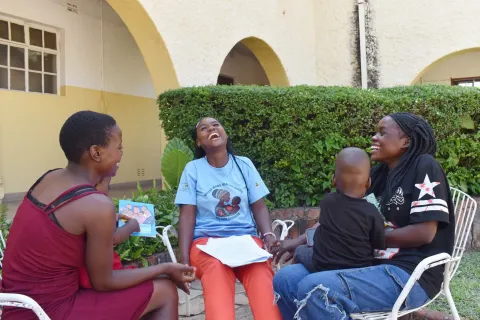
Debbie, sitting in the garden at the offices of Zvandiri, a Non-Governmental Organisation founded in 2004 that connects children and young people living with HIV with peer counsellors to assure health, happiness and hope speaks confidently of her community work.
Debbie’s experiences influenced her decision to join CATS. Debbie said she went into a meltdown after testing HIV positive in August 2012.
“At first it really affected me, thinking how I got the virus, would I have a future or even enjoy life. Worse was when after my status was disclosed that I faced HIV related stigma from friends and relatives. I ended up having self-stigma,” said Debbie
That changed when CATS introduced her to support groups and various activities conducted on adolescent days.

“It was already my dream before the opportunity even arose. I wanted to help other young people because of the way CATS had treated and supported me.” She went for interviews, passed and started receiving training before being posted to a health facility.
“At the facility I take their details with the consent of their parents. I then follow up at their house to check on living conditions and the kind of support they would be getting.
Sometimes I refer them to other organisations if they need services that I can’t provide,” explained Debbie, who relies on hairdressing and marketing beauty products to support her unemployed 55-year-old mother.
“My mother is particularly proud because she was present when I got support from CATS on how to take my medicines correctly, the importance of disclosure and good mental health and wellbeing,” said Debbie, said Debbie, who is looking forward to a career in public health and has already enrolled for a course in counselling as part of that journey. “She encourages me to take my work seriously and to realise the power I have in changing attitudes, supporting my peers to survive and thrive.”
Every Friday, Debbie walks several kilometres from her house in Dzivarasekwa suburb for home visits, recording important details such as adherence to medication in a notebook.
Her colourful Zvandiri t-shirts draw attention and people often stop her on the streets to ask about the project.
“They end up wanting to know more and some end up referring their relatives, children or other young people to me for assistance. In my area, my neighbours always say I have a calling to serve the community because it is not easy getting young people living with HIV to talk,” said Debbie.
But perhaps the most touching story for her is that of 13-year-old Sandra who is living with HIV. It remains also her story of success.
She pauses before she speaks: “Sandra was keen to remain invisible.”
Sandra would timidly keep her distance at a local health facility as her parents collected her medicines and would keep an arm’s length from other adolescents.
And then Debbie intervened. She counseled and made her feel comfortable enough to know that “she was loved and her dreams were still valid.”
Now Sandra can’t stop asking about the next support group meeting, party or soccer match.
“She has become very chatty and active, always asking when we can meet again. It’s a transformation,” said Debbie.
Sandra represents what dedicated CATS like Debbie are changing in the community, one young person at a time.
Debbie is one of the 80 CATS at the forefront of the Zvandiri mission in the capital, Harare.
A huge responsibility
Though small in stature, Debbie understands the magnitude of her responsibility.
According to UNAIDS, adolescents make up a third of all new infections in Zimbabwe, and often endure negative stereotypes that leave them isolated, self-loathing and habouring suicidal thoughts. Research published in The Lancet medical journal in 2020 showed that such stigma had a negative impact on adherence to medication for over 70 percent of all adolescents living with HIV. The same study noted that adolescents are the only population with increasing mortality rates in sub-Saharan Africa, where 85% of adolescents living with HIV globally reside.
Debbie wants this narrative to change but feels it’s only young people like her who can effectively lead the transformation.
“Adults don’t even know the slang that we use as young people. Peer to peer talk is important because young people may feel intimidated and fail to express themselves.
But they pour their hearts out when they talk to us. We are not judgmental, plus we have gone through the same experiences,” said Debbie.
She knows. As a teenager, Debbie was hesitant to make friends or even visit relatives. She wanted her HIV status kept a secret.
That changed when she began networking with CATS before physical interactions were limited by the outbreak of COVID-19 in 2020.
“They would cheer me up and I began to treat them as my sisters. I was very tiny, but they took me out to social events and meetings. I never defaulted or went to bed hungry because CATS were always there by my side,” she reminisced.
When one of the CATS told her of an opening for new recruits in 2021, Debra, then 17, grabbed the chance.
Other times Debbie is on her phone interacting with fellow adolescents on e-support groups or individually reminding her peers to follow medication timetables.
And it’s not always serious business.
“We are not always hammering on treatment issues. We talk about family issues and our dreams,” she said. The modelling aspirant loosened her long braids and continued: “Oh and we make sure we have lots of fun. We have parties, we attend weddings and do sports.”
Challenges in accessing peers in need
However, it’s not always as pleasurable as it sounds.
Challenges include being turned away by those who want to keep adolescent children living with HIV from public glare.
“Sometimes parents can lock their child indoors and lie to us that our friend is not home, or our friend actually shows us that they don’t want us there. Some parents chase us away, complaining that our interactions with their children are meaningless because we don’t bring foodstuffs, clothes or other goodies,” she said, turning subdued.
Often, perseverance pays. Debbie’s encounter with Sandra is a good example.
Even though she had willingly shared her contact details with Debbie, Sandra was reluctant to engage in follow-up phone calls. Debbie persisted, regularly greeting Sandra on whatsapp and reminding her of treatment timetables. Eventually Sandra began to warm up to the conservations. Debbie took the chance and invited Sandra for a group meet up that included a discussion on the importance of disclosure, followed by a party and a soccer match.
“Adolescents from all over Harare were there. People were joking around and enjoying themselves. Sandra suddenly realised that she was not alone, and everything changed from that day. She always wants to be out and about. She is now asking how she can join CATS,” said Debbie, with an air of accomplishment.
*Name changed to protect identity of child