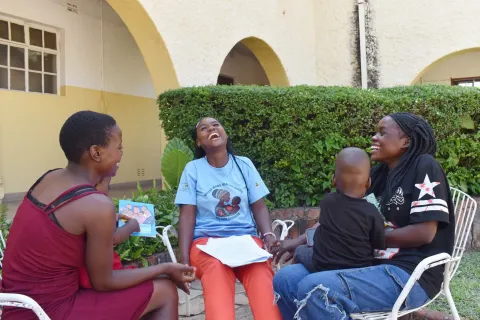
Community fairs give girls a pathway back to school, and much more
Optimism ignited… In Zimbabwe, community fairs are providing answers about education and life to out-of-school vulnerable adolescent girls

Lower Gweru, Zimbabwe - Sukoluhle, a 16-year-old girl who dropped out of school due to financial difficulties two years ago, woke up at dawn and skipped her routine household and farming duties on a recent day in Zimbabwe’s Midlands province. Instead, she decided to walk six kilometers along winding dusty roads and bush paths to reach Maboleke Secondary School.

In the same province, Minehle, a 16-year-old girl with disability, was helped into a minibus headed for the same venue, weathering rough bumps from the potholed gravel road.
United by a common desire
The journeys were odious for both girls, but a shared desire kept them going: attending a community fair that promised information and action on how they could enroll in school and change their fortunes for the better.
Sukoluhle said she heard about the fair - one of dozens held countrywide with the support from the UK government - from a community volunteer who was going around local villages to spread word about the event.
“Sitting at home is too painful and risky for a girl child,” said Sukoluhle, highlighting fears of dangers such as early pregnancy. “So, I just couldn’t afford to miss this opportunity.”
Before the event, Minehle had never set foot in class because her parents believed she would not cope due to her disability. At 16, disabled, and having never enrolled in school, many would have long given up on ever getting a chance for formal school education. Not Minehle.
“She really wants to go to school. She is very intelligent and she can answer questions. Though she has speech problems, she is audible and she has that zeal to be enrolled in school,” said Ntini,” watching, as a government speech correctionist assessed Minehle.
Officials from the Public Service, Labour and Social Welfare registered Minehle and Sukoluhle so that they could be considered for assistance, before imparting comprehensive information on enrollment procedures.
One-stop shop
The community fairs being rolled out across Zimbabwe are bringing adolescent girls and children with disability who are out of school closer to their dreams by providing them with clear and practical pathways to enroll in school.
The Integrated community service fairs, implemented by the Ministry of Primary and Secondary Education and implemented by UNICEF, are providing much more than just information on pathways to the classroom for adolescent girls.
At Maboleke Secondary School, experts and community workers offered guidance and counselling on issues ranging from sexual and reproductive health and rights to menstrual health, how to avoid risky behaviours, Gender-Based-Violence, identifying and reporting abuse, civil registration and career guidance.
Adolescents in the community face a myriad of challenges, including physical and sexual abuse, dropping out of school and inability to enroll due to poverty, or disability and incessant sexual advances from artisanal miners who swarm the area in search of gold, said Dorcas Gumede, the village head. Many are married off at a young age or give up on their dreams after getting pregnant, she said.
According to UNICEF, adolescents face multiple deprivations ranging from poverty, high rates of early pregnancies, child marriages, maternal deaths, physical and sexual violence, HIV infection, school dropout and limited engagement and participation opportunities in matters that affect their lives and their families.
About 22 percent of girls aged between 15 and 19 have begun childbearing, while one in three young women have been married in childhood, according to UNICEF.
As such, challenges are rarely discussed in the community, leaving the girls in the dark about critical health, economic and social issues that affect their daily lives, said Gumede, the village head, describing the fair as “an eye opener.”
“A lot of people in my village did not have the information we received here. Children were failing to enjoy their right to education because we didn’t know how to enroll. We are going to take this information to others who didn’t attend this fair,” she said.
Those who attended the fair found the process to be smooth.
After signing the attendance register, participants went through a row of desks. One desk was for those who dropped out of school. Another served children with disabilities and one was for parents and guardians. A speech correctionist assessed children with hearing and speech disorders. Next to him, a rehabilitation technician attended to those with physical disability as part of an array of services offered by various government departments, community volunteers and non-governmental organisations.

“The assessment determines the nature of the intervention. It helps that we are using the whole of government approach to integrate services. We simply refer each case to the relevant department,” said provincial psychologist Bothwell Makoni. Part of Makoni’s job is to follow up and ensure recommended interventions are implemented.
Determined to chart own future
Adolescent girls who dropped out of school were noticeable by their dominant turnout, making up 260 of the 340 females at the Midlands fair. Ten children with disabilities attended the fair, six being girls.
The numbers highlighted the bravery and never-say-die spiritamong adolescent girls who are increasingly determined to triumph over deeply entrenched hurdles caused by lack of information, financial and social status or physical conditions, said Mr. Makoni.
For Sukoluhle, the fair was life-changing in many ways and has awakened a desire to be a community advocate for education and sexual and reproductive health and rights of girls.
One of her immediate tasks after leaving the fair was to spend the next few days canvassing her peers who are out of school to change their attitudes.
“I have to share the good news with everyone. Education can be an escape route from the hazards faced by girls who are out of school,” said Sukoluhle, who dropped out of school in Form 2 in 2022 because her mother could only afford to pay for her two siblings in primary school after the death of her father.
“I feel empowered, I learnt so much here. I am going to be telling my friends and other girls all about it, they deserve to learn as well,” said, smiling and confident that her dream of becoming a pilot could materialise after all.