TEACH: Inspiring Community Ownership of Solarisation in Beitbridge
This is the new reality at Jopembe Primary School in rural Beitbridge, where access to reliable solar power is changing how children learn and teachers teach.

All eyes are fixed on a beam of light illuminating the front of an otherwise dark classroom. Black plastic sheeting covering the windows keeps the room dim, drawing even greater attention to the brightly lit screen where words, questions and possible answers appear.
At the front, the teacher guides the lesson. Excited chatter fills the classroom as hands shoot into the air.
This is the new reality at Jopembe Primary School in rural Beitbridge, where access to reliable solar power is changing how children learn, and teachers teach.
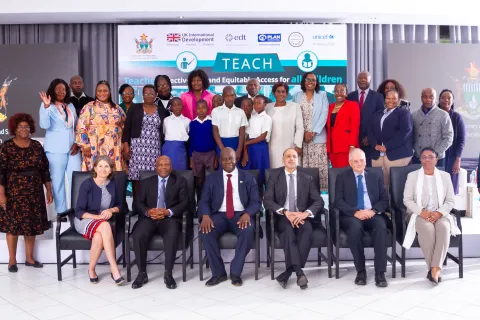
A recent visit to Beitbridge District under the Teacher Effectiveness and Equitable Access to Quality Learning (TEACH) Project demonstrated how school solarisation is helping transform learning environments in some of Zimbabwe’s most remote communities.
Implemented with support from UNICEF Zimbabwe and funding from the UK Government, the TEACH Project has supported the solarisation of 150 schools across Zimbabwe, providing reliable and sustainable energy that enables schools to make greater use of digital learning tools and other technologies.
UNICEF has also directly supported the solarisation of four additional schools, further expanding access to electricity for children and teachers in communities where reliable power remains a challenge.
At Jopembe Primary School, the impact is visible in the classroom: technology is no longer something children can only hear or read about. It is becoming part of their everyday learning experience.
For children in remote communities, a reliable source of electricity can mean more than simply switching on a light. It can switch on new possibilities for learning
The solarisation initiative has enabled schools to integrate digital learning into classrooms by providing laptops, tablets, and projectors. Learners now have greater access to educational content, digital textbooks, and interactive learning materials, helping to bridge the gap between rural and urban schools.
In Beitbridge District alone, seven schools have benefited from the solarisation programme. During visits to Jopembe Primary School, Msane Primary School, and Mapili Primary School, teachers, learners, and community members shared inspiring stories of how access to electricity has changed the learning experience.
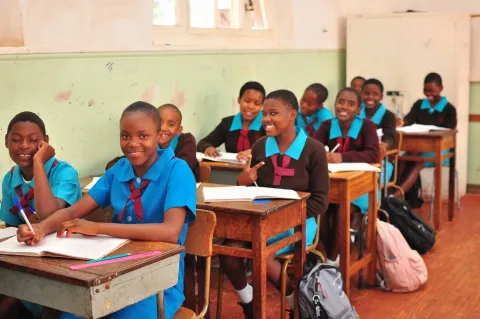
Learners at Jopembe enthusiastically follow their teacher in class.
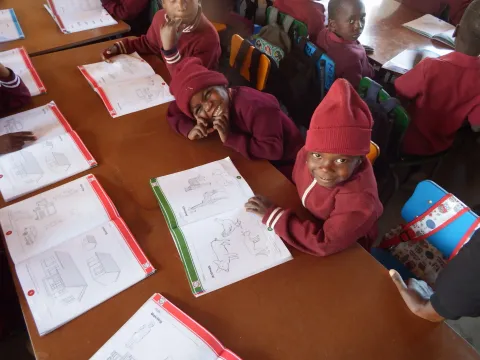
Learners expressed excitement about attending school and engaging with digital learning tools, while teachers reported improved classroom participation and greater access to teaching resources. In several schools, the introduction of digital learning has contributed to improved academic performance and increased pass rates.
“We love watching the screens and learning from the screens,” enthused one of the grade five learners.
“There is a great deal of enthusiasm from the learners when they come to school, thanks to new methods of teaching that we now implement as a result of the solar. Kids enjoy setting up the projectors and looking at them. The kids are happy, and that makes our job more enjoyable and easier to do, says Precious Moyo, a teacher at Msane Primary School.
One of the most encouraging outcomes of the project has been the strong sense of community ownership. Following community engagement training conducted by Bantwana Zimbabwe, locals have embraced the project as their own and taken active steps to ensure its sustainability. Some have established committees to safeguard solar equipment, with volunteers providing security services for the installations. Others have mobilised resources to support internet connectivity, while some communities have introduced school feeding programmes to improve learner attendance and concentration in class.
At Jopembe Primary School. Community representatives said they will do more to amplify the message of community ownership.
“We could do more, and we have to, because we know that UNICEF or Bantwana is not going to come and fix if there is a breakdown. So we will work on mobilising our own resources to do it,” said a community member in attendance.