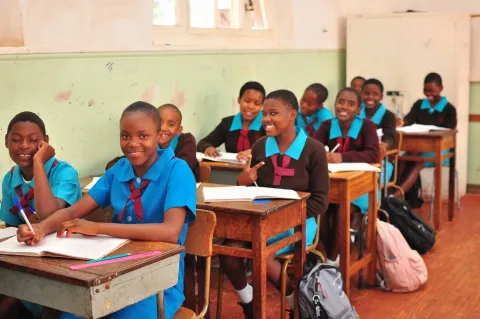
School furniture is bringing learning within reach in rural Zimbabwe
At a school in rural Zimbabwe, children once sat on the floor or fought for scarce chairs. Now, tiny desks and toddler-sized seats are doing more than making students comfortable.

MUREHWA, Zimbabwe - Six-year-old Shalom Mhizha flips through a picture book on her desk, her tiny feet now planted firmly on the cement floor. Moments later, her class bursts into an alphabet song, voices high with excitement as each child sits comfortably in their chair. At the end of classes, they carefully place the chairs on top of the desks, a now-familiar routine.
“End of day, what a busy day, all day long. Goodbye, teacher, see you tomorrow,” they shout in unison in what has become a routine chorus.
Even though the walk to school is long, Shalom eagerly looks forward to each new day.
“It’s fun! I like learning and singing with my friends,” she said shyly, slinging her satchel over her back as she began the nearly one-kilometre trek home in rural Murehwa in Zimbabwe’s Mashonaland East province.
Here, in this remote Zimbabwean district, the arrival of new school furniture is doing more than offering comfort. It is transforming access to education and giving disadvantaged children a better shot at quality learning.
Until recently, children like Shalom had to learn while awkwardly standing behind oversized, ageing desks — or sitting on the floor — in Early Childhood Development (ECD) classes. But that changed when the school received the School Improvement Grant (SIG) Regular funding.
The SIG programme provides financial support to under-resourced schools for essential non-personnel needs, such as classroom furniture. Schools and their local communities jointly develop an approved School Development Plan to identify and prioritise their most urgent needs.
For years, age-appropriate desks and chairs were among the school’s most urgent needs. But for families surviving on subsistence farming, often struggling to put food on the table, raising funds for furniture was out of reach.
“Before, it was heartbreaking,” said Memory Charakupa, an ECD teacher for the past nine years. “The desks were too tall, the chairs far too big. A child would sit with legs dangling in the air, unable to concentrate. Their legs dangled in the air, which can cause numbness if they sit like that for too long. Some would stand up to reach the desk. Others would stop coming to school.”
Noise and disorder were constant. Maintaining a clean, calm learning space was next to impossible.
“The screeching of desks and chairs dragged around the room all day was unbearable,” she said. “Every time they needed to write, they would push the furniture around. Honestly, how can anyone teach properly in that chaos?”
But since 2022, the atmosphere has begun to shift. The purchase of child sized chairs -sized chairs and group desks has brought dignity and order, helping bridge a long-standing gap for children who previously might have felt excluded from meaningful learning.
Attendance has improved, and so has academic performance.
“Even the handwriting is better,” said Charakupa. “Before, you would open an exercise book, and it looked like a snake had passed through, just meandering lines from poor posture. Now they sit well, and they write well.”
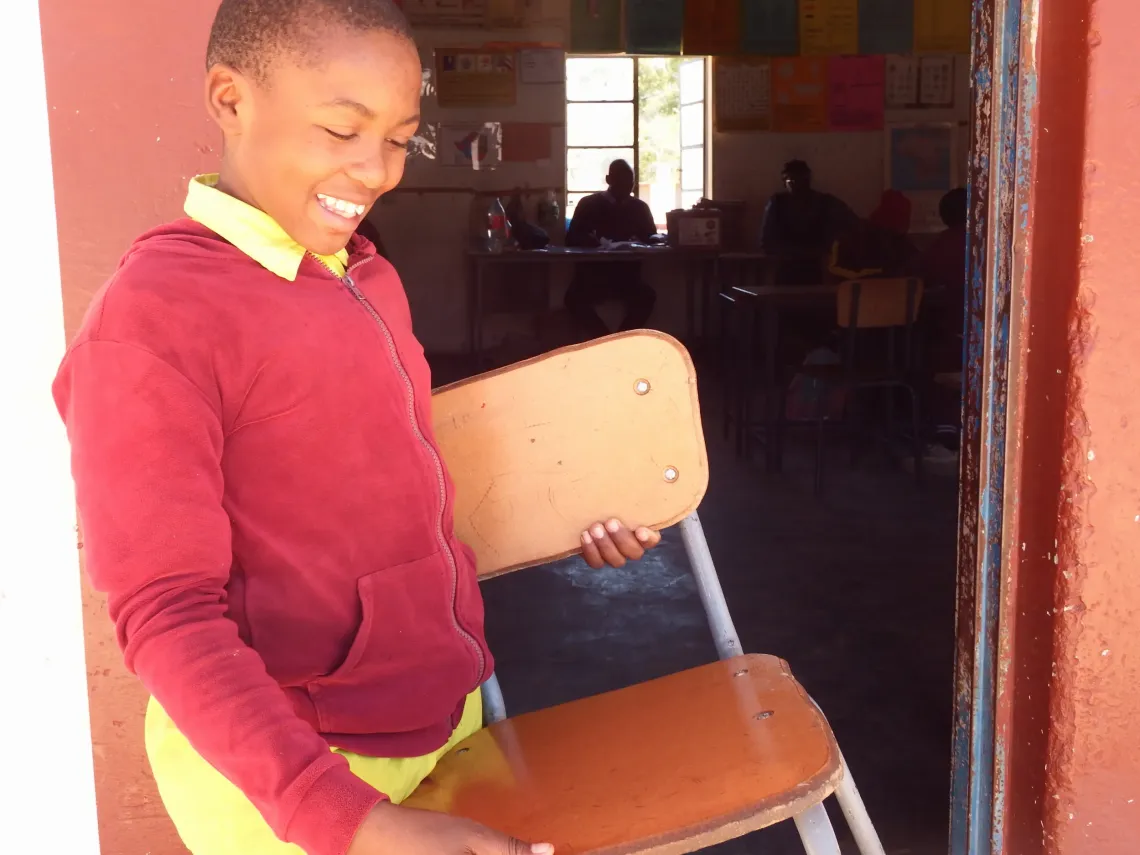
In the upper grades, too, the difference is clear. Classrooms once plagued by fights over the few available chairs have been transformed into safer, more hopeful spaces.
“I want to be a teacher when I grow up,” said Anotida Mutandiwa, a Grade 7 pupil. “Our teachers stayed patient, even when we were fighting and learning was hard. They showed us how to stay calm and never give up. I want to be like them.”
Anotida chuckles now when he remembers the daily battles for a seat. But he has the scars to show for it.
“It used to be war,” he said, showing scars on his elbow and legs. “Everyone rushing in, shoving, grabbing chairs. Some kids came late but still bullied others to get a seat. If you refused, they would fight you. Sitting on the floor in winter was painful, so sometimes I would say: ‘I am a man too. I will fight.”
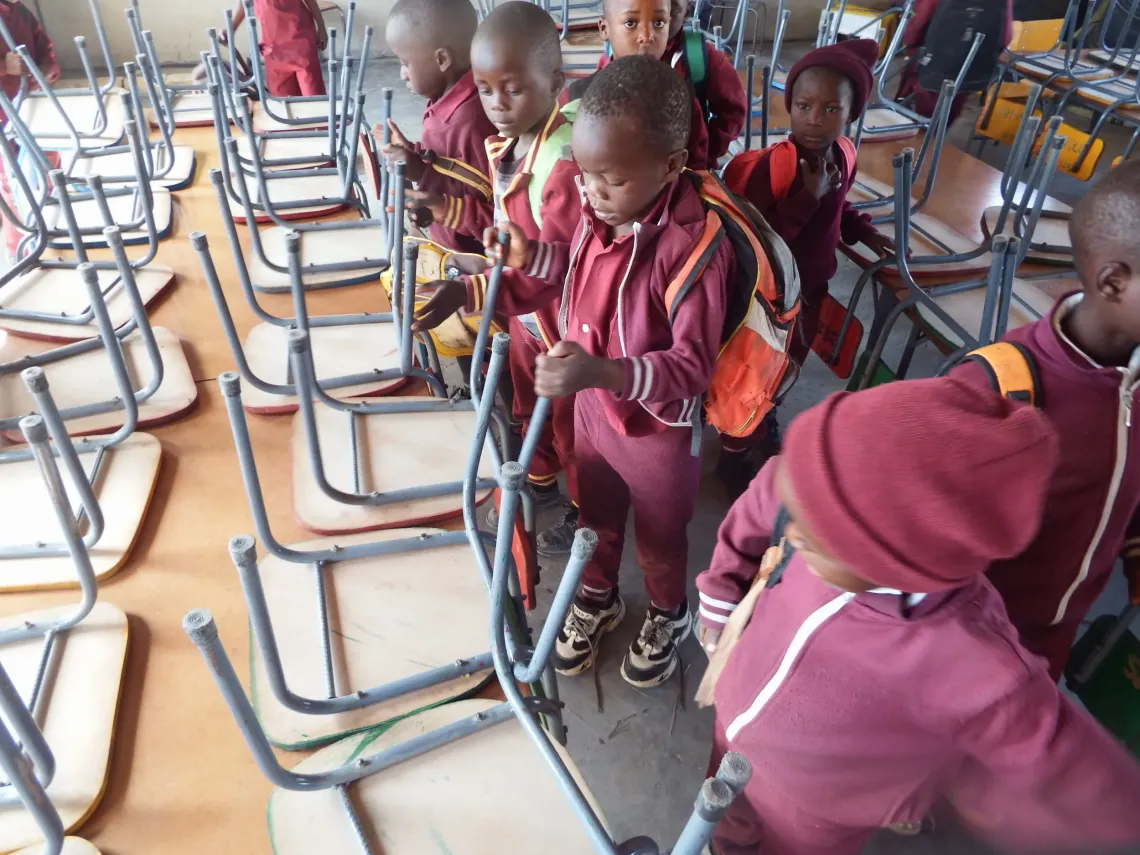
Parents, too, are noticing the change.
“Before, I would have to wake up at 4 a.m. just to prepare them to go to school,” said Sylvia Makore, a mother and secretary of the School Development Committee (SDC). “Otherwise, they would refuse to go because they knew they would sit on the floor or get into fights. Now they are the first to get ready.”
Some children used to leave home pretending to go to school, only to spend the day hiding or playing in nearby bushes, said the deputy head, Madeline Chimusoro. Even teachers were caught in the conflict, sometimes arguing over who should receive the few available chairs.
But the arrival of SIG funding changed that.
Led by the Ministry of Primary and Secondary Education, with technical support from UNICEF, the programme has eased the burden for schools in hard-to-reach and poverty-stricken areas.
The TEACH programme (Teacher Effectiveness and Equitable Access for All Children), funded by the UK Foreign, Commonwealth & Development Office (FCDO) and the Global Partnership for Education (GPE) through the System Transformation Grant (STG) and Multiplier Fund (MF) are both supporting the SIG Regular program running from 2023 to 2026.
According to UNICEF, Zimbabwe’s public schools rely heavily on parental support for funding. Government contributions typically cover only recurrent expenditures such as teacher salaries. In rural communities like Murehwa, parents survive mainly on small-scale farming, growing maize, vegetables, and occasionally travelling to Harare to sell their produce.
With repeated droughts linked to climate change, harvests have dwindled — and so has their ability to pay school fees. Only around 20% of parents at Maponongwe Primary School pay the full US$23 per term, said Makore, the SDC secretary.
“Sometimes you get someone paying a dollar here, a dollar there,” said Makore. “That’s not sustainable. But now with SIG, we can breathe. Some parents are even starting to value school more and pay more regularly.”
Enrollment at Maponongwe has grown from 400 to 600 pupils in the past three years. The school’s pass rate has jumped from 49 per cent to 80 per cent, and nearby families are transferring their children to benefit from the changes.
And for children like Shalom, school has become something to look forward to, not dread.
“Tomorrow I want to read another storybook and sing again,” Shalom beamed. “And I like my chair. It fits me!”