Solarisation is changing the lives of learners in Zimbabwe
Zimbabwe is rolling out an ambitious programme to get all schools to access electricity and the Internet

According to the latest available date, approximately one school out of three in Zimbabwe cannot access electricity. Lack of electricity or alternative power affects thousands of learners in rural and remote areas of the country, widening the inequality gap between them and those in urban areas. Without electricity, there is no connectivity to the digital world. Access to learning material is reduced, and introducing ICT into the classroom remains a far-away dream.
For the Government of Zimbabwe, connecting schools to electricity and the internet is now a countrywide priority. To make this happen, the Government of Zimbabwe, through the Ministry of Primary and Secondary Education and Ministry of Information Communication Technology and Courier Services and the Ministry of Energy and Power Development, is rolling out an ambitious programme to solarise schools with the support of UNICEF, the Giga Initiative, and partners, including the UK. Off-grid solar electrification in a country with low and unreliable access to electricity provides a sustainable, resilient solution in the face of a changing climate and is economically viable. Improved lighting and access to reliable power foster an enhanced learning environment enabling more learning and studying times and access to other electronic learning materials.
Over and above solarising schools and as part of its engagement to connect its learners to the digital world, Zimbabwe has joined the Giga programme, the global initiative of UNICEF and the International Telecommunication Union to connect every school to the Internet and ensure access for every young person to digital information. Moreover, with the support of UNICEF and Microsoft, the country launched the Learning Passport, a mobile application that provides free educational resources to learners, parents, and educators.
Slowly but surely, the learners in Zimbabwe are connected to the digital world as their schools access electricity and the internet.

Zimbabwe works in close collaboration with UNICEF to provide schools with solar power. A solar system typically comprises a 6.5KVA solar power system, with 10KW lithium battery storage capacity, power to teachers’ houses (one lighting and one charging point per teacher), and a computer laboratory with a maximum of 40 charging points for laptops and access devices.

Children of Mambwere Primary School in Manicaland Province proudly pose in front of their solar power system. The system has brought electricity to their school and improved their education opportunities.

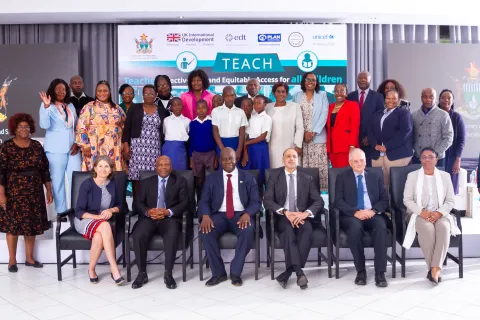
As part of the Teacher Effectiveness Equitable Access for All Children (TEACH)-programme, the UK funds a large solarisation programme to strengthen the education system by enhancing children’s learning environment by providing clean, off-grid energy in the poorest Government primary schools. The programme focuses on 154 schools in two Provinces and seven districts. The solar system set up at the school includes a separate charging station with a capacity of six phones to charge six cell phones concurrently. This charging station is intended for the community living around the school to charge their cell phones for a reasonable fee. The school uses the income generated to maintain its power system.

Dzvairo Primary School is benefiting from the greening education push as one of about 150 schools in Zimbabwe benefitting from the solarisation and computerisation programme being rolled out nationwide. For the learners and the teachers, getting access to electricity and the internet is like a dream come true. Now, pupils can easily access numerous educational resources and research.

Thanks to the Giga programme, the digital world is now accessible to a growing number of learners in Zimbabwe. Zimbabwe is one of the 19 countries participating in Giga - a global partnership between UNICEF and the International Telecommunication Union (ITU) - to connect 2,8 million schools, including all schools in Zimbabwe, to the Internet by 2030.

The solarisation and digitalisation of schools in Zimbabwe align with the global Re-Imagine Education Agenda, adopted at the Transforming Education Summit in New York end of 2022. The Summit resulted in a call for all nations to support foundational learning as a key element to transform education; promote green education by making climate change education an integral part of learning; prioritise digital learning for all children; encourage gender equity in education, and increase investment in education. Under the Learning Passport, UNICEF has contributed towards distributing 500 tablets to 50 secondary schools and 188 offline digital learning hubs, of which the UK supported the procurement of 150.

Pupils are exploring the Learning Passport at Westlea Primary School in Harare. The Learning Passport is a free digital e-learning platform for teachers and learners developed by the Ministry of Primary and Secondary Education in partnership with UNICEF and Microsoft. A selected group of senior teachers from the Ministry of Primary and Secondary Education created the content for the Learning Passport.