Measles vaccination drive shifts a gear up
At hospitals, on the streets and in children’s homes. Zimbabwe and development partners go all out to ensure that no one is left behind as measles vaccination campaign gets underway

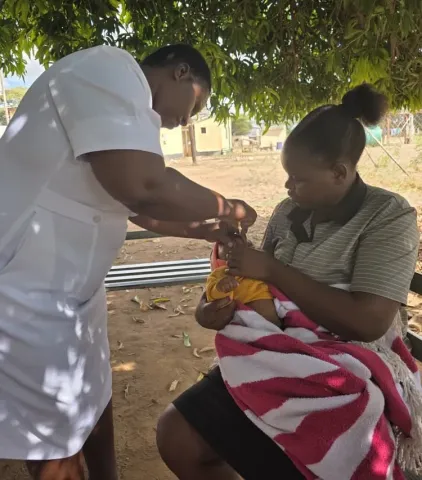
HARARE, Zimbabwe-A baby sitting on her mother’s lap eagerly opened her mouth for the nurse to administer droplets of Vitamin A at a hospital in Zimbabwe’s capital, Harare. But the mood quickly changed and she began to cry when the sleeves were rolled up and a nurse held up a needle. “Shhh, this is for your own good, it will be over soon,” the nurse said, trying to calm her down and simultaneously jab the baby’s left arm with the measles vaccine.
People holding babies sat on wooden benches in a large room awaiting their turn at Mbare Polyclinic in Harare’s populous Mbare suburb, where the measles vaccination drive was underway.
Zimbabwe is currently experiencing a measles outbreak that was first recorded in the eastern region of Manicaland province in April and has now spread across the country. The outbreak has claimed the lives of more than 700 children. According to the government, many of the deaths have been among unvaccinated children.
To control the outbreak, the Ministry of Health and Child Care, with support from UNICEF, the World Health Organisation and other partners have embarked on a massive nationwide measles vaccination campaign targeting children from 6 months to 59 months.
The response from the public has been overwhelming. At Mbare Polyclinic on a recent day, parents trooped in with their children. Nurses said they had vaccinated more than 100 children by mid-morning.

I want to encourage other men to take their children’s health seriously. It’s not a woman’s job.
Among those in the line was Tatenda Kunzwi. The 29-year old father of one said he briefly abandoned his egg selling business to make sure that his 9 months old daughter is vaccinated.
“My wife is busy elsewhere so I am taking the responsibility to make sure that our child is protected against measles. I want to encourage other men to take their children’s health seriously. It’s not a woman’s job. As parents we all have a duty to make sure that our children are safe,” he said, unfastening a baby carrier and waking the daughter from deep slumber when they reached the front of the line.
Measles is a severe disease caused by a virus. It is normally passed through direct contact with an infected person and through infected air. The measles virus can spread through coughing and sneezing, close personal contact with an infected person or direct contact with infected nasal or throat secretions.
Signs that a child may be infected with measles include a hot body, rash which starts on the forehead and neck and then covers the whole body, running nose and eyes, red eyes, cough, white spots in the mouth and diarrhea.
Unvaccinated young children under 5 years old are at highest risk of measles and its complications, including death, while unvaccinated pregnant women are also at risk. In Zimbabwe, vaccination challenges include populations that belong to religious sects that are anti-modern medicines prompting the government and supporting partners to engage traditional and faith leaders to support the vaccination drive.
The Zimbabwe Expanded Programme of Immunisation programme, is receiving support from the Measles Rubella Initiative, GAVI, The Vaccine Alliance, the Health Development Fund, the Government of Japan and the European Civil Protection and Humanitarian Operations (ECHO). The drive is aimed at controlling the outbreak through the tracking of cases in the community and through supplementary immunization activities. The campaign is targeting more than 2 million children aged between 6 months and 5 years and more than 4 million children aged 5 to 15 years.
To reach people who may not visit health centers to get their children vaccinated, mobile teams have fanned out into communities carrying out both vaccination and awareness campaigns.
On a recent day, one mobile team from Mbare Polyclinic visited market stalls and moved from street to street. Another team had just left Waterfalls Refugee Transit Centre, which houses refugees from various countries, while others visited children’s homes to administer jabs.
Beneficiaries of the mobile exercise expressed gratitude that the campaign is leaving no one behind.
“We are getting the vaccine like everyone else, there is no discrimination. We are very happy that as refugees we are getting assistance to keep our children safe,” said Olga Bashika, who is from the Democratic Republic of Congo and is staying at the Waterfalls Refugee Transit Centre.