Bulawayo stimulation centres bring relief for caregivers
“We started lobbying for a stimulation centre to cater for children with severe disabilities as far back as 2019 when we realised that we have many of them in the community ."

Headmistress Leaflet Nyathi lobbied for nearly a decade for her school to be allowed to house a stimulation centre for children with severe disabilities from the community who were being left out of the education system.
Nyathi, the headmistress of Dumezweni Primary School in Bulawayo’s Pumula South high-density, said she was uncomfortable with the fact that some children in the community were out of school because of their physical condition.
“We started lobbying for a stimulation centre to cater for children with severe disabilities as far back as 2019 when we realised that we have many of them in the community who were not going to school,” she said.
“We established that the children were not going to school, yet the government’s education policies say every child must attend school despite their status.
“The school wrote to the Ministry of Primary and Secondary Education to say we needed a unit over and above the special class we already had.
“Unfortunately, there was that period of COVID-19, which delayed the process, but we are happy that we , there was that period of COVID-19, which delayed the process, but we are happy that we have partners that came along, and the stimulation centre has been opened.”
Dumezweni Primary School’s new stimulation opened its doors in May this year following lobbying by the Zimbabwe Parents of Children with Disabilities Association (ZPHCA) through a partnership with the Ministry of Public Service, Labour and Social Welfare and UNICEF's Child Protection Fund III funded by the Swedish International Development Cooperation (SIDA).
The advocacy programme has contributed to implementing the National Disability Policy (NDP) commitments for children with disabilities in five districts of Zimbabwe.
It aims to strengthen the caregivers' capacity to advocate for free access to disability-specialised services by promoting formal collaboration between health, education, social development, and protection services actors and community-based support groups of caregivers of children with disabilities, basing their demands on provisions of the NDP.
Engagements with the Ministry of Primary and Secondary Education’s Learner Welfare, Psychological Services and Special Education Needs Department have resulted in the assessment of disabilities for placement of children in special classes and in stimulation centres for children who cannot benefit from usual learning environments.

Opened doors
Three stimulation centres have since been opened at Bulawayo’s Dumezweni Primary School, Insukamini Primary School, and Josiah Chinamano Primary School, with 17 children enrolled so far.
The ZPHCA is now pushing of a fourth centre at another primary school in the high-density suburbs.
Nyathi said parents and caregivers of children with disabilities were instrumental in children running the centre, as they took turns running it, preparing food for children, and caring for them.
“The children are benefiting from the stimulation centre because they no longer have to be sitting at home, and here they are learning basic life skills so that they can look after themselves,” she said.
“We also have the school feeding programme where they can have hot meals with other children.
“We are very grateful for the equipment we received from UNICEF to assist these children.”
Nyathi said she expected the enrolment to increase as the community became more aware of the stimulation centrebecame more aware of the existence and became more aware of the stimulation centre's existence.
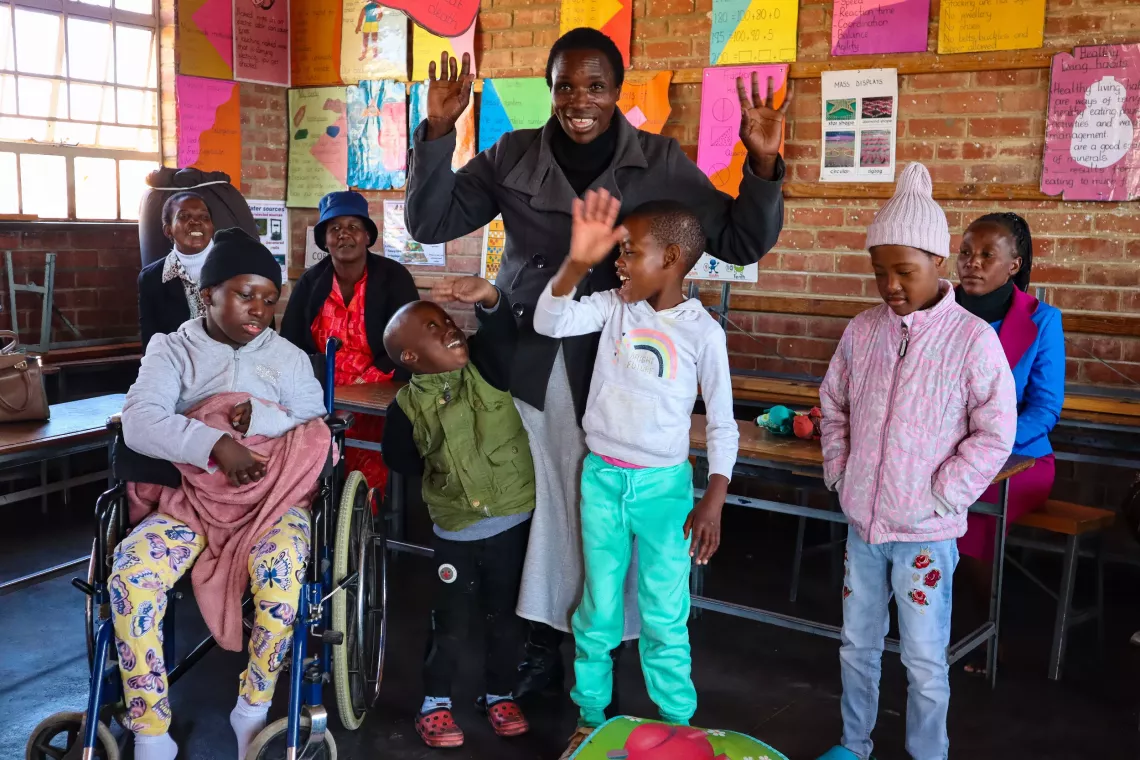
Farirai Hlomayi, the teacher responsible for the stimulation centre, said the class had children with severe disabilities aged between five and 12.
“We teach the children life skills such as feeding, dressing up, bathing, cooking, gardening and poultry, among other things, so that they can look after themselves when they grow up,” Hlomayi said.
“They start their lessons at midday and go home at 3 PM. We are delighted as Dumezweni Primary School and me as a teacher because I can practice what I was trained to teach.”
Protection from abuse
Pumula South resident Diana Mnikwa, whose six-year-old son has Down syndrome, said she was relieved when the stimulation centre was opened within her community.
“I had challenges looking after him at home as I did not have adequate information about his condition,” Mnikwa said. “I am happy that we now have this centre where we can access experts to assist our children, who have different conditions.”
Subusisiwe Ncube, whose nine-year-old son has cerebral palsy, said besides teaching children with severe disabilities life skills, the stimulation centre shielded them from abuse.
“Some children with disabilities are abused by parents or caregivers not out of choice but because of circumstances,” Ncube said. “Some parents lock them up at homes so that they can fend for the family since they cannot afford to pay childminders.
“At the stimulation centre, the children are safe from abuse, and parents have a chance to attend to other pressing issues when the children are here.”
Portia Sibanda, a volunteer at the stimulation centre, said she was inspired to be a caregiver after staying with a landlord with a child with disabilities.
“I want to thank UNICEF and its partners for the support,” Sibanda said. “I will continue to help these children as much as possible.”
One stop service
The ZPHCA has been lobbying for children with severe disabilities who cannot be enrolled in schools to be accommodated at daycare centres within government and local authorities’ education systems for sustainability.
Caregivers of children with disabilities say they are finding it difficult to access formal education systems due to prohibitive costs and lack of appropriate facilities in most of the schools.
Tendai Masumba, the ZPHCA field officer for Bulawayo, said the stimulation centres will become a one-stop service for caregivers of children with severe disabilities to access various services.
“We call them one village where you find everything that a child with disabilities requires, including special needs teachers,” Masumba said.
“There will be a feeding place in schools with feeding programmes, and caregivers can access government assistance through the Basic Education Assistance Module at the centres.
“There would be physiotherapists that will be coming to these classes twice a month for physio sessions and this will cut on transport costs as caregivers will no longer have to travel to Mpilo Hospital for physio.”
The programme to implement the disability-inclusive parenting model has been rolled out in Bulawayo, Harare’s Epworth district, Manicaland (Mutasa), Matabeleland South (Beitbridge) and Midlands (Zvishavane).
To date, 366 children with disabilities have benefited from a package of services from the government departments responsible for providing community-based services for children with disabilities.