High Level Dialogue on Education Financing
State-funded Basic Education: Leaving No One Behind

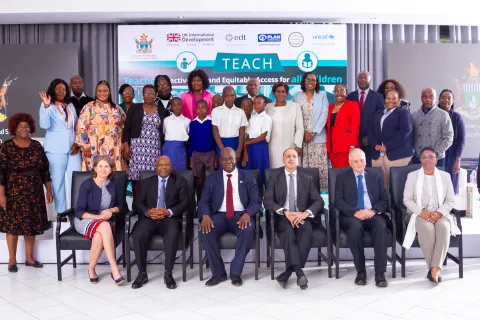
Harare, 25 January 2023 – The Ministry of Primary and Secondary Education, UNICEF and the Zimbabwe Economics Society (ZES) convened a High-Level Policy Dialogue on Education Financing in Zimbabwe, under the theme Basic State-funded Education: Leaving No One Behind, which supports the Governments ambition to ensure compulsory basic education for all children in Zimbabwe by 2023.
The Dialogue included panelists from key ministries, donors, partners and UNICEF allowing the exchange of knowledge, and generating recommendations that will contribute towards shaping basic education financing in Zimbabwe.
The dialogue is part of the ongoing Child Budgeting Series that was started in 2021 by UNICEF and the Zimbabwe Economics Society which serves as a knowledge exchange platform to discuss how macro and microeconomic policies and investments impact children. It seeks to influence policy development in the social sectors.
In a comparative analysis of the 2014 and 2019 Multiple Indicator Cluster Survey (MICS) results, school readiness in Zimbabwe improved from 86% to 92%. Early Child Development (ECD) and lower secondary Net Attendance Ratios increased, while the number of Out-of-School children for primary school was reduced from 6.6% to 4.7%. And there is gender parity in primary education in Zimbabwe. However, the completion rate for primary education declined from 98.5% to 89% and the number of Out-of-School children for secondary education worsened to nearly one child out of three.
State funded basic education is vital in ensuring equal access to education and closing disparities. The Constitution of Zimbabwe requires that all practical measures are taken to promote compulsory basic education for children. The 2020 Education Amendment Act further emphasizes that every child shall be entitled to compulsory basic state funded education. In furtherance of the National Development Strategy 1 (2021-2025), the Education Sector Strategic Plan 2021-2025 seeks to provide quality, equitable and inclusive education for all children in Zimbabwe and in line with the UN Secretary General’s 2022 Transforming Education Summit to tackle the global learning crisis, and make quality education inclusive, equitable, while promote lifelong learning opportunities for all.
Despite good policy intent and supporting programmes, and encouraging results, the education sector faces several challenges that are negatively impacting provision and access to education services and achieving desired outcomes. The current macro-economic challenges, characterized by high inflation and exchange rate depreciation.
have not spared the education sector. They have resulted in the erosion of the budget of the Ministry of Primary and Secondary Education, as well as incomes for teachers and parents’ spending power.
As a share of the national budget, education expenditure continues to fall short of the huge needs and recommended international targets. The 2022 Ministry of Primary and Secondary Education revised budget accounts for 12.1% of the total Government budget, far less than the 20% investment recommended by the 2000 Dakar Declaration of the World Education Summit.
Over the period 2017–2021, domestic resources accounted for an average of 94% of education financing, while 6% came from external sources. A lion’s share of the Ministry of Primary and Secondary Education budget is going to wages and salaries. Employment costs are crowding out other elements critical for the delivery of education services.
In light of the Government of Zimbabwe’s commitment to provide basic state funded education, the Ministry of Primary and Secondary has come up with a draft Schools Financing Policy outlining financing requirements and gradual phasing towards the realisation of State-funded basic education in Zimbabwe. With limited fiscal space, widening need and policy intent for State-funded basic education it is critical to explore how basic education can be sustainably financed in Zimbabwe.
Media contacts
About UNICEF
UNICEF promotes the rights and wellbeing of every child, in everything we do. Together with our partners, we work in 190 countries and territories to translate that commitment into practical action, focusing special effort on reaching the most vulnerable and excluded children, to the benefit of all children, everywhere.
For more information about UNICEF and its work for children, visit www.unicef.org.