Zambia launches Child Justice Week 2026 with a call to strengthen protection of children in digital spaces
The Permanent Secretary, Ministry of Technology and Science, Eng. Dr. Brilliant Habeenzu, launched Child Justice Week as UNICEF presented “Through Children’s Eyes” report with new evidence on technology-facilitated child sexual exploitation and abuse
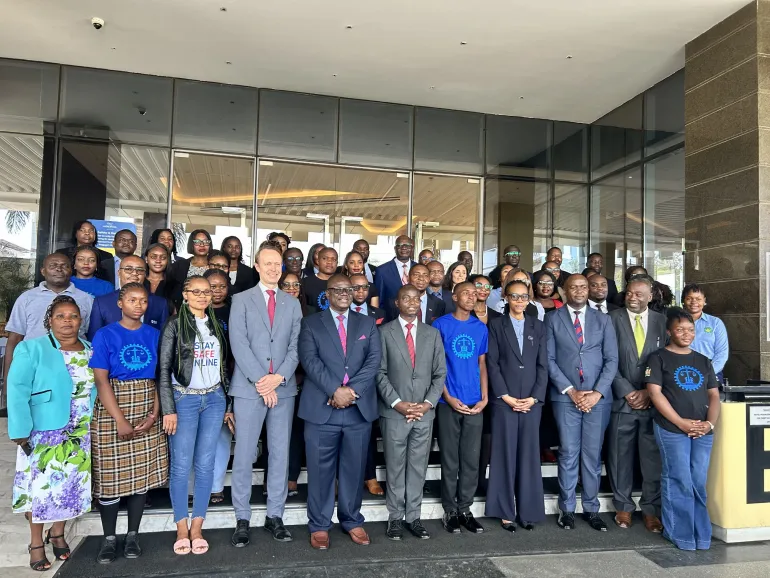
LUSAKA, Zambia, 07 October 2026 – Zambia has renewed its commitment to protecting children from violence, abuse and exploitation in digital spaces as the country officially launched Child Justice Week 2026. Under the theme “Protecting Children in Digital Spaces”, the event brought together representatives from the Judiciary, Government, child protection institutions, ZICTA, UNICEF Zambia, civil society, development partners, children and the media.
Child Justice Week provides a platform for stakeholders to strengthen collaboration for the protection of children, with particular attention this year to the opportunities and risks presented by digital technologies.
“Digital technologies, including artificial intelligence, are opening new opportunities for children to learn, connect and innovate, but they also expose them to new and serious risks. As Zambia implements the National Child Online Protection Strategy 2025–2029, the Government remains committed to working with all partners to create a safer digital environment where every child is protected online,” said Eng. Dr. Brilliant Habeenzu, PS, Ministry of Technology and Science.
During the launch, UNICEF Zambia presented its new global report, Through Children’s Eyes: How Digital Technologies Enable Child Sexual Abuse. The report includes extensive survey evidence with children's testimonies from 21 countries.
The report estimates that among approximately 20 million internet-using children aged 12–17, almost one in five, experienced at least one form of technology-facilitated sexual exploitation and abuse in a single year across the countries studied.
The research found that children were exposed to unwanted sexual content, pressured into sexual conversations or the sharing of sexual images, and had sexual images of themselves shared without their consent. The report also found that more than four in ten children’s experiences were not disclosed to anyone, while fewer than one per cent were reported to authorities such as police, social workers or helplines.
“These findings remind us that children need protection not only in their homes, schools and communities, but also in the digital spaces where they learn, communicate, play and build relationships. We therefore call on government, regulators, schools, families, communities and technology companies to act together to prevent online abuse, strengthen reporting and response systems, and ensure every child can seek help safely and without fear,” said Henri Heikura, UNICEF Representative, OIC.
To bring the global findings into the Zambian context, UNICEF Zambia, in partnership with Lifeline/ChildLine Zambia, presented available data covering the period January to August 2026. In that time frame, Childline recorded 1,208 online-safety inquiry calls and cases, 85 per cent involving children and nearly six in ten involving girls and women. Some of these cases are under investigation by relevant law enforcement agents. The leading concerns — including online addiction, harassment, unwanted sexting, cyberbullying and sextortion — show that online harms are disproportionally affecting children in Zambia, particularly girls, highlighting the need for targeted prevention, confidential reporting, effective referral tracking and timely response. Moreover, according to the Child Kids Online Survey by Save the Children, 21 per cent of children reported unwanted sexual advances online.
“Every call from a child is an opportunity to listen, protect and connect them to the help they need. Our role is to provide a safe and trusted first point of contact, to listen, assess, verify concerns, counsel, and ensure that children are referred to the appropriate protection and support service. We must continue strengthening these pathways so that no child who reaches out for help is left without a response,” said Florence Nkhkuwa, Executive Director – Lifeline/ChildLine Zambia.
The launch also featured a panel discussion with relevant government stakeholders, including a youth advocate, Yolanda Grace Tembo. It highlighted the need for a coordinated national response to technology-facilitated abuse, prioritizing prevention, digital literacy, accessible child-friendly reporting, timely support, stronger institutional capacity, and effective pathways to justice.
Zambia has already taken steps to strengthen child online protection through the National Child Online Protection Strategy 2025 – 2029. In January 2026, UNICEF Zambia supported a Children's Conference at which children called for greater investment in digital literacy and child-friendly reporting mechanisms.
“We must ensure that children know where and how to seek help, while strengthening the systems that prevent abuse, support victims and hold perpetrators accountable -
“ZICTA is committed to working with partners to make Zambia’s digital environment safer for every child,” said Eng. Collins Mbulo, Director General from ZICTA.
The event concluded with a Call to Action urging policymakers and child protection institutions to strengthen action to protect children online and:
- Modernize and enforce laws, policies and regulatory frameworks to anticipate and address rapidly evolving forms of technology-facilitated child sexual exploitation and abuse;
- Build specialized, child-sensitive justice and investigative capacity to ensure timely, coordinated and accountable responses, including capacity to preserve digital evidence, protect children’s privacy, communicate appropriately with children and avoid repeated or harmful interviewing;
- Scale up confidential, accessible and child-friendly reporting, referral and support mechanisms that deliver timely protection and care, with Childline 116, ZICTA, police units, one stop centres and social welfare services operating as one joined-up pathway for referral, feedback and follow-up, and ensuring that every referral leads to safety, psychosocial and family support, continued learning, legal assistance and responsible case closure;
- Embed age-appropriate digital literacy and online safety education across schools, communities and family support systems;
- Close evidence and accountability gaps through a nationally representative baseline study, consistent age- and sex-disaggregated reporting on referrals, services and case outcomes, and designation of a national agency to receive and act on CyberTipline reports;
- Hold digital service providers accountable for safety-by-design, effective risk mitigation and stronger safeguards for children, including effective reporting tools, evidence preservation and rapid response to lawful requests where children are at risk;
- Equip families and caregivers to recognize risks and respond to children’s disclosures with empathy, protection and appropriate action; and
- Institutionalize meaningful child participation in the design, implementation and oversight of policies, services and digital solutions affecting their lives.
The partners reaffirmed that the digital environment must be a place where children can learn, connect, play and express themselves safely.
Every child has the right to be safe - online and offline.
###
Notes to Editors:
Through Children’s Eyes: How Digital Technologies Enable Child Sexual Abuse draws on nationally representative surveys of approximately 21,000 internet-using children aged 12–17 across 21 countries, together with in-depth interviews with 100 young people who experienced abuse in childhood. (UNICEF)
The report forms part of the wider evidence generated through the Disrupting Harm project, implemented by UNICEF, ECPAT International and INTERPOL.
UNICEF Zambia has worked with partners to support implementation of Zambia's National Child Online Protection Strategy 2025 - 2029, including engaging children to contribute their perspectives and recommendations on online safety and digital well-being.
Media contacts:
UNICEF Zambia: Betty Chella Nalungwe | [email protected] | +260-966767770
ZICTA: Hanford Chaaba | [email protected] | +260-977282424
Child Justice Forum: Nandipha Ngulube | [email protected] | +260-977629094
Lifeline/ChildLine Zambia: | Maxim Murungweni | [email protected] | +260-975622707
Media contacts
About UNICEF
UNICEF promotes the rights and wellbeing of every child, in everything we do. Together with our partners, we work in 190 countries and territories to translate that commitment into practical action, focusing special effort on reaching the most vulnerable and excluded children, to the benefit of all children, everywhere.
For more information about UNICEF and its work for children in Zambia, visit www.unicef.org/zambia.
Follow UNICEF Zambia on Twitter, Facebook and Instagram