Supporting others starts with supporting yourself
Carolina’s story from the Mexico-Guatemala border

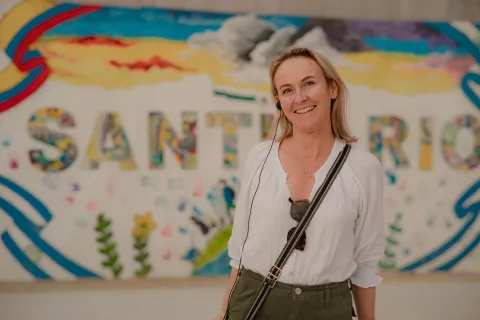
In the bustling border town of Tapachula, Mexico, where the movement of migrants and stories of hardship are part of daily life, 24-year-old Carolina is a steady presence offering psychological support to those in transit. A trained psychologist working in a refugee shelter, Carolina understands the emotional weight that people on the move carry. But behind her calm and composed demeanor is a young woman navigating her own challenges, and finding comfort in an unexpected place: a mental health podcast.
Carolina first discovered On My Mind, a mental health podcast for young people, developed by UNICEF in partnership with Spotify, thanks to a fellow volunteer. “A volunteer with UNICEF Mexico introduced me to it,” she recalls, “At first, I just listened out of curiosity. But then I realised how much I needed it.”
For Carolina, mental health is not just a profession; she’s conscious of the importance of looking after her own mental health as well. “Even though I’m a psychologist, I’m still young. I sometimes second-guess myself. Sometimes I question my own identity, my values or the things I want to achieve,” she shares,
“Sometimes I leave work and I’m still thinking about the cases I had to deal with that day. I try to disconnect by doing some sort of exercise like yoga or a home work out. I also believe that this podcast helps me to remove myself from my own crises and ruminating thoughts. It reminds me to breathe, to ground myself and to come back to who I am.”
She listens on her way to work, while cooking, or during a walk, treating the episodes as small acts of daily self-care. “I remember the first time I tried the abdominal breathing technique from the podcast,” she says. “I was overwhelmed after a difficult case I had to deal with at work. I put on the episode, followed the breathing…and it was like a sense of relief just washed over me.”

Carolina isn’t alone in finding value in these tools. “Young people are more open now to talking about mental health,” she notes. “But many still don’t know where to start or how to ask for help. That’s why something like On My Mind matters. It’s accessible, it’s validating, and it meets us where we are.” She believes that a cultural shift is underway, fueled by a greater access to content like videos, podcasts and social media, where young people see others openly sharing their struggles. “All of this new content opens the door to conversations. It’s taken time, but little by little, people are learning that it’s okay to talk about mental health. That’s how it was for me and my friends – we’ve made space for it.”
The podcast’s practical tools are a key part of its appeal. “There’s one which is a sort of visualizing technique, like to manifest your thoughts. You close your eyes and then start visualizing and focusing on your thoughts. That exercise is really helpful for me, especially whenever I have an idea that I can’t get out of my head.”

Among her favorite episodes are those on self-care, mindfulness, and grief. “The self-care one really stuck with me. It tells you it’s okay to find joy in small things. It gives you permission to prioritise your well-being, even if you're just listening on the bus.” What stands out to Carolina is the podcast’s simplicity and adaptability. “It’s concise, clear, and you can go back to it anytime,” she explains. “It’s like a friend reminding you of tools you already have, and showing you new ones along the way.”
Although she hasn't formally introduced the podcast at the shelter for refugees where she works, Carolina is eager to share it. “I’ve listened to it with my partner, and I would absolutely recommend it to the young people I work with. Especially those dealing with loss or struggling to express their emotions. The only thing is that a lot of them don’t have access to the internet so we’d have to figure out a different way of sharing it with them.”
As someone deeply engaged in the mental well-being of others, Carolina also offers insight into how to amplify the podcast’s reach. “If you want young people to engage, you need young people promoting it,” she advises. “Put it on other platforms too like TikTok. Share it on YouTube. Make it visible where youth are already spending time.”
At the heart of Carolina’s story is a simple truth: support doesn’t always have to come from a formal session or structured therapy. Sometimes, it’s through a voice reminding you to breathe.
Carolina appreciates the podcast for acting as a constant reminder to apply things she already knew, “It’s amazing that there’s this podcast you can listen to over and over again, to reinforce what you know, to support yourself and to help you feel stronger.”