

Inclusive Education
Quality learning and education for every child
- English
- Tiếng Việt
Challenges
Every child has the right to learn. Education for all means a system that welcomes and supports every child – no matter their abilities or needs.
But in today’s Viet Nam, a child’s gender, ethnicity, disability, household income and location still determine learning outcomes, their ability to fulfil their potential and become productive members of society.
Despite significant strides towards inclusive education, many are left behind.
Just under half of children from rural areas and one-third of those from the poorest households complete upper secondary education. Fewer boys than girls attend upper secondary school, but gender traditional gender norms inhibit girls from studying science, technology, engineering, and mathematics subjects. These ingrained trends mean that by the age of 19 years, only one-in-five from the poorest 20 per cent of the population remains in education, compared with four-in-five peers from better off households.
Children with disabilities remain underrepresented in education, with only one-in-10 attending secondary school. For those who reach school, the system is not fully prepared: only one-in-six primary and one-in-10 lower secondary schools have a teacher trained on disability inclusion, while 3 per cent of schools have suitable infrastructure.
Ethnic minority children do little better. This cycle of exclusion starts with low rates of preschool attendance: 38 per cent for Khmer children compared to 80 per cent nationally. This results in higher illiteracy rates, lower test scores and school completion rates, with 93 per cent of Mong children out of school and just one-in-five ethnic students reaching upper secondary school.
Solutions
UNICEF will not stop until every child in Viet Nam, no matter their situation or origin, has access to inclusive education. This means early learning opportunities through to completion of upper secondary education and meaningful transitions from school to work.
To achieve this, we help build the capacity of teachers, school managers and decision-makers in remote communities in the Northern Mountains, Central Highlands and deep in the Mekong Delta through to Viet Nam’s biggest cities to enable innovative and inclusive education opportunities for all. A key component of this capacity building focuses on gender transformative action to empower teachers to ensure biases in the classroom do not inhibit girls’ learning.
For children with disabilities, we are supporting the roll-out of inclusive education resource centres nationally to act as bridges into regular school. We engage teachers to support parents of children with disabilities to enhance learning outcomes and remove gender stereotypes and social norms that hinder access to education.
Getting more ethnic minorities into school means breaking down language barriers with Mother Tongue-Based Bilingual Education and supporting community-based education opportunities. This child-friendly and rights-based learning approach has already proven impactful in using local languages in early grades to ensure children’s engagement and attendance through the education system.
To ensure no one is left behind in a rapidly changing digital world, we are committed to a holistic approach and inclusive design to advance digital transformation in education. By bridging social, cultural and economic divides, we empower marginalized children through enhanced digital access, essential skills development and accessible content.
You can be the change for children!
Help UNICEF provide children and families with critical essential services for health and nutrition, education and protection.
Impacts
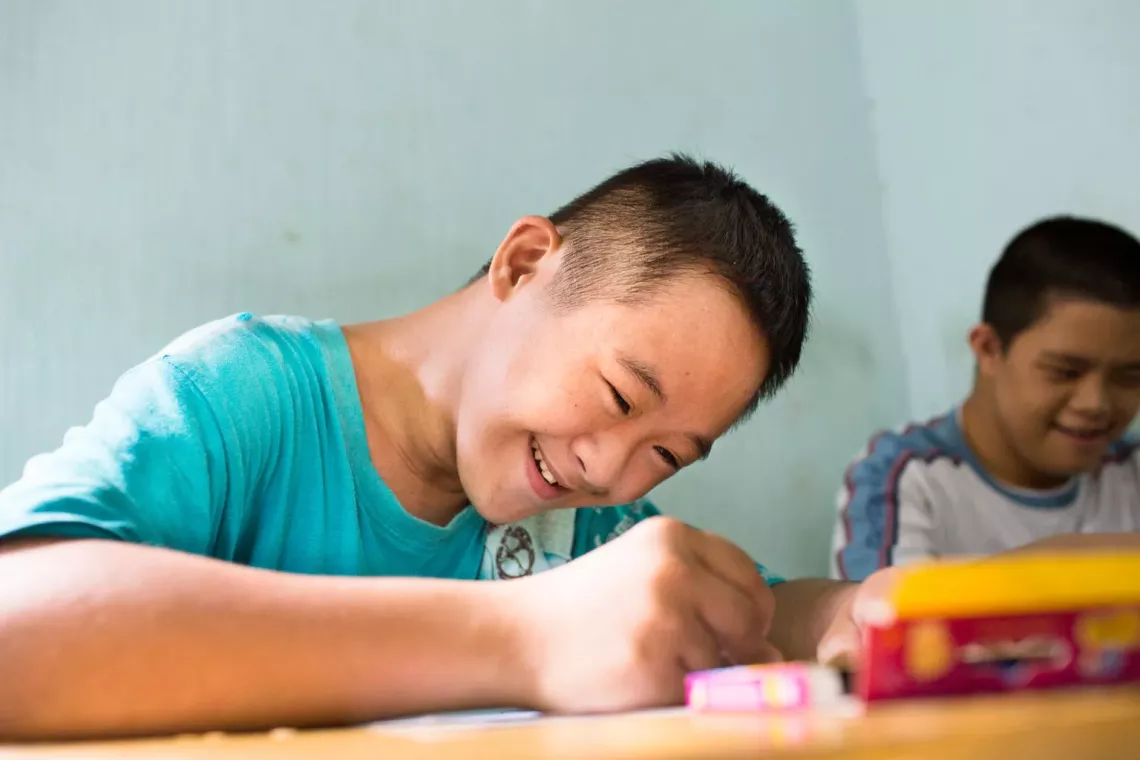
UNICEF is working for a future where all children in Viet Nam, especially ethnic minorities and children with disabilities, both girls and boys, can realize their rights to inclusive education opportunities and ensure they are not left behind. With our support to access the mainstream education system, children and adolescents will have the essential building blocks to grasp vocational training and tertiary learning opportunities to enter the workforce and thrive as productive citizens.