

Bringing mother tongues into the classroom
For two decades, a teacher has worked to make learning more inclusive for ethnic minority children.

- English
- Tiếng Việt
It was noon. Tau, 11 and hungry, was late for lunch at his ethnic minority boarding school. When he reached the cafeteria, his classmates had already finished eating. There was nothing left.
The teachers were still there, but instead of asking them about his lunch portion, he sneaked out and walked 15 kilometres home to eat.
“I was too shy,” Tau recalled. “And to be honest, I didn’t know how to ask in the language either.”
The language, Vietnamese, was used in class and spoken by his Kinh-majority teachers. But as a Mong boy raised in a Mong village of Lao Cai province, Tau hadn’t known a word of it when he started school. He often felt anxious and left behind.
His story was not unique. It was shared by many ethnic minority children who struggled to learn in a language not their own. As a result, students’ learning in language and other subjects like mathematics faltered, their interest in school waned, and far fewer completed primary school compared to their Kinh peers [1][2].
During his long walk home, Tau thought hard.
“I just knew I had to get better,” he said. “And I wanted to grow into someone who could be there for children, so they wouldn’t have to go through what I did.”
He didn’t know it then, but he was looking toward his own future. Years later, Tau would become a teacher and champion a pioneering effort to help learning in Viet Nam become more inclusive for ethnic minority children.
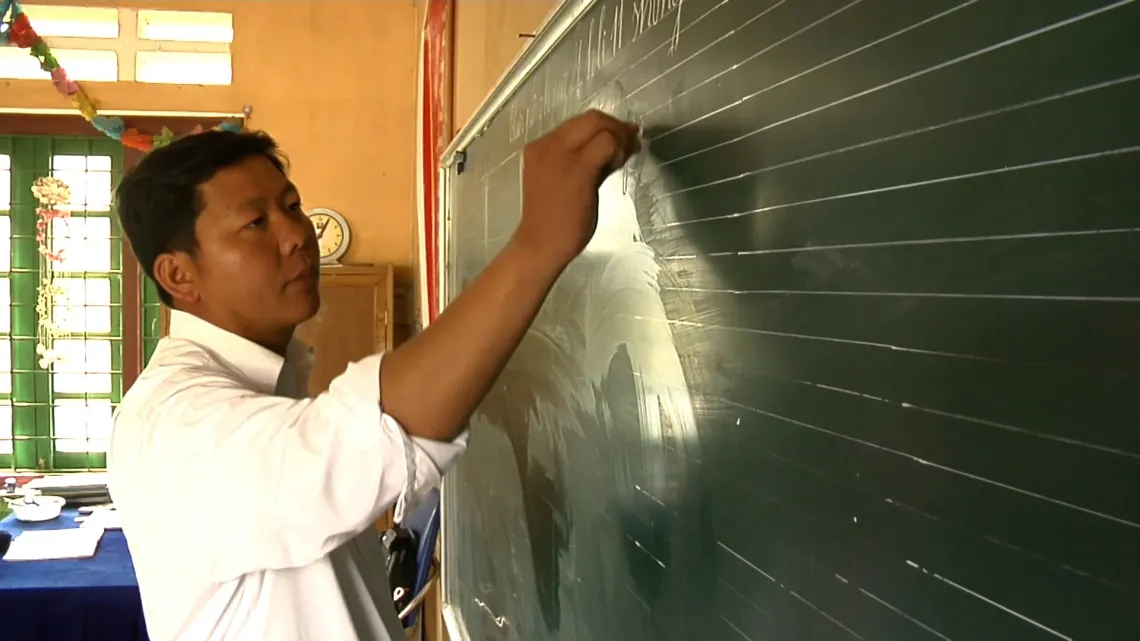
In 2008, five years into his teaching career, Tau joined the pilot Mother Tongue-Based Bilingual Education (MTBBE) programme, implemented through a partnership between the Ministry of Education and Training and UNICEF.
The first of its kind in Viet Nam, the programme has a simple but transformative goal: to help ethnic minority children master their mother tongue, which in turn supports their learning across all subjects — from language, to mathematics, to science. Beyond academics, the approach helps preserve ethnic minority language and culture, while allowing young generations to communicate with elders and learn about important beliefs and customs passed on orally.

Specifically for Mong children, the programme has meant learning in both their mother tongue — Mong — and Vietnamese, from preschool through grade 5.
In the early years, Mong is the main medium of instruction, helping children grasp new concepts and build confidence in a language they understand. As students progress in their learning in Mong, Vietnamese is gradually introduced and takes on a larger role; so that by the time these students finish primary school, they are confident in both languages, and are ready to learn across all subjects entirely in Vietnamese.
Being the only Mong teacher at Lao Chai primary school at the time, Tau felt a heavy responsibility to make it work.
During training workshops, he met other teachers who were as passionate as they were anxious. “I realized nothing could be perfect from the beginning,” Tau smiled. “We learnt alongside the children and adjusted as we went.”
Based on the programme framework, Tau adapted lessons to make them more relatable to Mong children. In class, he wore several hats: teacher, interpreter, and cheerleader.
“Having him teach us in Mong made it so much easier to understand,” recalled Tung, one of Tau’s students. “He would translate new words and explain things using examples from our culture. It really made a difference.”
Slowly, the results began to show. Students in the bilingual programme arrived in class more confident and eager to learn. They spoke up more, helped one another, and seemed at ease in both Mong and Vietnamese languages.

“It wasn’t hard to tell who was in the bilingual class and who wasn’t,” Tung added. “My friends from other classes were much more reserved.”
As parents noticed this progress, attendance began to rise too.
“When I first taught at Lao Chai, the attendance rate was around 80 percent at best,” Tau said. “But over time, I started seeing more faces. Perhaps because the parents saw a Mong teacher, and they realized there was something meaningful in it for their children: their language, their culture, their sense of belonging.”
For many families, it was the first time their children could read and write in Mong, a skill few adults in the community had.
“When I learned in Mong, I’d show my mother the words,” said De, another alumnus of Tau’s bilingual class. “She couldn’t read, but she always knew their meanings. It made me feel closer to my family and my culture.”
Many of Tau’s students felt the same. Over eight years of the pilot, he saw the impact unfold far beyond his classroom.
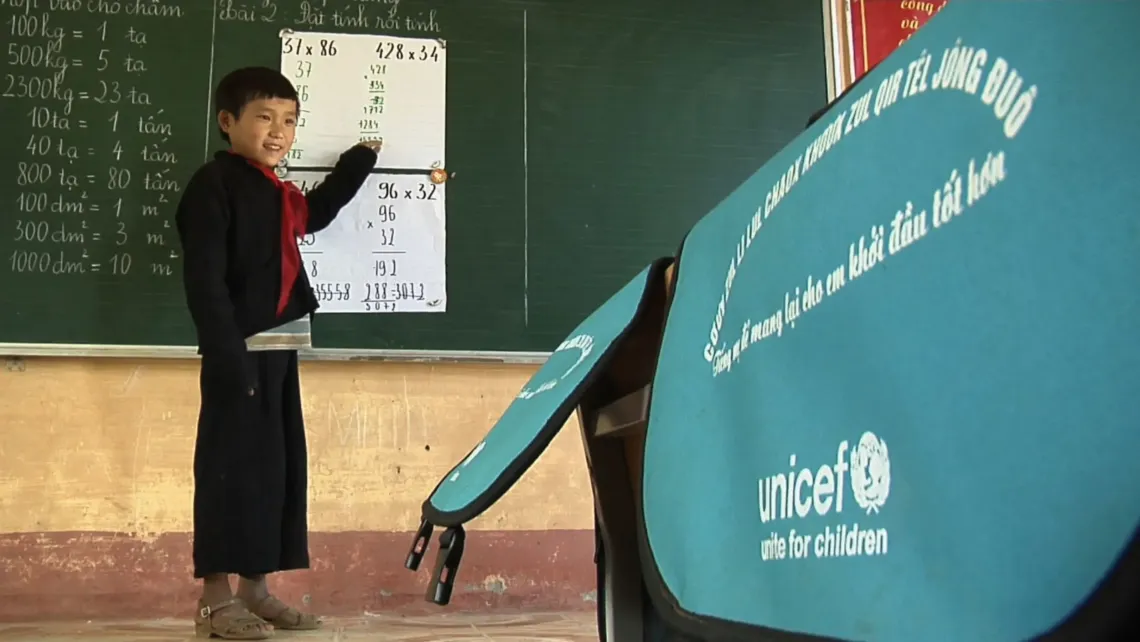
His two cohorts became more creative and self-assured; many went on to attend selective schools and universities. Wherever they went — including big cities like Ha Noi — they carried their culture with them, joining initiatives to promote Mong traditions and language.
Some, like Tung and De, still call Tau for advice and encouragement. More than fifteen years from the moment they stepped into Tau’s class, both now hope to become teachers and support Mong students of their own.
“I love children,” Tung smiled. “It’s just as simple as that.”
“I want children from my community to feel proud and seen, just like we did,” De said.

For Tau, seeing his former students following the same path feels fulfilled. At 46, he continues to pass on that spirit.
As the bilingual programme grew in Lao Cai and expanded to more provinces, Tau’s work helped shape new ways of teaching that valued children’s languages and identities.
Today, he not only teaches but also trains and supports other Mong teachers who lead Mong language classes across the country.

Looking back, he knows that his childhood wish — to help children from his community learn — has, in many ways, come true. Yet the journey is still long, filled with doubts and reflection.
“You try so hard to make sure your students move in the right direction,” Tau said. “But when they don’t, you feel like it’s your fault. You know there are many factors — it’s never one person’s job — but you just can’t help feeling it.”
“Still,” he added, “I wouldn’t trade it for anything else.”
[1] National Statistics Office and UNICEF. 2021. Survey measuring Viet Nam Sustainable Development Goal indicators on Children and Women 2020-2021, Survey Findings Report. Ha Noi, Viet Nam: National Statistics Office.
[2] Ministry of Education and Training of Vietnam and UNICEF Vietnam. 2021. SEA-PLM 2019 Regional Assessment Results: Vietnam Country Report.
About the Mother Tongue-Based Bilingual Education (MTBBE) programme
The MTBBE programme was piloted from 2008 to 2015 by the Ministry of Education and Training (MOET), with UNICEF’s support, in three provinces with large ethnic minority populations: Lao Cai (Mong language), Gia Lai (J’rai) and Tra Vinh (Khmer). The programme enables children to learn in both their mother tongue and Vietnamese from preschool through primary school.
Evidence from the pilot showed improved learning outcomes, stronger confidence among students, and growing support from families and teachers.
Building on this foundation, Lao Cai has expanded the model to nine primary schools and five preschools.
Nationally, the Ministry of Education and Training, with UNICEF’s support, has introduced an action plan to scale up mother tongue-based bilingual education in eight provinces with large ethnic minority populations, including investments in teacher training, learning materials and digital tools.