Exclusive breastfeeding: The strongest bond between mother and her baby
To promote and reinforce breastfeeding in health facilities, UNICEF supports capacity building for staff, provides essential supplies, and rehabilitates spaces for maternal and childcare.

- Español
- English
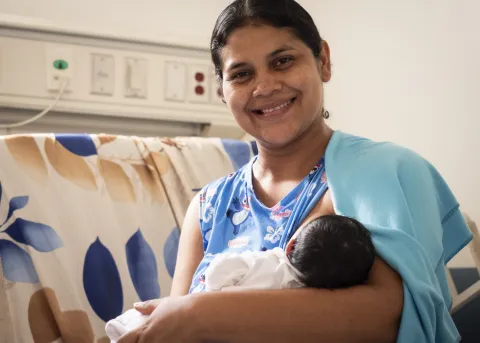
Karla González is 32 years old and is the mother of Miguel Elías Calvate González, one month and eighteen days old. She and her family live in El Valle parish in Caracas, Venezuela.
"I felt sick, I almost fainted. I managed to go for a gynecological check-up, and they did an echo sonogram. When he (the doctor) introduced the instrument to visualize what was in my uterus, I had my gestational sac, with the yolk sac, with the baby's heart beating there, and I started to scream," Karla says. For her and Jonh, her husband, that moment was magical, because that is how she found out she was pregnant with her first baby.
Karla, from the moment she received the news of her pregnancy, began to look for information about the humanized birth plan in Venezuela. That is how she arrived at a maternal and child health center supported by UNICEF. There she was received by the humanized childbirth promoters who offered her guidance, supported her with breathing exercises for the moment of giving birth, and taught her how to eat a balanced diet.


At the maternal and child health center, Karla also received support to start breastfeeding her baby from the moment of birth.
"For me, it is fundamental because it provides the necessary nutrients, both vitamins and antibodies, and also in the cognitive area because Miguel Elías is going to be an intelligent child. In addition, it creates that bond, that attachment that we have," says Karla.
Exclusive breastfeeding gives children the healthiest start in life. During the first 6 months, breast milk provides all the nutrients a baby needs for development without the need to include food or water.

For Karla, the support of her husband, Jonh, has also been important. She tells with nostalgia that since her baby was formed, he talked to his, and sang songs to her and Miguel Elías would recognize him by kicking his belly.
Men and families can play a key role in supporting women who breastfeed their babies. They can provide emotional support and take on more household or childcare tasks to give them more time and space to breastfeed.

"For me, it is important that the breastfeeding centers are extended so that there is this bond so that there is not so much morbidity. It is essential for the mother to be able to share more with her child," says Karla.
In the breastfeeding room of this UNICEF-supported maternal and child health center, mothers are accompanied by a medical team composed of promoters, doctors, and nurses. This team advises them on the proper techniques to achieve successful breastfeeding and preserve their breast milk.
In 2023, UNICEF Venezuela contracted services for the refurbishment and rehabilitation of nine breastfeeding rooms and three breast milk banks in the country.
"The breastfeeding room is a wonder. This is love, a sample of the source of love. Whoever comes here has to like it, fall in love, because otherwise, it doesn't work," says Carmen Morfee, Teaching Coordinator and Breastfeeding Counselor.
She explains that she works with the entire pediatrics and neonatology team at the maternal and child health center, but that she also conducts breastfeeding training with other health center staff, both administrative, security, and maintenance.
For mothers to be able to breastfeed their babies during the time and in the conditions, they need, the contribution of families and communities is fundamental. The commitment of all actors in society is necessary to ensure that breastfeeding-friendly environments exist and are maintained.