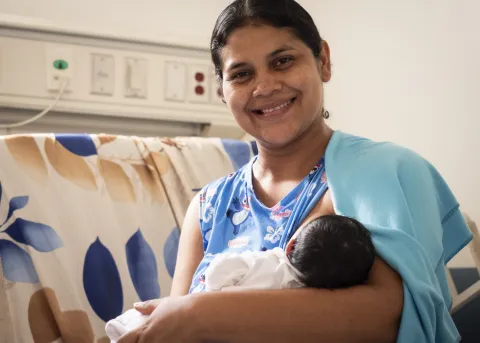
Government of Venezuela and UNICEF Establish the National Technical Committee on Breastfeeding to Strengthen Early Childhood Health
Representatives from various health sector institutions, alongside UNICEF, formalized the launch of this inter-institutional coordination space in Caracas
- Español
- English
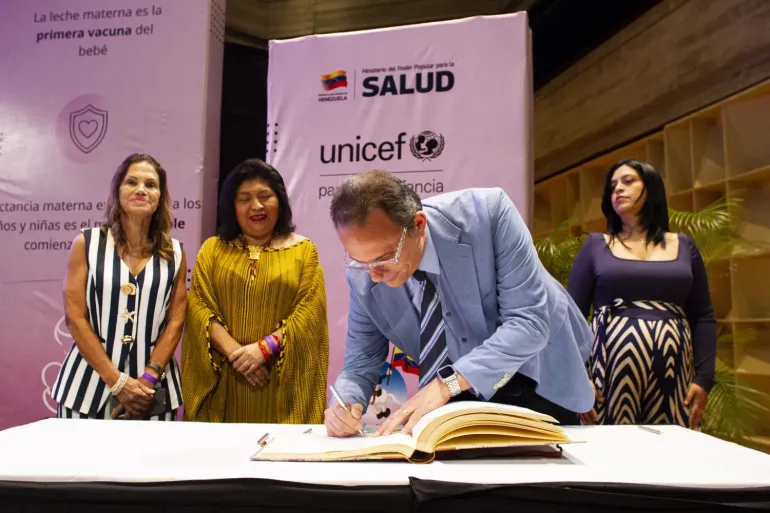
Caracas, May 21, 2026. Within the framework of World Breastfeeding Protection Day, representatives from the Government of the Bolivarian Republic of Venezuela and the United Nations Children's Fund (UNICEF) signed an agreement this Thursday formalizing the establishment of the National Technical Committee for the Protection, Promotion, and Support of Breastfeeding. This mechanism aims to strengthen inter-institutional coordination to consolidate and expand the country's progress in this area.
The signing took place at the José Félix Ribas Hall of the Teresa Carreño Theater in Caracas. The agreement was signed by Noly Fernández, Vice Minister of Ambulatory Health Care Networks of the Ministry of People's Power for Health (MPPS); Adriana Urdaneta, President of the National Nutrition Institute (INN); María del Valle Carneiro de García, President of the "El Niño Simón" National Foundation; and Manuel Rodríguez Pumarol, UNICEF Representative in Venezuela.
The document states that the participating institutions reaffirm their political will and commitment to the comprehensive protection of maternity, early childhood, and the right to adequate nutrition, emphasizing the recognition of breastfeeding as an essential public health intervention for human development.
The Technical Committee for the Protection, Promotion, and Support of Breastfeeding will focus its priority lines of action on strengthening regulatory and legal frameworks and reinforcing the public health system's capacity to support mothers and children. It will also work to guarantee exclusive breastfeeding during the first six months of life, followed by complementary feeding from six months up to two years of age. Furthermore, it will promote community participation, public communication, social behavior change, research, and knowledge management in favor of breastfeeding.
The signatory institutions agreed on the need to optimize efforts against current challenges that affect optimal breastfeeding practices, such as social, workplace, and institutional barriers, as well as the rise of misinformation and marketing strategies for breast-milk substitutes, especially in digital environments.
In his remarks, Rodríguez Pumarol recalled the vital importance of breastfeeding, noting that it constitutes "a baby's first vaccine, their unequivocal source of nutrition, and the biological engine of their brain development."
He added that to consolidate progress in breastfeeding, “UNICEF proposes globally to focus efforts on seven key actions: increasing funding to extend breastfeeding up to two years; strictly enforcing and monitoring the International Code of Marketing of Breast-milk Substitutes to curb misleading advertising; promoting paid family leave and dignified workplace breastfeeding spaces; rigorously implementing the Ten Steps to Successful Breastfeeding in maternity wards; guaranteeing specialized and updated counseling for health personnel; strengthening links between health networks and communities by supporting community promoters; and constantly evaluating the progress of all these policies and programs.”
Venezuela has a solid framework for the protection of breastfeeding, which includes provisions established in the Constitution of the Bolivarian Republic of Venezuela; the Law for the Promotion and Protection of Breastfeeding; the Organic Law for the Protection of Children and Adolescents (LOPNNA); the Organic Law on Labor and Workers (LOTTT); the Law for the Protection of Families, Maternity, and Paternity; the Organic Law on the Right of Women to a Life Free of Violence; the Organic Law on Prevention, Conditions, and the Work Environment (LOPCYMAT); Ruling No. 991 of the Constitutional Chamber of the Supreme Court of Justice; the protocols and technical standards of the MPPS; and the guidelines of the National Breastfeeding Coordination of the INN.
This framework incorporates principles and provisions promoted by the World Health Organization and UNICEF Global Strategy for Infant and Young Child Feeding, the International Code of Marketing of Breast-milk Substitutes, and relevant World Health Assembly resolutions.
Media contacts
About UNICEF
The United Nations Children's Fund (UNICEF) works in 190 countries and territories together with partners from governments, the private sector, and organized society to promote the fulfillment of the rights of all children and adolescents around the world.
UNICEF has been working in Venezuela since 1967, when a Basic Cooperation Agreement was signed. In 1991, the first Country Programme was approved with the National Government, transforming the commitment into actions that contribute to the protection and strengthening of the rights of children and adolescents.
Follow us on our website and Twitter, Facebook, Instagram, YouTube, and TikTok