For Every Girl, NO More Violence
November 25th is the International Day for the Elimination of Violence Against Women.

- Español
- English
Thousands of organizations, institutions, and people around the world raise their voices every November 25 to make visible the violence against women and girls, which continues to be one of the most widespread, persistent, and devastating human rights violations.
From UNICEF, we join this call that, beyond the commemoration, seeks to give visibility to this problem and promote justice for women and girls survivors of violence who, even in the middle of 2020, are still unable to report due to different obstacles such as impunity, lack of access to services or fear of being stigmatized and re-victimized. Likewise, it is important that all of us are aware of the causes and consequences of violence against women in order to prevent and eradicate it.
The origin of #25N
The call began in the framework of the commemoration of the murder of three women in the Dominican Republic as a repression of the fight for their rights. In 1993, the United Nations General Assembly adopted Resolution 48/104 for the Elimination of Violence against Women and in 1999 it claimed this date by proclaiming November 25 as the International Day for the Elimination of Violence against Women.
Why do we speak of violence against women and not violence in general?
We understand violence against women as “any act of violence that has or may result in physical, sexual or psychological harm or suffering for women, as well as threats of such acts, coercion or arbitrary deprivation of liberty, whether they occur in public life or in private life. "[1] The most common forms in which it manifests itself are sexual violence and harassment, human trafficking, intimate partner violence, domestic violence, child marriage, genital mutilation, and femicide. While men and boys can also experience this type of violence, women, and girls around the world experience it disproportionately. In other words, women, and girls, just because they are, are at much greater risk of facing this violence. Despite all the advances in legislation to classify and penalize these acts in many countries, violence against women and girls continues to be minimized, disqualified, and even made invisible by societies.
The violence may have been fueled by the # COVID-19 pandemic. The virus prevention measures place women, adolescents, and girls at greater risk of contagion of the virus, as well as increasing their risk of suffering some form of violence. Another characteristic of violence against women is that an aggressor is often a close person. Global data from the United Nations found that in 2017 one of every 2 murdered women was murdered by her romantic partner or a member of her family. In the case of men, these circumstances only occurred in one of every 20 murdered men.[2]
The actual numbers are likely to be higher if we counted the unreported cases. However, femicides and survivors who report physical harm show only the tip of the iceberg. Many women and girls suffer daily from acts that leave no visible evidence but cause adverse consequences to their mental health, life, and development, such as psychological violence.
Violence against women and girls has a strong cultural and social root. It is the responsibility of the state, families, and society to stop patterns that promote this phenomenon and act when we become aware of any case of violence.
No country can advance without equality and violence against women and girls continues to be an obstacle to the development and well-being of Venezuelan children.
How does UNICEF contribute?
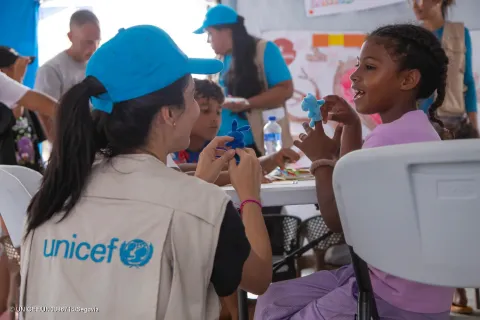
As part of the actions that UNICEF is taking to prevent, mitigate and respond to Gender-Based Violence are the actions to strengthen the institutional response to cases of GBV against children and adolescents through training and accompaniment to institutions of the National Governing System for the Comprehensive Protection of Boys, Girls and Adolescents that manage cases, as well as with social organizations that provide support to NNA survivors of GBV, focusing on essential protection services, health, psychosocial care, and legal guidance.
On prevention issues, since last October 11, we launched a campaign to sensitize and inform the general population about what Gender-Based Violence is and how it affects the lives of children and adolescents, either directly or indirectly. living in environments where this type of violence is practiced.
In addition, we have a team of child protection specialists focused on working with their partners in the field, local and regional governments, civil society and institutions to respond to the protection needs of children during the contingency, through our specialists in Caracas, and from our local offices in Táchira, Zulia and Bolívar.
Likewise, we have redoubled efforts to provide psychosocial support to families and in the dissemination of violence prevention messages, including gender-based violence.
[1] Declaration on the Elimination of Violence Against Women, A / RES / 48/104 February 23, 1994
[2] https://www.un.org/es/events/endviolenceday/