Small babies, big potential
A health care provider’s commitment to saving premature babies in Uzbekistan

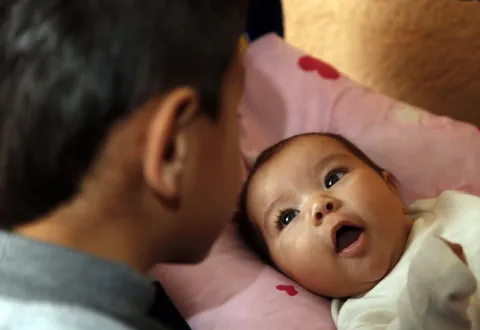
When Murodjon was born in the beautiful Fergana Region, his family was elated. However, Murodjon was born prematurely, and his lungs were not yet fully developed. He was struggling to breathe, and his oxygen levels were dangerously low. For his parents, what was a joyful moment minutes before, quickly became one filled with fear and uncertainty.
For Dr Umida Kasymova, a dedicated neonatologist at the Fergana Regional Perinatal Center, this was a moment that required immediate action.
“The baby was in a serious condition, with breathing difficulty and low oxygen saturation,” she recalls solemnly.
Her team began providing respiratory support using the Vayu bubble continuous positive airway pressure (bCPAP) system, which helps keep a newborn's lungs open and supports breathing without immediately requiring invasive mechanical ventilation. Gradually, the baby's condition began to improve. His breathing became less labored, and the oxygen level in his blood improved.
Dr Umida Kasymova knows that the first moments of a newborn's life can change everything. As a neonatologist, she has taken care of many babies who entered the world too early, some so fragile that even breathing on their own was a struggle.
Dr. Umida has treated more than 10 000 premature babies during her 30 years of her work. Yet, no matter how many newborns she has treated, each one brings a new responsibility and a new reason to hope.
“As a doctor, I feel an enormous responsibility for the life and health of every newborn,” she says. “Our profession requires attentiveness, composure and the ability to make quick decisions. I also have trust in my team, because teamwork is one of the most important elements of newborn care.”
But stabilizing the newborn was the first challenge.
The newborn son of the Yusupovs’ family needed to be transferred from the delivery room to the neonatal intensive care unit (NICU), where he could receive further specialized care. Although the journey would take only a few minutes, Dr. Kasymova knew that even a brief interruption in respiratory support could put a critically ill newborn at risk.
In such a situation, the Vayu bubble CPAP system comes in especially important. Unlike some conventional respiratory support systems, the device does not require electricity or a compressed-air supply, making it particularly useful in settings where such infrastructure may be limited.
During the transfer, Dr Kasymova and her colleagues closely monitored the baby's breathing, heart rate, oxygen saturation and temperature. Then, unexpectedly, the baby’s condition deteriorated. His breathing became more difficult, and his oxygen saturation dropped.
Rather than continuing towards the NICU, the team stopped assessing the situation and took immediate action. They checked the CPAP pressure generator, oxygen flow, nasal interface, and system connections, making the necessary adjustments before proceeding. Only once the baby had stabilized did they continue towards the NICU.
Moments like these illustrate why caring for premature babies requires not only medical knowledge and availability of life saving equipment, but also calm decision-making and trust between colleagues.
For Dr Umida Kasymova, caring for premature newborns is an everyday responsibility. At the Fergana Regional Perinatal Centre, where she works, many babies require specialized care from their very first moments of life.
A study published in 2026 found that more than one in five deliveries at the center in 2024 were preterm, highlighting the importance of ensuring that healthcare workers have the skills, equipment and resources needed to care for vulnerable newborns.
Across Uzbekistan, an estimated 7,112 babies died during their first 28 days of life in 2024, according to United Nations estimates. Although neonatal survival has improved over the past two decades, these figures underscore the continuing need to strengthen quality of newborn care.
Dr Kasymova understands that behind every newborn in intensive care is a family experiencing anxiety, fear, uncertainty, and hope. Reassuring parents and helping them understand their baby's condition are essential parts of neonatal care.
The Yusupovs’ family was no exception. She remembers the family's reaction as their son's breathing improved.
“I tried to calm the parents, explained their baby's condition and why respiratory support was necessary, and responded to all their questions,” says Dr Kasymova. “The parents were especially happy when they first heard their baby cry. It was not a loud cry, but it helped them understand that their baby was breathing on his own. It was a small sound, but one that brought enormous relief”.
For Dr Kasymova, every newborn who recovers is a reminder of why her work matters. Because behind every premature baby's chance at a healthy future are healthcare workers who refuse to give up on even the smallest lives.
UNICEF, working with the Ministry of Health, has supported improvements in maternal and newborn care across Uzbekistan. Through the Ishonch-funded maternal and perinatal healthcare programme, all 231 perinatal centers nationwide have received support to strengthen service delivery, combining essential medical equipment with training for healthcare professionals, updated clinical protocols and improvements in quality of care.
Latter-day Saint Charities (LDSC) has also made an important contribution to strengthening neonatal care in Uzbekistan. Since 2013, LDSC has supported healthcare facilities through donations of essential equipment, including Vayu bubble CPAP systems, neonatal resuscitation bags and masks, pulse oximeters and oxygen therapy accessories. Its support has reached regional perinatal centres and district hospitals, including facilities serving remote communities.
Over this period, LDSC's direct equipment donations have exceeded US$1 million, while more than 2,500 healthcare workers have received specialized training with its support.
Together, these efforts demonstrate how investments in medical equipment and healthcare workers' capacities can translate into better care for newborns. For professionals like Dr Kasymova, access to appropriate respiratory support makes it possible to respond to breathing difficulties earlier and maintain essential care during transfers within health facilities.
“I have never regretted, and will never regret, choosing this profession,” she smiles proudly.