

New health emergency operations center in Nukus advances Uzbekistan’s vision for stronger nationwide preparedness
Established through U.S. Government funding, the center strengthens regional coordination and helps lay the foundation for an integrated national response system
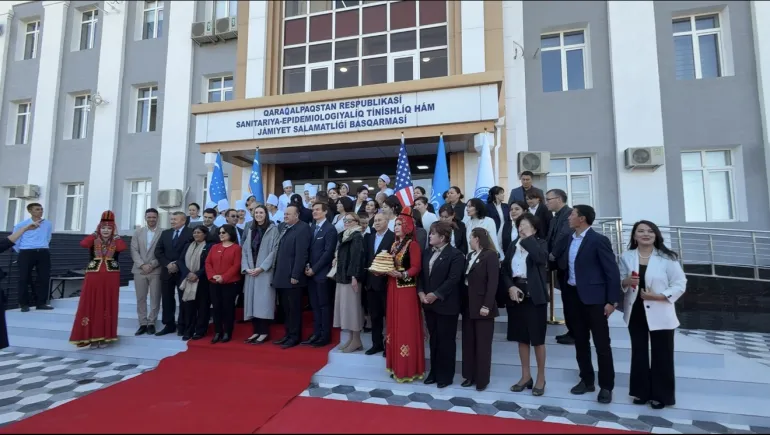
NUKUS, Uzbekistan, 4 November 2026 – The inauguration ceremony of the Public Health Emergency Operations Center (PHEOC) was held today in Nukus marking an important step towards strengthening the country’s capacity to prepare for and respond to infectious disease outbreaks and other public health emergencies in the northwest region and beyond.
The new center is intended to help health authorities turn early information about emerging threats into coordinated action. Its operational functions include incident management, emergency activation procedures, situation monitoring, and information sharing among the institutions responsible for public health preparedness and response.
The center was established by the Committee for Sanitary and Epidemiological Welfare and Public Health of the Republic of Uzbekistan, with financial support from the U.S. Government and technical assistance from UNICEF under the Global Health Security Program.
Heather Byrnes, Deputy Chief of Mission at the U.S. Embassy in Uzbekistan, highlighted the importance of international partnership in strengthening health security:
“Strong emergency preparedness is important not only for Uzbekistan, but also for the United States. Epidemics are indifferent to international borders, hence cooperating on global health protects us all.”
In April 2026, a Public Health Emergency Operations Center was also inaugurated in Termez. Together, these two regional centers demonstrate progress towards establishing an interconnected system for managing public health emergencies across the country. During the inauguration, Regina Maria Castillo, UNICEF Representative in Uzbekistan outlined a long-term vision of establishing a unified national network of such centers across Uzbekistan’s 14 administrative regions. The long-term value of such a system will depend on more than facilities and equipment. Effective preparedness also relies heavily on community engagement, trusted information, risk communication and the ability to counter misinformation. These measures help families understand risks, take protective action, and sustain confidence in public health responses during crises.
Botirjon Qurbonov, Deputy Chairman of the Committee for Sanitary and Epidemiological Welfare and Public Health, outlined the Government’s priorities for strengthening institutional preparedness and coordination:
“The establishment of the Public Health Emergency Operations Center in Nukus is an important step towards strengthening Uzbekistan’s public health emergency preparedness and response system. Our priority is to ensure that national and regional institutions are equipped not only with the necessary infrastructure, but also with the capacity to detect public health threats early, coordinate effectively, and respond promptly to protect the health of our population.”
At the inauguration, representatives of the Government of Uzbekistan, the U.S. Embassy and UNICEF reviewed the center’s coordination mechanisms, activation procedures and situation dashboard. Discussions focused on the practical requirements of a sustainable system, including a skilled and adequately trained workforce, operating procedures, regular readiness measures, and effective links between regional and national authorities.
Regina Maria Castillo, UNICEF Representative in Uzbekistan, underscored the importance of moving beyond infrastructure to readiness and coordinated action:
“The Nukus PHEOC is much more than a building. It represents readiness, coordination, and the ability to transform information into timely action when lives are at stake.”
Participants also considered lessons from an August 2026 benchmarking visit to Türkiye and potential follow-up measures to strengthen the Public Health Emergency Operations Center network. The aim is to translate learning and investment into routine operational capacity that remains effective well beyond an opening ceremony.
For children and families, effective public health preparedness means faster responses and fewer interruptions to essential health services during emergencies. The Government of Uzbekistan, the United States Government and UNICEF share a commitment to strengthening nationally owned institutions and partnerships with communities so that preparedness translates into lasting resilience.
For additional information, contact the following media contacts:
UNICEF: Nargiza Egamberdieva, +998 93 380 3419, [email protected]
Committee for Sanitary and Epidemiological Welfare and Public Health: Maftuna Saidova, +99890 317 12 51, [email protected]