

Inclusive education through the eyes of children
UNICEF advocates for human-rights approach to inclusive, safe, and equitable learning environments for all
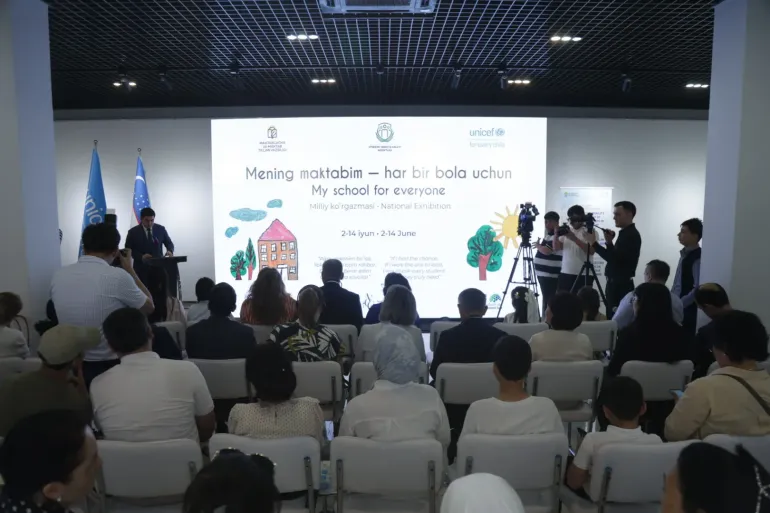
TASHKENT, 2 June April 2026 –The United Nations Children’s Fund (UNICEF) in partnership with the Ministry of Preschool and School Education and the National Agency for Social Protection/International Inclusive Hub, showcase emerging promising and good practice on inclusive education from across Uzbekistan, as they launch a national exhibition titled “My School for Everyone.”
The exhibition presents drawings, essays, poems and photograph and video images from all regions of Uzbekistan reflecting perspectives of children on education and aspirations for accessible and supportive learning environments.
“Through children’s artwork we are reminded that inclusive education is not simply an education issue. It is about dignity, equality, opportunity, and the future we want to build together”, said Regina Castillo, UNICEF Representative in Uzbekistan. “At UNICEF, we strongly believe that inclusive education is one of the most powerful drivers of quality education systems. When schools become inclusive, they become better for every child. They become more child-centered, more flexible, more innovative, and more responsive to learning needs of all children”, she added.
Uzbekistan is taking important steps to advance inclusive education, enabling all children, including children with disabilities, to participate in quality school and preschool education through strengthened capacity of mainstream institutions. However, many children in the country continue to face barriers to accessing and fully participating in learning.
Out of an estimated 122,300 children with disabilities in Uzbekistan, only 5,999 are enrolled in mainstream schools—representing fewer than 5 out of every 100 children. This gap highlights the urgent need to transform education systems and societal attitudes so that all children—regardless of ability—have equal opportunities to learn and grow.
Besides removing physical barriers, there is a need to shift societal perceptions from viewing disability through a medical or charity lens, to focusing on rights of children with disabilities. Evidence from the 50 model schools, which UNICEF supports through the ISHONCH 2030 initiative, shows that:
- 43% of parents and 32% of teachers view mainstream public schools and preschools as the best educational setting for children with disabilities;
- 18 % parents and 19 % of teachers support specialized schools for children with disabilities;
- Only 8% of parents and 15% of teachers consider home-based education as the preferred option.
These findings highlight growing confidence in inclusive, community-based schools and reinforce the need to expand quality, accessible, child-centered learning opportunities close to home. Modeling schools demonstrate how inclusive education can work in practice through integrating inclusive pedagogy and differentiated teaching, assistive technologies and adaptive learning materials, introducing accessible infrastructure and child-friendly environments.
Through showcasing children’s perspectives and community stories, the exhibition aims to raise public awareness about inclusive education, promote positive attitudes toward diversity and inclusion, highlight progress, and encourage collective action across government, communities, and partners.
The exhibition is organized within the framework of the SMART-ED Project funded by the Islamic Development Bank (IsDB), the Arab Coordination Group (ACG), and the Global Partnership for Education (GPE). It will be open for all visitors till 14 June 2026 at the Ikuo Hirayama Cultural Caravanserai.
Address: 37A, Yusuf Khos Khodzhib Street (Landmark: Higher School of Choreography, near the Kosmonavtlar metro station).
For media queries please contact:
Dilfuza Khamidova Inclusive Education Officer Phone: +99893 505 54 94 E-mail: [email protected]
| Nargiza Egamberdieva Communication Officer Phone: +99893 380 34 19 E-mail: [email protected]
|
