

Global immunization efforts have saved at least 154 million lives over the past 50 years
WHO, UNICEF, Gavi, and Bill & Melinda Gates Foundation launch “Humanly Possible” campaign to scale up vaccination programmes around the world during World Immunization Week 2024
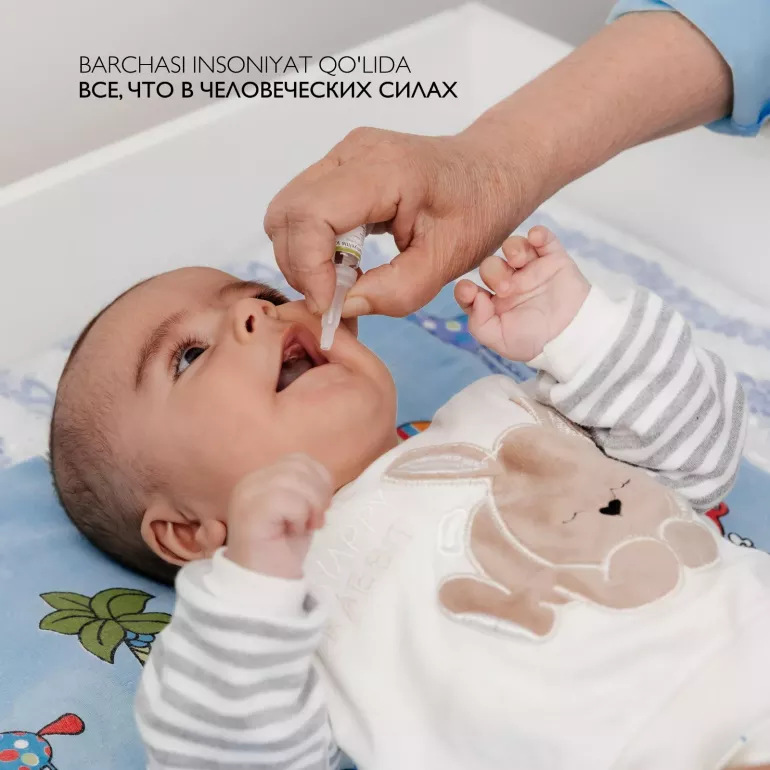
24 April 2024 | Geneva / New York / Seattle /Tashkent – A major landmark study in be published by The Lancet reveals that global immunization efforts have saved an estimated 154 million lives – or the equivalent of 6 lives every minute of every year – over the past 50 years. The vast majority of lives saved – 101 million – were those of infants.
The study shows that immunization is the single greatest contribution of any health intervention to ensuring babies not only see their first birthdays but continue leading healthy lives into adulthood.
Over the past 50 years, vaccination against 14 diseases (diphtheria, Haemophilus influenzae type B, hepatitis B, Japanese encephalitis, measles, meningitis A, pertussis, invasive pneumococcal disease, polio, rotavirus, rubella, tetanus, tuberculosis, and yellow fever) has contributed to reducing infant deaths by 40% globally.
As the result of vaccination against polio more than 20 million people are able to walk today who would otherwise have been paralysed, and the world is on the verge of eradicating polio, once and for all.
These gains in childhood survival highlight the importance of protecting immunization progress in every country of the world and accelerating efforts to reach the 67 million children who missed out on one or more vaccines during the pandemic years.
The study highlights that fewer than 5% of infants globally had access to routine immunization when EPI was launched. Today, 84% of infants are protected with 3 doses of the vaccine against diphtheria, tetanus and pertussis (DTP) – the global marker for immunization coverage.
In Uzbekistan, UNICEF's technical assistance, in collaboration with Gavi, WHO and USAID, significantly improved immunization services and infrastructure, benefiting three and a half million children through the National Immunization Programme. This includes ensuring a steady supply of safe vaccines, allowing 950,000 children to receive three doses of the diphtheria, tetanus and pertussis (DPT) vaccine annually.
In 2023, UNICEF facilitated the procurement of 28.1 million routine immunisation doses and ten million COVID-19 vaccine doses through the COVAX facility. The Ministry of Health (MOH) reports 96 per cent coverage with routine vaccines and 54.1 per cent completion of the COVID-19 primary vaccination series. Additionally, 47.3 per cent of the population (16.1 million people) received a booster, with no vaccine stockouts reported.
To increase immunization coverage, UNICEF, as one of the largest buyers of vaccines in the world, procures more than 2 billion doses every year on behalf of countries and partners for reaching almost half of the world’s children. It also works to distribute vaccines to the last mile, ensuring that even remote and underserved communities have access to immunization services.
“Thanks to vaccinations, more children now survive and thrive past their fifth birthday than at any other point in history,” said UNICEF Executive Director Catherine Russell. “This massive achievement is a credit to the collective efforts of governments, partners, scientists, healthcare workers, civil society, volunteers and parents themselves, all pulling in the same direction of keeping children safe from deadly diseases. We must build on the momentum and ensure that every child, everywhere, has access to life-saving immunizations.”
UNICEF's support in Uzbekistan improved the efficiency of the immunization program, enhancing vaccine storage and distribution. This included strengthening cold chain infrastructure, conducting temperature mapping assessments in all vaccine warehouses, and deploying a Remote Temperature Monitoring System (RTMS) in all 221 vaccine warehouses. RTMS enables real-time monitoring and timely intervention to maintain optimal storage conditions.
Further, UNICEF supports Uzbekistan with digital technologies, which are leveraged to strengthen the immunization system and supply chain. UNICEF developed and implemented the Electronic Immunization Registry (EIR), ensuring interoperability with other systems. Eight thousand vaccination staff received training on EIR operation and computer literacy skills, supported by the procurement of 3,000 tablet PCs. This initiative aims to provide citizens with online access to their immunization records through a one-stop web portal in 2024.
“The story of immunization in Uzbekistan is a story of human triumph,” said Geoffrey Ijumba, Deputy Representative, UNICEF Uzbekistan. "From the mothers, the patronage nurses, the mobile vaccinators and the warehouse managers and drivers, truly showing what is humanely possible.”
Globally, including in Uzbekistan, immunization programmes, have shown what is humanly possible when many stakeholders, including heads of state, regional and global health agencies, scientists, charities, aid agencies, businesses, and communities work together.
Today, WHO, UNICEF, Gavi, and BMGF are unveiling “Humanly Possible”, a joint campaign, marking the annual World Immunization Week, 24-30 April 2024. The worldwide communication campaign calls on world leaders to advocate, support and fund vaccines and the immunization programmes that deliver these lifesaving products – reaffirming their commitment to public health, while celebrating one of humanity’s greatest achievements.
The next 50 years of EPI will require not only reaching the children missing out on vaccines, but protecting grandparents from influenza, mothers from tetanus, adolescents from HPV and everyone from TB, and many other infectious diseases.
****
Notes to editors
Read the study, Contribution of vaccination to improved child survival: modelling 50 years of the Expanded Programme on Immunization, accepted for publication in The Lancet on 22 April 2024.
For more information on WHO World Immunization Week 2024 campaign, visit World Immunization Week 2024 (who.int) and Humanly Possible campaign, http://itshumanlypossible.org
Access photos and broll on immunization here.
Media contacts
WHO Media Team: [email protected]
Sara Alhattab, UNICEF New York, Tel: +1 917 957 6536, [email protected]
Meg Sharafudeen, Gavi, [email protected] +41 79 711 5554
Cirũ Kariũki, Gavi, [email protected] +41 79 913 9441
The Bill & Melinda Gates Foundation: [email protected]
Media contacts
О ЮНИСЕФ
ЮНИСЕФ работает в некоторых из самых сложных мест в мире, чтобы помочь самым обездоленным детям. В 190 странах и территориях мы работаем для каждого ребенка, везде, чтобы построить лучший мир для всех.
Для получения дополнительной информации о ЮНИСЕФ и его работе в Узбекистане, посетите www.unicef.uz.
Следите за ЮНИСЕФ на Twitter | Facebook | Instagram


