Women and girls spearhead hope and change in Ukraine
As the world marks International Women’s Day 2023, we look at some of the women and girls contributing to a better tomorrow in Ukraine.

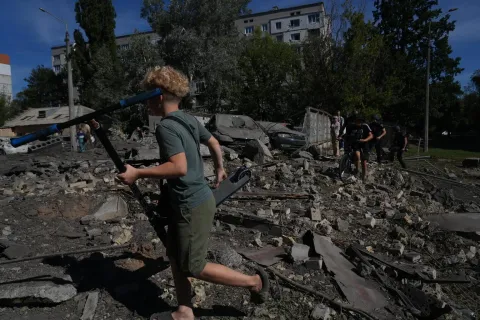
Women and girls are among the most vulnerable and affected by the war in Ukraine, with millions uprooted from home and thousands injured and killed. But they are also the backbone of its recovery.
Despite the devastation and violence, many have played a pivotal role, stepping up to take care of families and neighbours, travelling long distances to bring children to safety and working tirelessly under shelling as doctors, nurses, teachers, caregivers and social workers. Their unwavering courage, resilience and determination has been a source of strength for millions across Ukraine.
Through it all, UNICEF and partners have been by their side, shoring up families and communities, and offering a sense of security at a time when many have been at their most vulnerable.
To mark International Women’s Day 2022, meet some of the extraordinary women and girls in Ukraine who are helping to safeguard tomorrow.

For months, psychologist Olga Stegura has been a familiar face at Uzhgorod railway station. But she is not waiting for a train. She is here to help the scores of Ukrainians who arrive every day after fleeing the war at home.
"My colleagues and I started as soon as the war began,” she says. “We are a group of specialists: a social worker, a lawyer, a physician and a psychologist. Our duty is to give support. I dedicate my whole life to people.”

Olga is part of a multidisciplinary mobile team put together by UNICEF, together with the Ukrainian Public Health Foundation. These teams work to help displaced Ukrainians at reception points across the country, offering specialist expertise and advice to the thousands who need it.

Tetiana Hatsenko from Sloviansk has also been working to help families and children displaced by the war, starting out by distributing humanitarian aid in Sloviansk.
“I couldn’t just stay home,” says the 23-year-old rehabilitation specialist. “So I got myself together and went to the train station. There were a lot of people there. As I think back, I can still hear the terrible screams and cries of children. We provided temporary housing, and fed and clothed those who arrived in Sloviansk.”

Now, along with a team from the Teplytsia NGO and the support of UNICEF, Tetiana and her fellow volunteers organise leisure activities for children in Lviv.

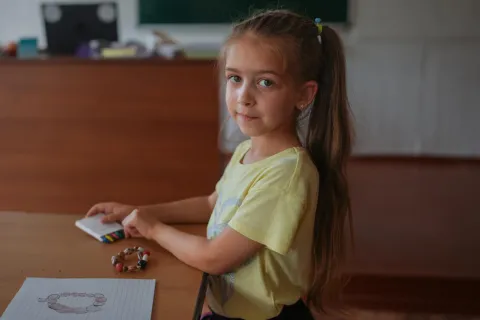
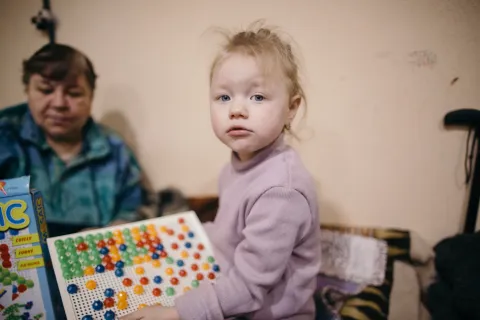
Ukraine’s children are particularly vulnerable to the violence. Many bear invisible scars and trauma that can take a lifetime to heal. However, women all over the country are striving to help.
Yaroslava, a ballet teacher from Kyiv, runs dance lessons for children via Zoom. Her students dial in from all over Ukraine and beyond.
“They dance, prepare for performances, choose costumes,” she says. “When we hold classes, it seems to confirm to the children that everything is fine, life goes on.”
Natalia Strunenko is a paediatrician who works with one of UNICEF’s multidisciplinary teams. She travels daily to villages in the Donetska region to provide children and adults with medical care. She has seen the impact of the war first-hand.
"The stress we are all experiencing now negatively affects children’s health,” she explains. “The immunity of each child decreases, which can lead to an exacerbation of chronic diseases.”

Her colleague and psychologist Svitlana Todovchych knows how critical the work they do is for children and their families.
“As soon as I got an invitation from UNICEF, I joined the mobile team,” she says. “I believe it's a really important job. We visit places where displaced people are living to listen to their worries, support them, and show them how to overcome all those feelings and find a way to continue living."

“As soon as I got an invitation from UNICEF, I joined the mobile team,” she says. “I believe it's a really important job. We visit places where displaced people are living to listen to their worries, support them, and show them how to overcome all those feelings and find a way to continue living."

The war is also impacting newborns and their mothers. In Kharkiv, one hospital has become a lifeline for thousands of women and children, offering refuge at the height of the violence when many had nowhere else to go. Recently, UNICEF supplied obstetric kits and a mobile intensive care unit.
"Since the war started, there is no neonatal resuscitation in Kharkiv anymore,” says Iryna Kondratova, head of the Kharkiv Perinatal Center. “So this mobile ICU is really needed, as it helps children quickly – for example, with surgeries. We have to transport children to surgeons and we need to do it as quickly as possible.”

Supplies like these are particularly important because many health facilities in Ukraine have been destroyed.
"Sometimes, there are missiles flying above us, sometimes we hear explosions, sometimes there are air raid sirens, and this all when there are surgeries or childbirth are going on,” says Iryna. “But we stay here and continue working.”


Young women and girls, too, have been helping Ukraine find its feet again. Ella helps to run free creative classes for children, with the support of UNICEF.
“You know, the children we work with are very strong,” she says. “I see how they hold up, sometimes even better than adults. They support their parents when they get discouraged.”

Budding psychologist Nastia Zholdak chats online to people affected by the violence, pairing them with organisations that help with their needs.
“On the second day of the war, I was messaged by a girl who wanted to leave a village that was under threat of occupation,” recalls the 16-year-old. “However, she had no fuel. I published her request and in 30 minutes, I received a message that she was helped and she left. She is safe now.”

And it is not just humans that these young women help – Daryna Kruk, who is 18, feeds and finds new homes for stray animals in Kharkiv.
"Even when I was safe with my dog, I thought about how many abandoned animals remained in Kharkiv,” she says. “I save those who were abandoned during the war and that helps me keep going.”

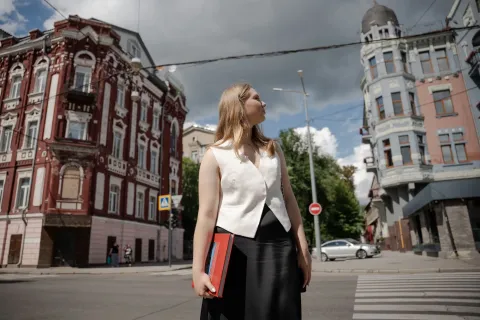
But it is perhaps 16-year-old Solomia, a volunteer in Lviv helping to greet and assist the displaced, who has learned the most powerful lesson of all.
“You don’t have to be a politician to change the world,” she says. “Maybe I can become a good journalist. For now, I’m here.”