Team of youngsters use drones to boost water quality
A team of young people taking part in the UPSHIFT programme have used drones to create a mini-laboratory for water monitoring and spreading fertilizer

- Українська
- English
Sixteen-year-old Zhenia, from the city of Novoukrainka in Ukraine’s Kirovohrad region, has loved fishing since he was a small boy. But recently he noticed that many of the fish in his local river were suffering due to poor water quality.
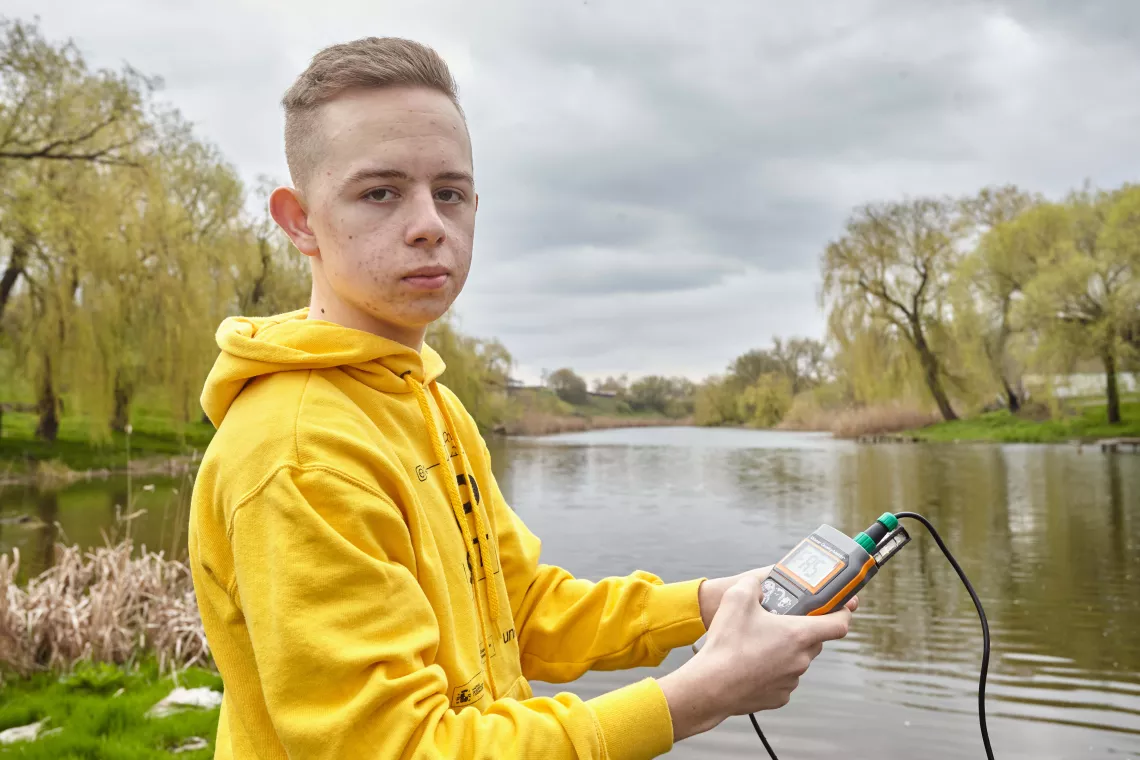
"I caught a lot of fish, but they were sick. And this is all because a lot of blue-green prokaryotes develop in the water. As a result of water bloom, there is waterlogging, siltation and increased acidity. The fish lack oxygen and die."
Now, together with his friends, Zhenia is determined to improve matters by taking part in the UPSHIFT programme supported by the United Nations Children’s Fund (UNICEF), which aims to empower young people to create change in their local communities.
His ‘Power Electronics’ team has created two floating drones for cleaning bodies of water. One is a mini-laboratory, which monitors the oxygen, acidity and transparency of the water. Another drone will deliver organic fertilizers to improve its condition.

“The drones can prevent water blooms and improve water quality in general,” says Zhenia. “We need the support of the entire community, because people often pollute the water reservoirs. For example, they throw garbage, pour out chemicals and waste there.”
The drones can be controlled by just one person and capture several indicators at once. This means that water monitoring is quick and requires minimal human resources.

“We can take two drones, put them afloat, pull a net between them and let them swim across the water body collecting garbage”
The boys used a unique technology to create a frame for the devices, which can help environmental services and organisations to study the water. They also help to monitor the impact of hostilities on the environment.
UPSHIFT is a youth innovations programme implemented by the United Nations Children’s Fund (UNICEF). Participants have the opportunity to receive training according to the methodology based on Human Centered Design, receive funding and eventually turn their ideas into effective projects that bring benefits to communities.
The war in Ukraine in 2022 caused a number of serious humanitarian challenges across the country. As youth are one of the driving forces in communities, UNICEF engaged UPSHIFT participants to address these challenges. In 2022, 115 teams (464 young people aged 14-24) took part in the UPSHIFT programme and developed projects that reached over 27,000 beneficiaries.