Ukrainian families fear for future as winter bites
As winter approaches in Ukraine, displaced families in Borodianka fear for the future

- Українська
- English
"The only thing I'm thinking about is surviving with the kids until spring," says Oksana, 43, sighing as she gazes at the small metal train carriage that is her new home.
This local modular town for internally displaced people (IDPs) in Borodianka in the Kyiv region is nothing like the home and community she and her children left behind, but Oksana is nevertheless grateful for it as winter approaches. Like many displaced families in Ukraine, they have little money for warm clothes, heating or rent.
And here, at least, they have escaped the worst of the war.

“We couldn't stay in our home city”
Oksana, her eight-year-old son Sasha and 13-year-old daughter Kateryna will share two bunk beds, a desk and a chair.
"For sure, my children aren't having the life they used to have back at home before the war,” says Oksana, sadly. “But we couldn't stay in our home city anymore as it became dangerous. I was afraid to let my children out of the house unaccompanied.”
When access to food, medicine and education dwindled, Oksana knew they had to leave.


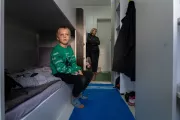
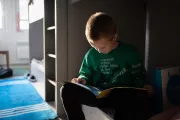

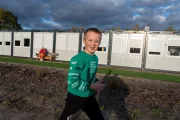
They fled with just a few belongings. Now, as temperatures begin to plummet, Oksana and her children do not even have warm clothes.
"There are outages every day, our carriage gets cold really quick,” she says. “I'm afraid of the upcoming winter. My son has the only pair of winter boots. If he gets them wet in the rain, I won't even have a place to dry them. And he doesn't have another pair to change."
Oksana was working as a nurse at the school in Borodianka, but has since lost her job, as many Ukrainian educational facilities have turned to distance learning. The village itself is still recovering from devastating airstrikes that destroyed 350 private residential buildings, 700 apartments, and important infrastructure facilities earlier this year.
“We are extremely sparing, even with food,” says Oksana. “My son is always stuck inside, he lacks communication and friends. After all, I don't even have money to buy him a sports uniform for attending the football team.”
Sasha dreams of riding a bicycle or a scooter, but his biggest dream is to return home, where his friends and relatives still live.
"Back at home, I have 15 friends, and we had a lot of fun together,” says the youngster. “We used to build forts every day. But once, while at the playground, I saw three missiles flying above me. I got scared and we ran home. It was the last time I played outside with my friends.”
“I'm afraid it will be tough”
Oksana is grateful that the water supply in Borodianka is uninterrupted.
"Utility services are free for us, and it is a great support,” she says. “We have water all the time, it has never been cut off."


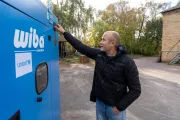
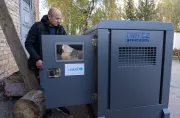

The water supply and sewage system in this modular town have been repaired by the local municipal enterprise. Chief engineer Oleksandr Tyshchenko is among those who worked hard to repair the damage amid shelling and risked his own life to return water to the people.
"At the beginning of the war, the power was cut off due to the shelling, so our pumping and sewage stations went offline,” says Oleksandr. “That means that people from all over Borodianka were left without water, while sewage wasn't discharged and filtered. We tried to solve the problem on our own by bringing water and connecting old generators.”
In September, the United Nations Children's Fund (UNICEF) purchased and distributed five new power generators to the Borodianka Heat and Water Utility, which enabled the utility to continue providing water and disposing of sewage even in the absence of electricity.
"We have been constantly using these generators since the power was knocked out,” adds Oleksandr. “With the help of UNICEF, we can provide water supply for people in Borodianka and sixteen neighbour settlements. This helps to cover families with children, schools, kindergartens, hospitals, boarding institutions and the modular town. Without these generators, thousands of people would have been left without water.”
The modular town where Oksana and her children live is growing. Families with children keep coming here, fleeing the hostilities. To date, around 300 people live in these metal houses, and it is estimated that there will be around 500 residents this winter.
"All I'm hoping for is our city to be liberated, the war to end and us to go back home,” says Oksana. “But until then, we will try to survive the upcoming winter. I'm afraid it will be tough.”
UNICEF is working with the government and its partners to expand programmes to save the lives of children and their families in Ukraine this winter. To support vulnerable children through the cold temperatures, UNICEF will provide humanitarian assistance, services and cash transfers to families. Winterization support includes clothing, boots and blankets, and the programme also aims to provide cash assistance to around 30,000 families in difficult circumstances. Schools and children's hospitals will be provided with generators and heating equipment.
"Access to health services and water are among the basic rights of children, so the critical infrastructure must be restored as soon as possible,” says Murat Sahin, UNICEF Representative in Ukraine. “We are ready to deliver all the necessary supplies to meet these needs.”
UNICEF would like to express its gratitude to the USAID Bureau of Humanitarian Assistance for the contribution and support they provide to the people of Ukraine.