Ukraine’s children return home to find future on hold
War has upturned the lives of children in the ruined village of Buzova, where schools and homes have been destroyed.

- Українська
- English
Before the war, Buzova’s school was one of the best in the Kyiv region. Around 500 children came here from five surrounding villages to learn, make friends and build their futures. Today, months after war broke out across Ukraine, the school is an empty shell.


"When I arrived, I wanted very much to go into the school and see what was here," says eight-year-old Anya, who had been looking forward to third grade. “I wanted to see my class, but my dad wouldn't let me go into the school because it was all smashed up."
Buzova’s school was shelled by tanks and rockets a total of 14 times. Nearby houses were also damaged, and many families with children fled Buzova as a result.


Nine-year-old Margaryta's family lived in Buzova for six years. The fighting destroyed their flat, so Margaryta, her younger brother Tymofiy and their parents have nowhere to return to.
Everything is changing, everything is moving,” says Artem, Margaryta's father. “It is not clear what the future holds. We live out of our bags. We can't afford a normal life in any way."
Tears fill Artem’s eyes when he sees the bombed-out streets of Buzova on a visit to pick up Margaryta's documents, ready for a new school year. But this year, on 1 September, Margaryta will need to go to a new school in Kyiv and start her life all over again.


Eight-year-old friends Anya and Nastya were torn apart because of the war. Anya and her family hid in their basement before the heavy bombardment of Buzova began. Nastya and her family fled to Poland, where she really missed her friend and school classes.
"Peace is where there is tranquillity, no bombs, no planes flying over our heads," says Anya.
The children kept in touch and have since reunited in Ukraine, but still have no idea whether they will be able to continue their studies together.
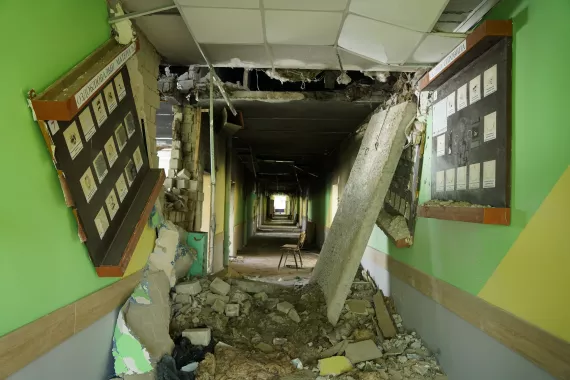


Many children who attended the school in Buzova have the same question. Public transport is limited here so, even if the school can be rebuilt, students who have found safety elsewhere will struggle to return.
Every school should be a protected space for students to learn and fulfil their potential, even during the war. Getting back to school is one of UNICEF’s priorities because learning gives children a sense of stability, as well as the tools they need to learn and improve their physical, nutritional health and social-emotional development.
To support the continuity of the learning process and the well-being of children, UNICEF has introduced the Back to Learning National campaign. We thank all partners for their contributions, especially the European Union, that allow to rebuild 73 schools and bomb shelters, distribute 1,000 activity packages for school bomb shelters, and provide 5,060 laptops for teachers, as part of the project.