Training for teachers helps strengthen gender equality in schools
UNICEF and partners are helping teachers in Ukraine to ensure that schools are free from gender-based stereotypes.

- Українська
- English
For several years, headteacher Dariia Poltavska has worked to eliminate gender-negative stereotypes and discrimination at her school in Myrhorod, where children study from preschool to ninth grade. She says it is crucial to address issues of gender equality and diversity at an early age.
"An upbringing free of gender stereotypes forms a society where the opportunities and conditions for discrimination vanish,” says Dariia.

“The world is changing, and many views or firm ideas about women’s and men’s behaviour are changing as well. This is why educators and those involved in child upbringing must also move forward.”
The United Nations Children’s Fund (UNICEF) is assisting Dariia, and thousands of other teachers like her, as well as parents, caregivers and specialists working with children and families, to embrace the concept of raising children without gender stereotypes. Recently, Dariia participated in a specialized training session held in Poltava, learning about gender equality and how to share her new knowledge with colleagues.
She also received a number of helpful manuals – a handbook for specialists called "Parenting without Gender Stereotypes", a handbook for training facilitators called "Parenting without Gender Stereotypes" and a booklet for children aged 3 to 5 called "Overcoming Stereotypes", produced by UNICEF in partnership with the Divchata NGO and the Gender Culture Center.
Teachers in Myrhorod now better understand the importance of allowing children to fully explore their potential without restrictive gender norms. For example, they ensure that children do not believe only men can be drivers or only women can be nurses.


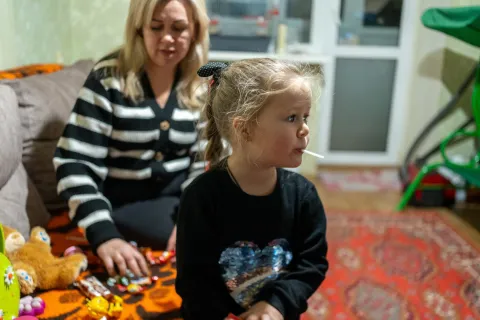
The teachers also strive to avoid imposing stereotypes on children. They encourage girls and boys to play with any toys they like and to wear any colour of clothing.
Recently, ‘girl’ and ‘boy’ symbols on the children's lockers were replaced with the children’s portraits. Teachers believe this promotes an appreciation of diversity, a child's personal space and highlights their individuality.
"A child develops best in free play, when she or he is independent and has a choice. It's important for the educator not to interfere, not to tell the girl: ‘No, don't take the construction set, it's for boys’. In a play, for example, a child should always have the choice of which role to play – whether rabbit, wolf or grandmother.”

"Children need to understand from an early age that we are all different, but we are all equal. Everyone can make their own choices and feel comfortable, now and in the future.”
The teachers understand how stereotypes can impact children’s mental health.
"During the full-scale war, it's crucial to be attentive to a child's emotions and not say something like ‘boys don't cry’,” explains Dariia. “Every child has their own way of overcoming stress, and tears are a normal emotional reaction for an individual. Moreover, during the war, children see that a woman can not only take care of her family, but also be in the military or work as a police officer.”
Dariia says that most parents are supportive of the school’s gender equality initiative. This is crucial as children spend a significant amount of time at home, and they bring with them to school the values and beliefs they encounter within their families.


"Parents are integral members of society and may also hold certain stereotypes, so it's important for us to work with them,” says Dariia. “When parents and educators share the same mindset, it makes our work much easier.”
From 2023 to 2024, UNICEF, in partnership with Divchata and the Gender Culture Center, and with the financial support of the Spanish Government, prepared seven manuals on growing up without gender stereotypes for professionals of different profiles, parents and caregivers, as well as children of all ages. In addition, 13 three-hour webinars and 14 three-day training sessions were held for scores of professionals, parents and caregivers.