

Having a child changes life very differently for women and for men. That much is undeniable. Pregnancy and childbirth, temporary loss of capacity to work, round-the-clock care, exhaustion, broken sleep, and the isolation that comes from cities simply not being built with children in mind. Many mothers describe the first three years of a child’s life as a genuinely hard stretch. And although Ukrainian law allows fathers to take childcare leave too, in the vast majority of cases it is women who take it. In wartime, with so many men defending the country, many families have no other option at all.
What we often forget, though, is that the impact of motherhood and fatherhood on social life and careers doesn’t end when a child turns three. It reaches into every area of life.
Only 13% of mothers with children under three are in paid work, compared with 95% of fathers. As children grow older, the gap narrows somewhat: 54% of mothers of children aged 3–6 are working, while the figure for fathers barely moves, at 94%.
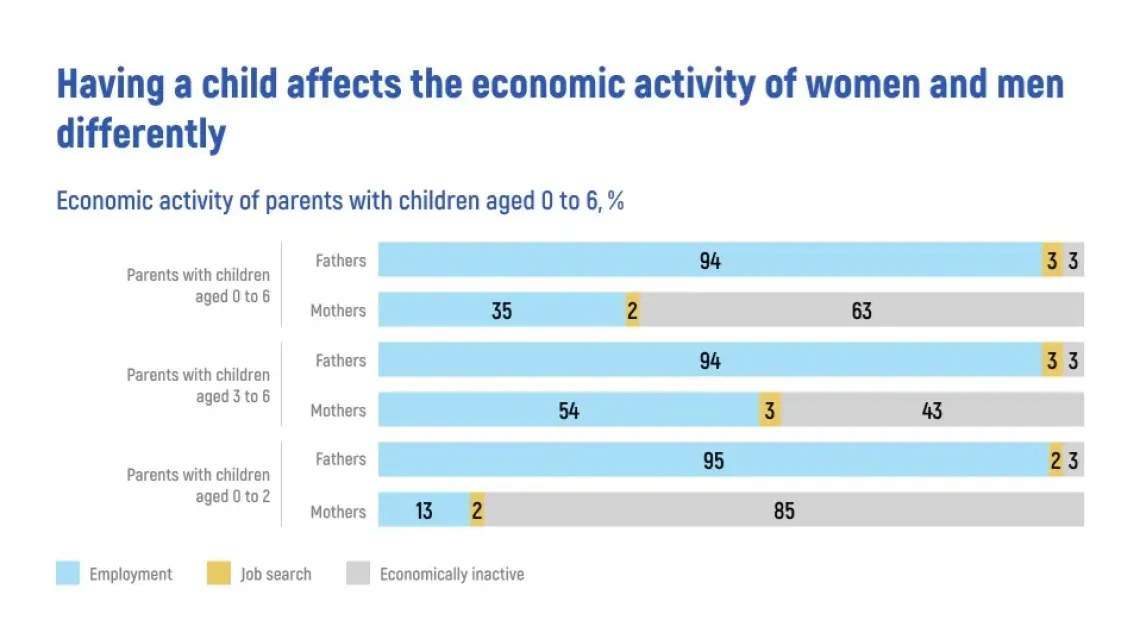
These figures come from the national study Access to Early Childhood Education and Care and Women’s Economic Empowerment in Ukraine, conducted by the Ukrainian Centre for Social Reforms for UNICEF in partnership with the International Labour Organization. The study surveyed more than 3,600 parents and caregivers of children under seven across all government-controlled regions of Ukraine and complemented the survey data with focus groups and in-depth interviews.
So why is the employment gap so wide? Is it a shortage of kindergartens? Employers’ reluctance to hire mothers? The fact that Ukrainian society has traditionally seen childcare as “women’s work”? Or all of these at once?
The study’s answer: all of these factors are at work at the same time. That is exactly why no single solution, whether more kindergartens, flexible working arrangements, or getting fathers more involved in care, can close the gap on its own. But it also means we can make progress on several fronts at once.
It’s not that women don’t want to work
Almost two-thirds of mothers with children under seven are economically inactive, meaning they are neither working nor looking for work. On its own, though, that figure explains very little.
Among economically inactive mothers, 28% say they would like to work but haven’t yet started looking. And among those who do actively look for a job, only around 5% remain unemployed. Across all mothers of young children, that comes to roughly 2%.
In other words, the overwhelming majority of mothers who actively look for work find it. The employment gap has almost nothing to do with a lack of education, skills, or motivation. The barrier appears much earlier, at the point where a woman is still deciding whether returning to work is even a realistic option for her.
Before she can make that decision, she has to solve a whole series of problems first: who will look after the child; whether the family can afford a nanny; how to get a place in a kindergarten; and how to find working hours that fit around the kindergarten’s schedule.
Then come the follow-up questions. What happens when the child gets sick? Will she be able to leave work early? Will her salary even cover the new childcare costs?
Only once all of that is settled does she get to the question of where to look for work, and what kind.

The researchers identify two patterns of economic inactivity. The first is involuntary: the woman wants to work but lacks the conditions and support she needs. The second is chosen: given her social and economic circumstances, staying home with her child seems the most rational or realistic option. But even this “chosen” path doesn’t exist in a vacuum. It is shaped by the availability of early childhood education and care (ECEC), her potential earnings, how involved her partner and family are, and society’s expectations of what a “good mother” looks like.
Meanwhile, 87% of economically inactive mothers want to return to work at some point, and 64% want to do so before their child turns seven.
Families’ financial vulnerability makes things even harder. Wages account for around 72% of income in households with young children, compared with 54% in households without children. Only 1% of families with small children have enough savings to last a year, 15% have savings that would last less than a month, and almost one in five families is in debt. Under these conditions, a mother leaving the labour market is a direct threat to the family budget.
To address this, the state and local communities should combine cash assistance with direct investment in nurseries and kindergartens, since payments alone, without accessible infrastructure, keep women out of the labour market. An important step would be to expand and simplify financial compensation, including through the Municipal Nanny, eNursery (єЯсла) and eKindergarten (єСадок) programmes, and to introduce vouchers to help cover childcare costs. It is also essential to create a single, clear information platform covering all forms of state, municipal, and employer support, because many parents simply don’t know what they are entitled to.
Even when mothers work, their jobs have to fit around their children
Inequality isn’t only about whether a woman works. It also shapes how she is able to work.
Among working mothers of children under three, 33% are self-employed or freelance. Among mothers of children aged 3–6, the figure is 18%. Here, self-employment is often less about entrepreneurial ambition and more about gaining at least some control over one’s own schedule.
Working hours tell the same story. A large share (40%) of mothers with children under three work fewer than four hours a day. Once the child is 3–6, that drops to just 9%, and almost three-quarters of mothers are able to work a standard five- to eight-hour day.
Part-time work, freelancing, and working from home are often presented as signs of a free and flexible modern labour market. For the mother of a young child, however, they are often a forced compromise. It’s not “I chose to work four hours a day,” but “four hours is the most I can manage.”
Over time, this leads to what is known as the “motherhood penalty”: lower income, slower career progression, and fewer chances of reaching management or entering well-paid sectors.
The average monthly income of mothers with children under seven is around UAH 13,700, compared with around UAH 25,000 for fathers. Men are twice as likely to hold management positions. According to the survey, 61% of women believe bias against hiring mothers of young children is widespread. And among mothers of children aged 3–6 who were turned down for a job, 74% say the employer explicitly cited their young child as the reason.

For men, the opposite often applies: the so-called “fatherhood bonus.” Employers tend to see fathers, often without realising it, as more stable, responsible, and motivated employees.
One employer interviewed by the researchers put it bluntly: a woman with a young child is seen as a risk, because she’ll supposedly be constantly distracted by the child. A man with a child is the reverse: he has to provide for his family, so he’ll work all the harder.
The same fact, having a child, counts against a woman and in a man’s favour.
Tackling this inequality requires joint action by government and business. In law, parents of children under seven should have a guaranteed right to request flexible working, with employers obliged to consider such requests. Companies, for their part, should train HR staff and managers to recognise and overcome bias in hiring. It also makes business sense to introduce return-to-work and mentoring programmes after parental leave: keeping an experienced professional is far cheaper than recruiting and training someone new.
“Someone has to stay home with the baby,” and that someone is usually mum
Another key factor is how care is shared within the family, when the father is not serving in the military.
In 99% of cases, childcare leave is taken by women. Men account for less than 1%.
Only 46% of men surveyed consider childcare their direct responsibility. Among those who are less involved, 54% say the main reason is the need to provide for the family financially. Another 21% say they aren’t ready to change the usual way of doing things, and 15% believe childcare is purely a woman’s job.

In practice, a father may do the grocery shopping, fix things around the house, drive the child to appointments, or play with them, but ultimate responsibility for the household, meals, health, and the child’s day-to-day logistics still rests mainly with the mother.
Care work involves a huge amount of invisible mental load. It’s not just physically spending a couple of hours with a child. It’s remembering vaccinations, buying what’s needed, keeping track of schedules, booking appointments with the paediatrician, filling in kindergarten paperwork, sorting out who picks the child up on Tuesday because you have a meeting, and always having a plan B in case the child gets sick.
When all this organisational work falls on the woman by default, it’s her career that becomes the easiest to cut back, put on hold, or reshape.
To encourage fathers to take a bigger part in childcare, concrete institutional incentives are needed. First and foremost, the law should reserve a portion of childcare leave specifically for fathers on a “use it or lose it” basis, as has worked successfully in Sweden and Spain. This leave needs to be well paid and linked to earnings, not a token sum; otherwise, it simply makes no financial sense for families to have the father take it. At the same time, employers need to support fathers who take on caring roles, so that it becomes a normal choice rather than a curiosity.
But what if everyone is happy with the way things are?
There is one more figure that may seem surprising at first.
A large share (77%) of women who carry the main responsibility for childcare say they are comfortable with this division of roles. Similarly, 86% of mothers of children under seven are comfortable with a model in which the man is the main breadwinner.
That looks like a paradox. If women are happy with this model and want to live this way, where’s the problem? But social norms rarely work as direct orders. More often, they create a choice that isn’t really a choice.
Nobody necessarily says to a woman’s face, “You’re a woman, so you should stay home.” It usually happens quietly, through arguments that seem obvious. He earns more, so it makes sense for him to keep working. She’s already been on maternity leave, so it seems logical for her to stay home with the baby. She knows the routine, the schedule, all the little details better. He has a “real, important job,” while she just has more flexible hours. This is how everyday stereotypes quietly shape our decisions.

Each individual decision may look perfectly rational. Together, though, they produce a very predictable result: the man’s career carries on, while the woman’s starts to bend around the family.
Most non-working mothers of infants (69%) say that one of the main reasons they aren’t looking for work is the belief that they should devote themselves entirely to their child. Among mothers of children aged 3–6, the figure is 47%.
More than half of the men surveyed believe a woman shouldn’t work outside the home while her children are small, and 18% are directly opposed to their partner having a paid job.
And even when a couple genuinely wants to live differently, there’s still the wider circle of family and friends. One study participant described how, even as she and her husband try to build a different kind of family life, their relatives look on disapprovingly. This often means a lack of support, no one to leave the child with even for a short time, criticism of the mother for working, and so on.
That said, the study also points to a positive trend: more parents are ready to share care more equally than was previously assumed. The gap isn’t about an unwillingness to change; it’s about the lack of infrastructure that would make those changes possible.
Laws and kindergartens alone can’t change social attitudes. That takes open conversation and real-life examples. First, people need to see concrete stories: fathers on childcare leave, family-friendly companies, and communities that help with childcare. Seeing it in practice works better than any appeal. Second, local support spaces matter, such as childcare cooperatives or parents’ groups, where sharing responsibilities equally is the norm rather than the exception. Alongside this, trade unions should help parents understand their rights to flexible working and leave, because the decision to stay home is often made simply out of not knowing there are alternatives.
Add to that the kindergarten that doesn’t exist
Gender stereotypes are reinforced by a lack of infrastructure.
For children under three, early childhood education and care services in Ukraine are critically scarce. In 2024, of the 986,000 places in preschool institutions, only 152,000 were designated for children under three.

In cities, there is only one place for every seven children in this age group; in villages, one for every ten. Before the full-scale invasion, around 18% of children under three were covered by ECEC services.
Actual nursery attendance is even lower: only 2–4% of children under two attend. Once a child turns three, the picture changes sharply and preschool enrolment rises steeply.
Mothers’ employment mirrors this shift: 13% of women work when their child is under three, and 54% once the child is older than three.
This doesn’t mean that a kindergarten place automatically “sends women back to work,” but the link is clear: it at least gives women the possibility of working.
Of course, the call for parents to “share care equally” is a great one. But in real life, it isn’t always possible. Imagine a child not yet two years old, no nursery available, grandparents who could help living somewhere else, and both adults needing to work. The family still has to find someone whose time will go into childcare. And given how roles are currently divided, the most obvious candidate is still the mother.
The state needs to recognise early childhood education and care as a strategic part of the country’s economic infrastructure, not just a form of social assistance. Beyond expanding support programmes like eNursery and eKindergarten, alternative models should be developed, including family-based and workplace kindergartens. Local authorities should assess local needs and set up preschool groups in unused spaces in schools or community centres. In remote rural areas, mobile kindergartens with visiting educators on set days can be introduced, rather than waiting for a full-scale facility to open.
The war has made access to childcare even more unequal
The full-scale war has deepened the infrastructure crisis.
Some kindergartens have been damaged, destroyed, or closed, while others operated remotely or in a hybrid format for long periods due to a lack of bomb shelters. Recovery is under way: by early 2025, 565 kindergartens had been repaired and 293 shelters built or fitted out, though shelters are still in very short supply.
At the same time, internal displacement has created further imbalances. Frontline communities now have fewer children, while communities hosting large numbers of internally displaced people (IDPs) have seen pressure on their preschool infrastructure multiply.
As a result, the total number of kindergarten places in Ukraine doesn’t reflect real needs. A place only helps if it’s where a particular family actually lives. The kindergarten must operate in person and have a safe shelter. Its hours must allow parents to work. And it must be willing to accept a child of the right age.
For a child with a disability or special educational needs (SEN), accessible facilities and trained staff are also needed, and according to the study, this is the group that finds it hardest to access inclusive ECEC services.
Rebuilding kindergartens is a task not only for the state but also for international partners. The priority should be to build and restore facilities where the war has hit hardest and local budgets fall short. Safe shelters come first, because without them kindergartens simply cannot operate in person. At the same time, the most vulnerable families, including IDPs, single parents, and children with disabilities or SEN, should be supported by reserving places for them outside the general waiting list.
A good kindergarten is one you don’t have to rush to by four o’clock
Beyond everything already mentioned, there’s another important point about kindergartens: accessibility isn’t only about having a place.
Parents who use ECEC services generally rate them quite positively. What matters most to them is professional staff, the child’s safety and comfort, and being close to home. Ideally, a kindergarten would be open five days a week, with flexible hours that match parents’ working day.
And this is often where the problem lies. The standard working day in Ukraine, followed by most organisations, ends at 6 p.m. If a kindergarten closes at 4 or 5 p.m., it doesn’t solve the problem of parents’ employment.

This again forces families to adapt: find a job closer to home, ask for shorter hours, turn down a role that involves staying late, ask grandma to help, hire someone for two hours a day to pick the child up, or explain to the boss every single day why you need to leave early.
And if the family already assumes that the mother is responsible for the child, she’ll be the one solving this logistical puzzle.
Adapting kindergarten hours to parents’ actual needs is an effective step that doesn’t require major capital investment. Extended-day or evening groups make daily logistics much easier. Partnerships between cities and businesses are another promising option, with companies co-funding extra hours at nearby kindergartens. And flexible working should become the norm for fathers as well as mothers: a father being able to pick up the child on time takes a huge load off the mother.
“Mothers can work.” But then who does everything else?
It’s tempting to tackle mothers’ employment purely through the labour market: more remote work, flexible schedules, a few hours of work a day. All of these are certainly needed.
But flexibility can become a trap in its own right. If only women’s careers are expected to be flexible, it creates the risk of a “double shift.”
The man keeps working a standard day, while the woman does the same paid work, just squeezed in between feeds, trips to the clinic, and putting the child to bed.
The study’s data on rest shows this clearly. Women have only around 10% of their time available for rest, and 18% of mothers say they have no time to rest at all.
In other words, returning to work doesn’t in itself solve the problem. Sometimes it simply creates a second shift. Over time, the effects of this pressure also feed into gender stereotypes: between 30% and 35% of mothers of children under seven consider themselves less productive at work than colleagues without children.

To keep flexible working from becoming a trap, it must become a universal norm for both parents. At the same time, educators and nannies need decent pay and working conditions, because high-quality care is what allows mothers to work fully and also get some rest. Employers, for their part, need to respect employees’ personal time, which means no late meetings or expectations of unpaid overtime.
Kindergartens won’t abolish gender norms, but without them those norms are very hard to change
All of this might seem to lead to one conclusion: build more kindergartens with convenient hours, and the problem will disappear.
Unfortunately, it won’t.
If a family is convinced that a young child is better off only with their mother, having a nursery nearby doesn’t mean they’ll use it. If an employer believes that the mother of a young child will be less productive, a kindergarten place won’t remove that discrimination. If a man believes his only responsibility as a parent is to earn money, a kindergarten won’t make him take sick leave when the child is ill.
But the reverse is just as true.
You can spend years urging men to be more involved in childcare and women not to give up their careers, but if a family has no physical access to childcare, someone will still have to stay home.
So, fixing just one element isn’t enough. A shortage of services, gender norms, discrimination, inflexible workplaces, and financial barriers form an interconnected system. That’s exactly why the study makes recommendations for five different groups at once: national government, local authorities, employers, trade unions, and international partners, rather than for any one of them alone.
Early childhood education and care isn’t just a question of where a child spends the day.
It’s also a question of whose time in the family is considered more valuable, whose work is easier to put on hold, and whose salary is seen as the main one. Who has to be available when the child gets sick, and who turns down a promotion if the new job means longer hours.
A solid foundation for Ukraine’s future
For now, having a child still leaves mothers and fathers with very different options for the rest of their lives.
No single solution, whether new kindergartens, legislative changes, or awareness campaigns, can close this complex gender gap on its own. But together, they can have a powerful, transformative effect.
Ukrainian society today shows a remarkable readiness for change: parents’ demand for equal involvement in raising children and for economic fulfilment already exceeds the existing infrastructure. This means investment in care has strong public backing and can deliver results quickly.
Investing in early childhood education and care is not just social support. It is one of the most effective economic levers for Ukraine’s post-war recovery and European integration.
According to ILO estimates, every dollar invested in childcare policies and services could generate around USD 3.76 in global GDP by 2035 by narrowing gender gaps in employment and pay.

According to UNICEF calculations, expanding access to quality ECEC services would bring almost 350,000 parents, mostly mothers, back into the labour market by 2030. And according to the ILO’s Global Care Policy Investment Simulator, building a universal childcare system would create nearly 177,600 new jobs by 2030, both in the preschool sector itself and in related industries.
Building accessible preschool infrastructure, supporting shared parenting, and ensuring equal opportunities in the labour market are a direct path to stronger family budgets, economic growth, and the healthy development of Ukraine’s children. Ukraine has every opportunity to turn this challenge into a success story and build a fairer, more resilient, and more prosperous society.
This article draws on data from the national study Access to Early Childhood Education and Care and Women’s Economic Empowerment in Ukraine, conducted by the Ukrainian Centre for Social Reforms for the UNICEF Office in Ukraine in partnership with the International Labour Organization (ILO) in Ukraine, with financial support from the Government of Germany through the Federal Ministry for Economic Cooperation and Development (BMZ) and KfW Development Bank.