Teams of experts unite to support families in Ukraine
UNICEF’s mobile teams of medical experts, lawyers and social workers are helping families across Ukraine to cope with the ongoing war

- Українська
- English
Roving teams of medical experts, lawyers and social workers, put together by the United Nations Children’s Fund (UNICEF), are still hard at work in Ukraine – processing cash payments, providing psychological counselling to children who have lost their homes, distributing hygiene kits for babies or delivering supplies to families in remote villages.
The team in the Mykolaiv region are no exception, planning their days down to the minute. In recent weeks, following the destruction of the Kakhovka Hydroelectric Power Plant, their work in the south of the country has become more crucial than ever.

Roving teams of medical experts, lawyers and social workers, put together by the United Nations Children’s Fund (UNICEF), are still hard at work in Ukraine – processing cash payments, providing psychological counselling to children who have lost their homes, distributing hygiene kits for babies or delivering supplies to families in remote villages.
The team in the Mykolaiv region are no exception, planning their days down to the minute. In recent weeks, following the destruction of the Kakhovka Hydroelectric Power Plant, their work in the south of the country has become more crucial than ever.
Families fleeing from the shelling and the flood waters flock here. For parents, the Spilno Child Spot at the railway station is a place where they can find information, get help and have a rest, while for children it is a safe space for playing and communicating.

"In the first days after the reservoir spill, the affected families were confused and frustrated. Women with children arrived at train stations and didn't know what to do, what help to ask for and where to go next. They had experienced a lot of stress and lost everything. We are trying to help everyone."
“The flooding wasn't even the worst part”
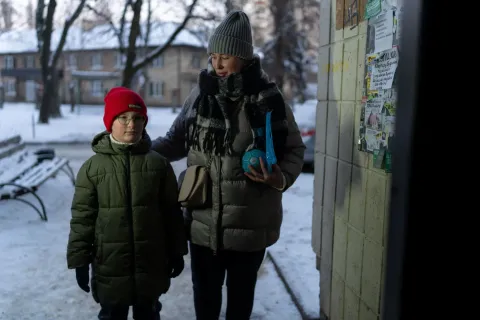
Today, 16-year-old Kyrylo is visiting the Spilno Child Spot together with his grandmother. They have arrived from Kherson, where their life turned into a disaster due to the war.
"Our house got flooded,” says 70-year-old Iryna, sadly. “But the flooding wasn't even the worst part, as there is no electricity, gas or drinking water. How is it possible to live like that? Moreover, the shelling has become worse lately."
While the team packs a hygiene kit for Iryna, a psychologist talks to Kyrylo.
"It was really difficult to study online, as sometimes there is no electricity and connection,” says the teenager. “And now I can't even call anybody because due to the flooding the electricity was cut off.”
As well as cash assistance and a hygiene kit, the pair are given a backpack containing items they may need for their journey home one day. Kyrylo is thrilled to discover a power bank inside, and immediately connects his phone to it so that he can text his family.
"Our life is very difficult now,” says Iryna. “I feel especially sorry for the children. My heart hurts for them and their lost childhood. The fact that children can play and talk here is great for them.”

Social worker Olesia says that after experiencing traumatic events, children need live communication as much as humanitarian assistance.
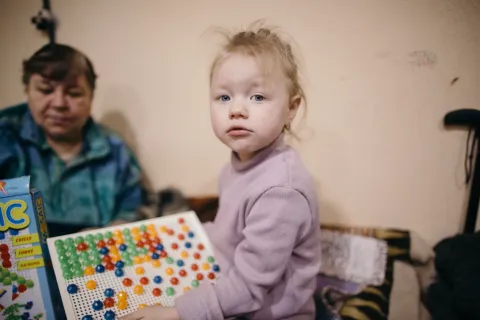
"Many children come to us at the Spilno Child Spot and say that their favourite toys sank,” says Olesia. “Sometimes they ask whether they can take any toy from here, so that they can take it with them on the road."
After saying goodbye to the many families they have helped today, Olesia and her colleague Kateryna prepare to leave the Spilno Child Spot, as they have received news that a large family with a newborn is waiting for help on the outskirts of Mykolaiv.

“Without help, I probably wouldn't have been able to cope”
The children run out to greet them when they arrive.
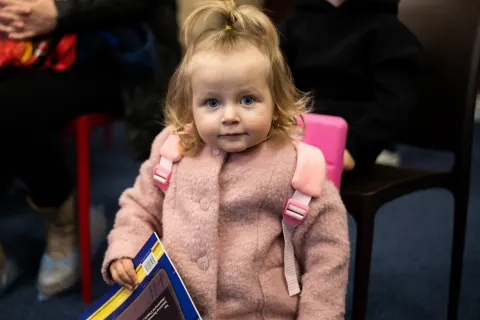
Anastasia, 33, has five children and, four months ago, gave birth to her youngest daughter, Mira (which translates as ‘peace’). The whole family chose the child's name.
"Having many children during the war is both a great joy and a very difficult thing,” says Anastasia. “Without help, I probably wouldn't have been able to cope either financially or emotionally."
Today, she receives a hygiene kit for the whole family, toys and stationery for her older children, and diapers for her younger daughter. UNICEF's mobile team will also visit the family from time to time so that the children can talk to a psychologist.

"I was really worried that the hostilities impacted children's mental health. Of course, I showed them by my own example that there was no need to panic, that everything would be fine, but it still affects the children."
While she was pregnant, her eldest children dug a large hole in the garden next to their house – an attempt to build a shelter from the shelling for their mother.
"They were worried about me, so they said this would be my bunker," she explains.
The family breeds rabbits and owns a goat. Anastasia believes that the animals have helped her children to cope with the stress of war.

"This summer, due to the spill of the reservoir in Nova Kakhovka, I can't send the children on vacation,” says the mother. “In my view, this is an environmental catastrophe. For children, recreation by the water would not be safe. So it's good that they have these animals and a garden."

The help from UNICEF’s mobile team is crucial for families like Anastasia’s, particularly since the explosion at the Kakhovka Hydroelectric Power Plant destroyed farms in the region, leading to a significant increase in the price of vegetables and fruits.

“This summer, it was significantly difficult to buy some food,” says Anastasia. “Before, I used to spend money so that, every month, I could buy something for the children, like clothes, to make them happy. Now there is a critical lack of money for this. That's why this assistance I received from UNICEF, both detergent and diapers, will really help me a lot because it will save us money.”