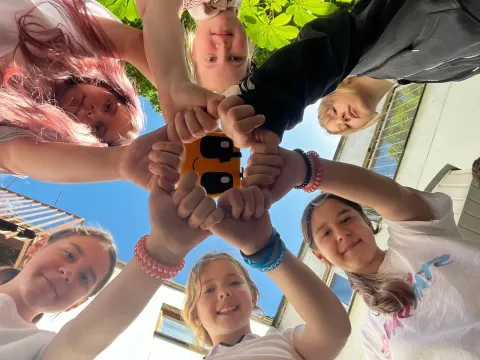
Poltava leading the way for child- and youth-driven recovery
Local youth – secondary school students Nastya and Misha – reveal how Poltava is responding to the needs of children, young people and families and transforming social services in the city.
- Українська
- English
Despite the ongoing war, children and young people in Poltava are striving to build a better future thanks to locally led efforts supported by UNICEF and the German Government through the German Government's Federal Ministry for Economic Cooperation and Development (BMZ) through the KfW Development Bank.
Local youth – secondary school students Nastya and Misha – reveal how Poltava is responding to the needs of children, young people and families and transforming social services in the city.
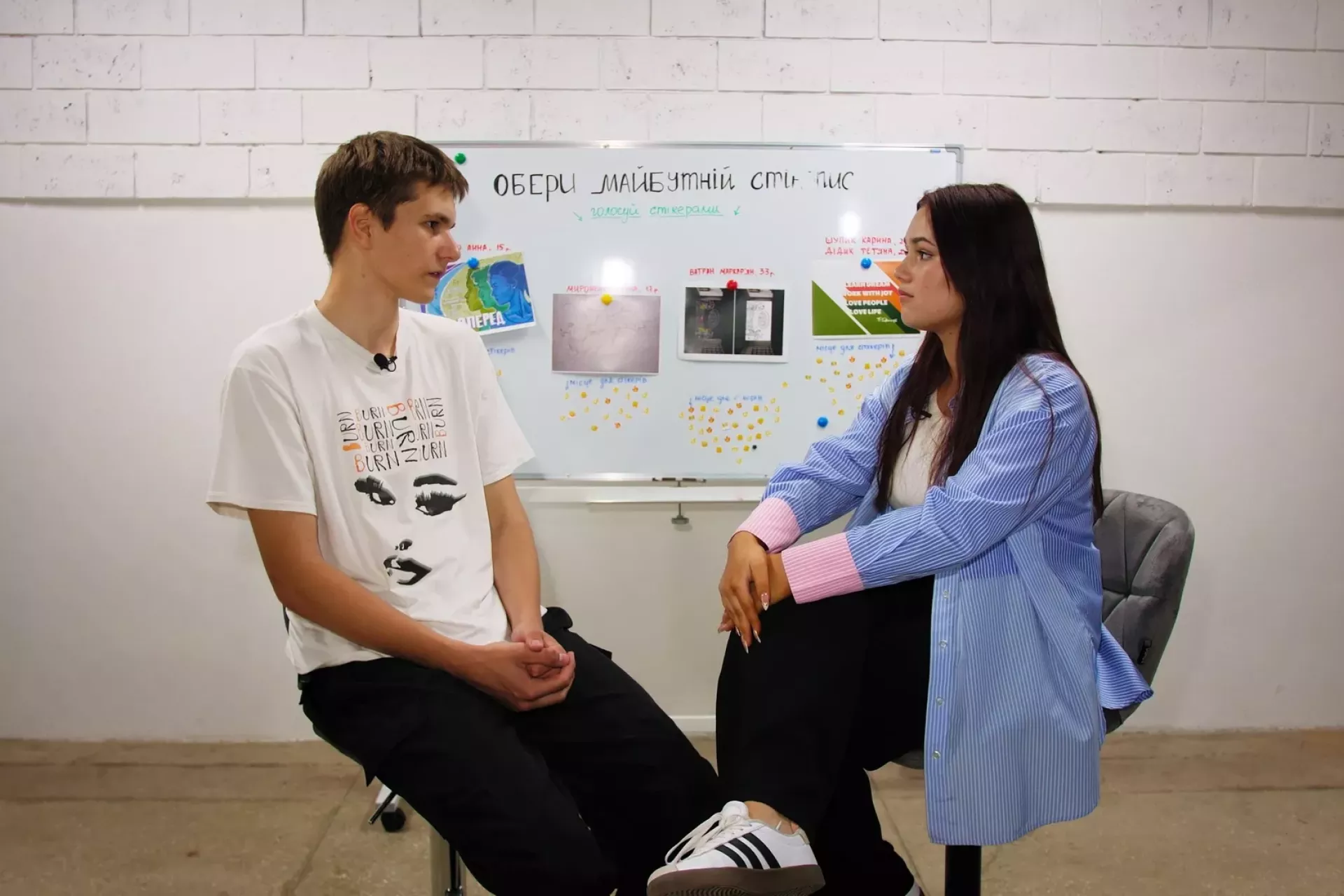
In this video series, they tour an early intervention centre, a youth career centre, a summer school session, a refurbished school shelter, and the city’s water utility. They speak with members of their community who are doing their part to help every child and young person fulfill their potential.
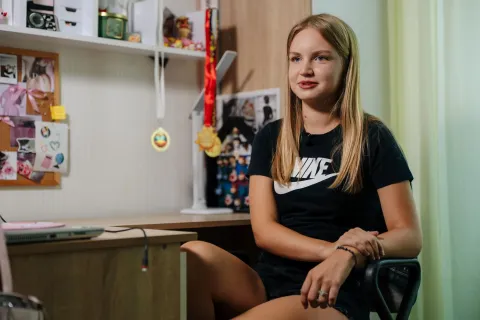
“I’ve just graduated from school. I’m passionate about languages and urban studies. I’m an intern at Poltava’s local government and I’m managing the social media accounts for the regional youth council,” says 17-year-old Nastya.
“Youth policy and public relations are what really drive me. My main goal now is to enter university and keep developing myself so I can do more meaningful and exciting things for the young people of Poltava.”
Joining Nastya is 16-year-old Misha, a participant in UNICEF’s UPSHIFT programme that is about empowering and skilling young people to be future entrepreneurs, CEOs and leaders. As part of the initiative, he and his teammates organised a series of street sports competitions in Poltava.
“When I was a kid, I could solve a Rubik’s Cube in just eight seconds. These days, I love filming videos and doing extreme bike flips,” Misha says. “I realised I could combine these skills and started promoting street culture and sports in Poltava! I also volunteer at the Career Centre, which helps young people explore their future professions.”
Poltava is one of 47 communities across Ukraine where recovery programmes, in partnership with UNICEF and supported by German Government through the German Government's Federal Ministry for Economic Cooperation and Development (BMZ) through the KfW Development Bank, are supercharging local development. The synergy between local authorities, children and young people, is already leading to visible results.
What exactly has been achieved? Let’s find out — together with Nastya and Misha.
Practical skills and guidance for youth career development
Together with Poltava’s youth ambassadors we visited the largest youth career centre in Ukraine. Opened in May 2025, the centre is fully inclusive, a welcoming space where youth, including those who are displaced, can socialize and build their friendships and community. Its location within a shelter also makes it safe for training sessions, meetings, and educational activities.
In this episode, we meet young people from Poltava who regularly attend events at the Youth Hub and Career Centre, and who have taken part in internships with the local government through the “Power of the Community: Youth in Action!” programme. We also join a focus group discussion held as part of the European Youth Capital 2025 project — a title extended to Poltava, Zaporizhzhia and Mykolaiv, alongside Lviv.
The acting mayor of Poltava, Kateryna Yamshchykova, also joined the focus group. “Young people have tremendous potential. It’s important that they are empowered and understand the mechanisms of how to bring their ideas to life. And the platforms for that already exist,” she said.
“Change begins with each of us, and there are plenty of opportunities today. What matters is that you’re not alone. Being part of a team brings a whole new level of support. Together, we can achieve a lot.”
Quality education in safe and inclusive schools for better learning
Poltava Oblast ranks among the top five regions in Ukraine with the highest number of air raid alerts. These frequent disruptions impact the learning process, result in learning losses, and affect students’ mental well-being.
To ensure children can continue their learning safely, UNICEF and German partners are helping equip schools with proper shelters. In this episode, Nastya visits one of Poltava’s lyceums that received a grant to reconstruct its ventilation system. The previously flood-prone space has been transformed into a functional and safe learning environment.
She also visited a digital learning centre, where summer classes are currently underway. These programmes are helping children catch up on missed lessons in maths, Ukrainian, English and history. Resilience-building sessions also help them manage the daily stress of living through war.
“After the war erupted, we spent a lot of time in shelters,” Nastya recalls. “At my school, the shelter was not properly equipped. It was cold and damp down there. I fell sick three times last year because of this. But here, the shelter is warm and comfortable. What’s more, it’s now inclusive — the space is barrier-free and there is a platform lift for wheelchair users.”
Early intervention gives a better start in life for the youngest
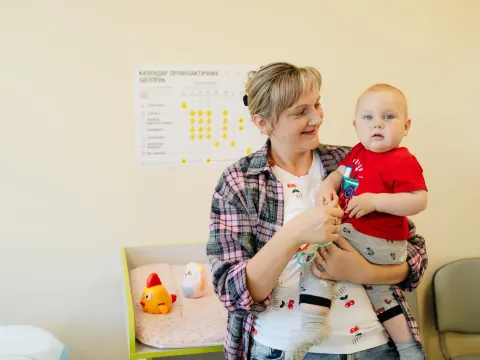
In 2024, Poltava opened an early intervention centre offering support for children aged up to 3 or 4-years with developmental delays. The introduction of this service has made it possible to provide rehabilitation for vulnerable children, address developmental challenges, and identify potential risks as early as possible. The earlier a child can receive support from specialists, the greater the chances of overcoming difficulties.
Today, nearly 60 families with young children are receiving support at the centre. A multidisciplinary team consisting of a psychologist andsocial pedagogue speech therapist works closely with each child. All of them have undergone specialized training with the support of UNICEF and its German partners, while the salaries are covered by local authorities which helps ensure the continuity of these vital services.
In this episode, we find out how early intervention services are helping two-year-old Arsen overcome developmental challenges.
Reliable and safe water supply even during blackouts
Poltava’s water utility is now able to provide steady access to safe water for a community of over 350,000 people — including internally displaced persons.
Attacks impacting energy infrastructure have resulted in power and water supply cuts, disrupting essential services for people. Poltava’s water utility has received equipment like generators, solar inverters, tools for emergency and routine repairs, and water purification reagents so the water supply system in the city can continue functioning.
Together with Misha, we visit the water utility to learn more about the water quality in the city, the backup systems in place for power outages, and how their team managed to overcome a major emergency last year when nearly half the city was left without water.
Working together for every child
Poltava city and the region is now home to many internally displaced people who make up around 20 per cent of the population.
UNICEF is collaborating with Poltava authorities and communities, including children and youth, to advance the region’s recovery. Since 2023, UNICEF, with support from Germany’s BMZ through KfW, has partnered with 47 communities across Ukraine affected by conflict and displacement. These partnerships focus on delivering quality, inclusive social services, water, sanitation, and hygiene (WASH), as well as education and healthcare for families and young people. In 2025, UNICEF will expand its network by supporting 21 additional frontline communities. These locally led initiatives strengthen systems and promote inclusive, child-focused recovery, aligning with Ukraine’s aspirations for European Union accession and improving young lives.

Poltava’s experience shows how a shared commitment to uphold the rights and wellbeing of children and young people can transform a community. By introducing new approaches to sustain essential services, supporting grassroots initiatives, and harnessing the potential of its youth, the community is able to respond to people’s urgent needs and adapt to challenges. This model of collaboration between the community, local authorities, international partners, and young people themselves is laying a strong foundation for recovery — not in the distant future, but right now.
In 2024, 4.4 million people — including 1.1 million children — across 47 communities in Ukraine, had access to improved social services as a result of UNICEF’s Recovery Programme, supported by the German Government's Federal Ministry for Economic Cooperation and Development (BMZ) through the KfW Development Bank.