Identify early, support in time
When early childhood care changes a child’s developmental trajectory

- Українська
- English
Ilon is a cheerful, smiling little boy. He is growing up in a large and loving family: with his mother Alina, his father, his sister Mariia and his older brother Serhii. Their home in Kyiv is always full of movement, care and children’s laughter.
But when Ilon turned two, his mother noticed changes that worried her.

“My first doubts appeared in the autumn of 2025. I noticed that apart from pointing and making simple sounds, my son had stopped saying anything else. There was a period when he tried to say simple words — ‘yes’, ‘no’ — and then he simply fell silent,” recalls Alina.
Ilon was not saying a single word. The only sound — “mm” — he used in different situations: when he didn’t like something, when he wanted to call someone, or when he was asking for something.
So Alina began searching for answers. She consulted various specialists, including a neurologist. However, she didn’t know that the necessary support could also be found in a paediatrician’s office.
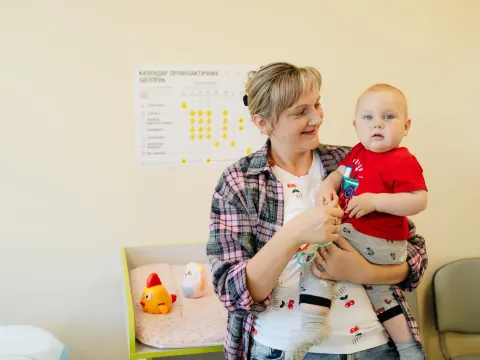
Eventually, Alina booked an appointment with Yulia. Yulia had recently completed a training course in the use of a new developmental assessment tool. The Guide for Monitoring Child Development (GMCD), was developed by the Ministry of Health, with UNICEF and IP "SpivDiia" technical support, and is now being rolled out to strengthen the capacity of healthcare workers across the country.
“When we work with the GMCD tool, we do not rush to conclusions or diagnoses. We identify the areas that need support and, together with the family, look for solutions,” explains Yulia.

During the assessment, the doctor carefully уточнювалаmonitors how the child moves, communicates, plays, responds to being addressed, and whether he uses words, gestures or sounds. For Ilon, the findings revealed a delay in expressive speech — and enabled Yulia to develop a specialized and tailored response.
“Our paediatrician gave us very specific advice. We went through the toys at home — there were so many that our son struggled to focus. We bought sensory mats and speech therapy cards. The whole family became involved in the process,” says Alina.
Visit after visit, Ilon began to change. After just five appointments, Alina noticed progress. He began to say individual words and more clearly show what he wanted and what he did not like. Ilon became interested in books and happily imitated animal sounds.


“We realised that previously we hadn’t devoted enough time specifically to communication. We started clarifying more, asking follow-up questions, and giving him a comfortable pace. And it worked,” explains Alina.
Early childhood is a period of rapid development during which even simple changes in daily interaction can significantly influence a child’s development. The key is to identify the need in time and strengthen the response for the child accordingly.
The implementation of the Guide for Monitoring Child Development is carried out by the Ministry of Health and UNICEF with the support of the German Federal Ministry for Economic Cooperation and Development (BMZ) through KfW.
To date, 678 doctors, nurses and paramedics in Kharkiv, Chernihiv, Kyiv, Zhytomyr, Lviv, Volyn and Zakarpattia regions have completed training under this programme and are using the tool in their daily practice.
This means that more and more families can receive timely and quality professional support and not be left alone with any worries about the early development of their children.