Early childhood intervention teams support children with disabilities
Thanks to the support of early intervention specialists, two-year-old Bohdanka has acquired new skills and her foster parents have received guidance on how to meet her needs.

- Українська
- English
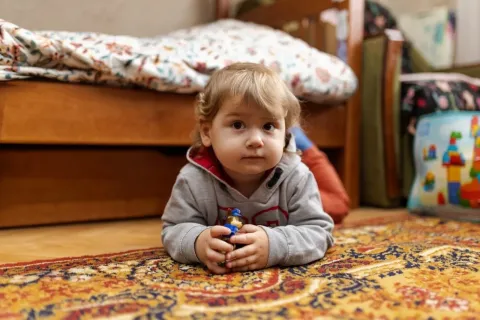
Little Bohdanka from Ukraine’s Volyn region is only two years old, but she has already faced a multitude of challenges in her young life.
From birth, she had serious health problems. Then, just months after the outbreak of the full-scale war, she was removed from her family along with her brothers and sister due to the critical situation and lack of proper parental care. The girl was just six months old and her health was alarming, with developmental problems and low weight.

"Bohdanka was the first child we took in after the bomb shelter was set up. Children with a syndrome like Bohdanka's have low weight. We immediately provided her with everything necessary and organized heart surgery in Kyiv, which she needed urgently. Later, we found a foster family that became a true family for her."
The children’s home where Bohdanka found respite is currently in the process of transformation. With the support of UNICEF, a strategy is being developed to transform it into a Center for Medical Rehabilitation and Palliative Care for Children, with repair works in the premises already underway. Crucially, the centre has started implementing new approaches to service provision, focused on the needs of children and families.
One of these approaches includes the early intervention service, which is new to the Volyn region. This service is aimed at supporting families raising children with developmental disorders or those at risk of developing them and is designed to help parents and caregivers acquire the knowledge and skills they need to overcome challenges.

While Bohdanka was under the centre’s care, a transdisciplinary team of specialists began working with the young girl. The team includes a speech therapist, psychologist and occupational therapist. In 2024, the team received specialized training from early intervention trainers, under a UNICEF project funded by the government of Germany through the KfW Development Bank and implemented by the Dzherelo Centre for Social Services and Rehabilitation.
Taking her first steps, saying her first words
After a year and a half, foster parents Liudmyla and Petro took Bohdanka and her older siblings into their care. At first, they worried about whether they could cope with all the challenges.
"We were invited to take care of the older children. And later, we learnt that there was also Bohdanka. I remember seeing her for the first time – she was so tiny and thin. Of course, we couldn't possibly separate her from her brother and sister."

When Bohdanka came home, the early intervention team continued to work with her. Specialists not only help the child but also teach her foster parents new approaches to childcare and early development. Together, they have identified key goals and prepared an action plan.
The occupational therapist helped Liudmyla and Petro to obtain adapted plates and dishes, as well as a special chair, and taught them how to help Bohdanka sit at the table. Meanwhile, the speech therapist helped teach the girl to communicate through simple gestures.

"When she started doing this, we moved on to speech stimulation. All this is done through play, because this is the best way for a child to learn. We taught the mother, because she is the one who helps the child to do all these activities at home and, to get the results, these activities need to be done consistently and regularly."
The support has helped Liudmyla and Petro to better understand their strengths and boost their parenting skills.
"We not only help the child but also work with the entire family so that they can overcome difficulties with confidence,” says psychologist Oksana Frolova. “Parents know their children best, and our task here is to suggest how best to support the child's development in their natural environment.”
After several months, Bohdanka showed significant progress – she learned to eat on her own, took her first steps and began to speak. The early intervention team played an essential role, supporting the family at every step and visiting them on a regular basis.
"Bohdanka became very active – she likes taking everything into her hands and studying it,” says Liudmyla, with a smile. “She loves listening to lullabies before bedtime, but she is still scared to be alone. We see how she changes every day, and it inspires us to move forward."
Bohdanka and her siblings are now thriving under Liudmyla and Petro’s care.
"The older children help with everything, they play with her and her sister braids her hair every day,” says Petro. “We are happy to see how she thrives.”


The UNICEF project aimed at strengthening social services for children with disabilities, as well as for children at risk of developing disability and their families, is being implemented as part of its support to the childcare system reform in Ukraine. The project is implemented by the Dzherelo Centre for Social Services and Rehabilitation, with the financial support of the German Government through the German Government's Federal Ministry for Economic Cooperation and Development (BMZ) through the KfW Development Bank.