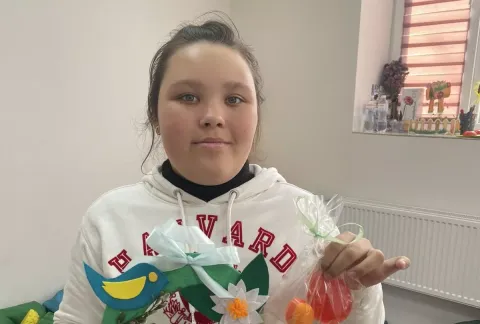
“I am smart, I am beautiful, I am strong”
How day care services help ten-year-old Eva and other children with intellectual disabilities to socialize and thrive.

- Українська
- English
"When Eva first came here, she couldn’t read, write or count,” says Oksana. She’s attending a day care centre, which she travels across Kyiv to reach every morning with her 10-year-old daughter.
The services are focused on quality social support where children build practical life skills in a nurturing environment.
For Oksana, and other families raising children with Down syndrome, the services run by the NGO, WeCan, are not only helping their children to develop under the care of a professional team but are also giving them the space to focus on their own wellbeing, careers and household matters.
“Now she reads, counts, writes, types on a computer and has become very good at drawing. Eva has made tremendous progress in socialising, she is no longer anxious around other children and she has become very independent at home. The skills we tried to teach her in our family didn’t work until she came here."

The lack of specialised local services for children with intellectual disabilities prompted Natalia Druzenko, who is also raising a daughter with a disability, and a friend to establish WeCan in 2020 to provide inclusive social services tailored to the child’s needs which enable children to live as independently as possible.
Children master communication and self-care skills such as personal hygiene, cooking, managing their rooms, and learning how to respond in emergencies. Day care services offered are complemented by rehabilitation and educational components, including maths, Ukrainian, geography and other subjects adapted for learners with Down syndrome.


The multidisciplinary team includes a social worker, a teacher-psychologist, an art therapist, a canine-assisted therapist and special education teachers, ensuring an individual approach for every child and much-needed family support.
"We offer our services as an integrated package. I believe this is the minimum that should be available in every community. The programme is tailored to the child’s needs and individual development plan. For example, our math lessons are not about abstract theory but about enabling a child to go shopping on their own," says Natalia Druzenko.
Natalia explains that when parents first bring a child to the centre, specialists spend several days assessing their needs before creating an individual care plan, which is regularly reviewed and adjusted.

“We provide feedback to parents on their child’s social behaviour, development and learning. This gives families peace of mind and confidence that their child is in the right place."
To strengthen their services, Natalia’s team applied for and received a small grant for local social service providers under the Social Protection for Inclusion, Resilience, Innovation and Transformation (SPIRIT) initiative. This programme aims to strengthen grassroots social protection systems and is led by the Ministry of Social Policy, Family and Unity, with support from UNICEF, and the Social Protection Fund for Persons with Disabilities and funding from the UK Government.
The grant enabled them to cover over 75 percent of their needs for delivering quality social service and bring the community‑led daycare service up to national standards.
"The social services sector is undergoing an important transformation, and our programme is supporting these shifts in communities to provide the best care possible for families at this time of immense need,” says Natalia Datchenko, UNICEF Ukraine Child Protection Specialist.
“By strengthening local service providers we improve access for children and their families to the support they need, while developing a more transparent social services market.”
The small grants programme forms part of the Ministry of Social Policy, Family and Unity of Ukraine SPIRIT initiative, funded by the UK Government and supported by UNICEF and the World Bank. The programme is being rolled out in ten regions, including Volyn, Dnipropetrovsk, Zhytomyr, Kyiv, Lviv, Mykolaiv, Poltava, Kharkiv, Khmelnytsky, Chernivtsi regions and the city of Kyiv.