Catch-up classes help children in Ukraine recoup lost learning
Displaced children from Ukraine's frontline regions are returning to school, thanks to catch-up classes organized by UNICEF and partners.

- Українська
- English
Last year, 16-year-old Artem became student president of his high school, winning the election with 60 per cent of the vote. Since then, he has created a school website, organized sports competitions and improved his math grades.
"But the most important thing is that I made friends and became part of the school's community," says Artem, who moved to the Ukrainian city of Poltava with his family, after fleeing the fighting in Kharkiv.
Artem is thrilled to once again be able to return to school, instead of studying online.
"Live interaction and face-to-face learning are irreplaceable".

“It was very stressful”
Asked how the ongoing war has changed his life, Artem says it was as if his childhood had been suddenly crossed out with a black marker.
"I had everything – a nice home, a school I loved, friends and a full life. Then the shelling started in Kharkiv and everything changed," he recalls. "Many schools were destroyed, shells fell next to mine as well. It was very stressful for me. I felt awful and wasn't ready to change schools or to start from scratch.”
The relentless rocket attacks forced his family to flee to Poltava. However, that first year away from home was disorienting, as Artem tried to adjust to a new city, new home, new surroundings and a new school.
Eventually, with the support of his family, teachers and friends, he began to thrive.
“Now I can study in person, with good teachers, great friends and in a nice school".
Over the past year, his school has become a second home, providing stability amidst the chaos of air raids and the dangers of war.
"I’m in a maths-focused class, with nine math lessons a week – about two per day,” Artem explains. “Now that I’m in high school, it’s very challenging. I wouldn’t want to go through this tough period online.”
After long periods of remote learning due to the ongoing war, power outages and COVID-19 pandemic, students like Artem are catching up on lost learning and returning to school once more, thanks to classes organized by the United Nations Children’s Fund (UNICEF). Over 35,000 children across Ukraine have participated in these classes, organized by UNICEF and partners with support from the European Union, the Global Partnership for Education (GPE), and the governments of Luxembourg, Germany, Japan and Norway.
Thanks to these classes, students at Artem’s school have had the chance to attend maths and Ukrainian lessons twice a week since last autumn.
"It’s a great option for those who can’t work with a tutor. A teacher’s personal explanation is the best way to grasp complex material.”
Feeling safer has also boosted his mood.
"I remember how I felt at the beginning of the war, with 15 air raid alarms a day. Now, in Poltava, it’s completely different – I feel safer here.”

“I can ask about things I don’t understand”
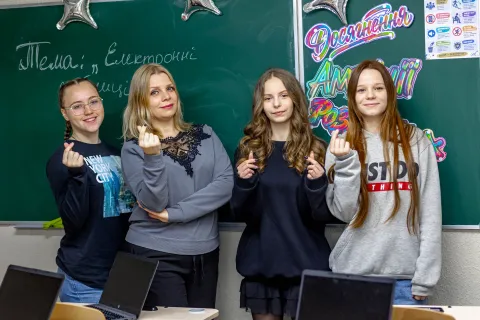
Last year, another school in Poltava held a ‘self-governance’ week, in which students took on the roles of teachers. Fourteen-year-old Polina stepped into the shoes of a geography and English teacher, an experience that helped her decide on her future career.
"I enjoyed working with children. I love kids in general and sharing my knowledge with them. I don’t think a self-governance week would have been possible online. Even if it were, it wouldn’t have sparked the same emotions."
Polina's family moved to Poltava to escape hostilities in Kupiansk, in the Kharkiv region. She used to study online, but her mother insisted on a full-time education, prompting their move to Poltava.

"When the war started, education in my town was suspended,” says Polina.
“Here, I can study one week online and the next in person. In person, I can ask the teacher about things I don’t understand and work through them.”
Both Polina and Artem agree that the biggest advantage of face-to-face learning is the live interaction with others.
"When you're part of a community, it’s easier to get through the war,” says Polina. “There are times when your mood just drops for a long time. That’s when being around people helps. Something interesting is always happening at school.”