UNICEF’s support to Ministry of Health to tackle the Sudan Ebola Virus outbreak in Ntoroko District
A critical initial step was the meticulous tracing and isolation of individuals who had come into contact with the confirmed case.

In the wake of the Sudan Ebola Virus Disease (SVD) outbreak in Southwestern Uganda, UNICEF was a key partner to the Ministry of Health and provided crucial support to response efforts focused on Ntoroko District and other parts of the country. The collaboration significantly contributed to raising public awareness, strengthened surveillance, and promoted infection prevention and control measures within the district's communities and schools.
Ntoroko District quickly became a focal point of the response after the burial of a probable case and the movement of a confirmed case that was traced back to the district. An alert was raised following the death of an individual in Kampala whose body was brought back to Ntoroko, and the subsequent death of a four-year-old boy who had been in contact with the initial case who was also diagnosed with SVD.
Upon confirmation of a positive case – the aunt of the deceased child – a multi-sectoral team, including officials from the Ministry of Health, UNICEF, the World Health Organization (WHO), and other partners, was immediately deployed to the district.

"On 3rd March 2025, I received a communication from the District Health Officer that there were officials from Ministry of Health, who had come to establish and investigate a suspected outbreak of Ebola in the district.”
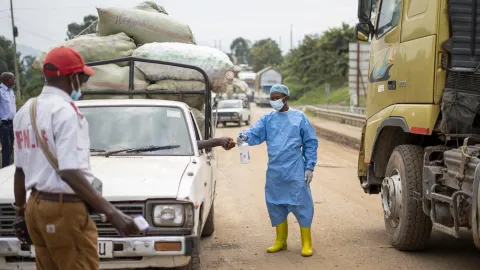
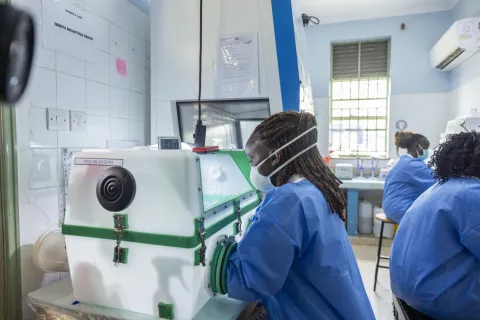
A critical initial step was the meticulous tracing and isolation of individuals who had come into contact with the confirmed case. These included household members and individuals the patient had interacted with at health facilities and even traditional healers. Nine close contacts were immediately taken to Fort Portal Regional Referral Hospital for isolation and testing.
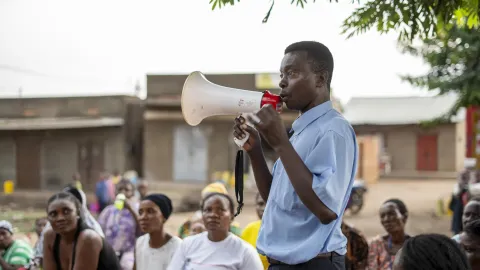
Following the incident, the Ministry of Health with UNICEF support and funding from the governments of Sweden and the United States embarked on community engagement and risk communication activities to control the spread of the outbreak. House-to-house visits were initiated in hotspot areas to educate residents on SVD transmission, signs and symptoms, and infection prevention measures.
However, the return of individuals who were taken into quarantine, even after testing negative, presented challenges related to stigma within the community.
Mr. Byaruhanga highlighted the need to address this: "There was a challenge of being accepted in the community because they were in contact with the sick which caused stigma among the people in the community. With support from UNICEF, we quickly handled it with the psychosocial team and mobilised the community to intensified awareness about the dangers of stigmatisation."

UNICEF significantly supported the Risk Communication and Community Engagement (RCCE) pillar of the response and provided essential information, education and communication (IEC) materials, translated into local languages, which were distributed in targeted communities, markets, transport stages, and schools. Furthermore, financial assistance and technical supervision were also availed.
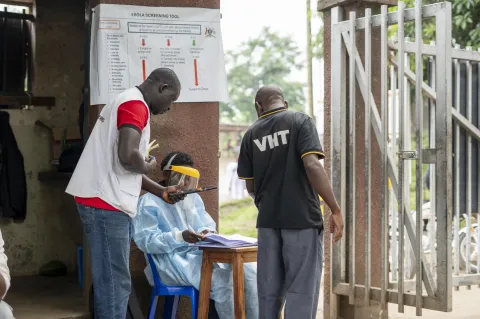
Capacity building was also done through training and orientation of various frontline workers and community leaders, including Village Health Teams (VHTs), teachers, and local council leaders. These trained individuals were equipped to conduct community sensitization, support early detection, and mobilize communities for health interventions.
In schools, UNICEF supported the ministry to conduct school-based engagements. Recognizing the potential for rapid spread in educational settings, teams visited numerous schools in hotspot areas, orienting teachers and engaging thousands of learners with critical information on SVD and mpox prevention, including hygiene practices like continuous handwashing.
Kemigisa Shalfat, a 14-year-old pupil recalling the lessons learned, shared: "The Ministry of Education & Sports, the Ministry of Health came and taught us about Ebola. The causes of Ebola are sharing clothes with an infected person. Then, getting into contact with fluids, including saliva, blood or sweat of an infected person."
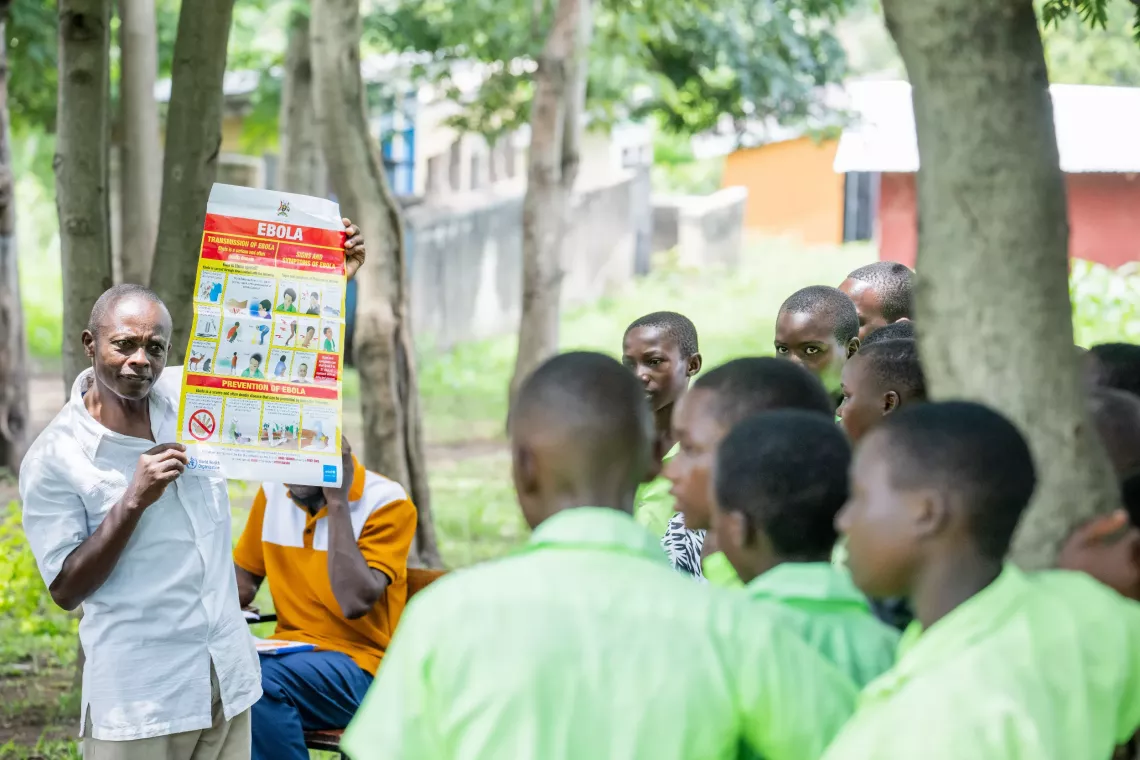

Baluk David, the headteacher of Karugutu Primary School, shared his experience:
"A team from the Ministry of Health and UNICEF visited our school. They spoke with both our staff and students, providing comprehensive information about Ebola. Thanks to their intervention, our learners became well-informed about the disease."
He also highlighted the continued practice of infection prevention measures in the school: "We've implemented various preventive measures, particularly hand washing. At our gate, we've installed a hand washing station with liquid soap and sanitizer. Thanks to our consistent sanitizing practices, the school remains safe as of now."
Stakeholder engagement was extended to religious institutions, markets, and transport groups like boda-boda (motorcycle) riders, ensuring widespread dissemination of life-saving information.
The collaborative efforts of the Ministry of Health, Ministry of Education & Sports and UNICEF, Ntoroko District local government alongside other partners, have been crucial in bringing the outbreak under control in Ntoroko. At the time Uganda was declared free of SVD, no new case had been reported in Ntoroko.
Ms. Seith Katusabe, Education Officer, guidance and counselling, expressed gratitude for the collective support: "We extend our gratitude to the Minister of Health, Minister of Education & Sports, and implementing partners like the UNICEF and WHO for their comprehensive support to our district. Their assistance, including financial, material, and technical support has been invaluable. As a district with limited resources, their involvement has enabled us to reach all the areas we identified as priorities."