Government communication experts share insights
When words become Uganda's first line of protection during a disease outbreak
In 2007, a mysterious illness began claiming lives in the hills of Bundibugyo, western Uganda.
The symptoms looked familiar. Patients developed high fevers, vomiting and unexplained bleeding. Health workers suspected Ebola, but something did not quite fit. Samples were collected and flown to the Centers for Disease Control and Prevention in Atlanta, United States.
The verdict surprised them. Uganda was confronting a strain of Ebola the world had never seen before.
It would become known as the Bundibugyo strain, named after the district, where it first emerged.
Dr Atek Kagirita, then part of the investigation team, said the experience left a lesson that has shaped nearly two decades of responding to deadly outbreaks. Viruses rarely arrive with certainty. They arrive with confusion. Before laboratories identify the pathogen, before treatment centres are established and before emergency plans are activated, fear often spreads faster than the disease itself.
Recently, Kagirita served as an Ebola Incident Commander at the Ministry of Health. Looking back on that first investigation, he said containing an outbreak has never depended solely on medicine.
It also depends on communication.
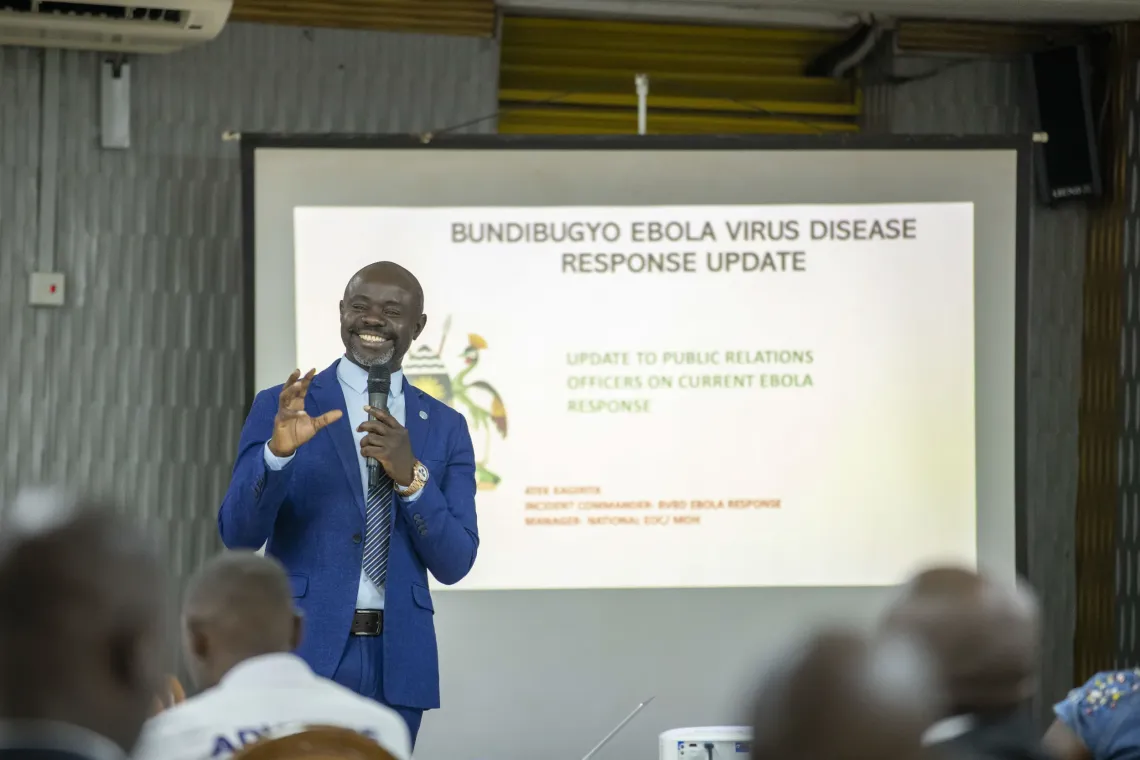
"It also depends on communication. Ebola is one of the viral diseases that can become catastrophic if it is not detected and contained early."
He said this during a training on public health emergency communication organised by the Ministry of Health with support from the United Nations Children's Fund (UNICEF), held at Hotel Africana in Kampala on July 10, with support from the governments of the United States and Iceland.
The audience in front of him was unlike the doctors, epidemiologists and laboratory scientists who usually fill emergency response meetings.
They were communication officers from across government ministries, departments and agencies, people whose daily work involves explaining government decisions, answering public questions and translating complex policies into language ordinary citizens can understand.
During a disease outbreak, however, their responsibilities change dramatically.
The statement issued a few hours too late, the social media post shared without verification or the rumour left unanswered can determine whether a worried parent takes a feverish child to hospital, or a family cooperates with health workers.
Communication becomes a public health intervention. That idea sat at the heart of the training.
The officers learnt how information itself can interrupt the spread of disease.
Public health emergency communication may sound technical, but its purpose is simple: helping people make informed decisions before, during and after a health crisis. When people understand what is happening, what the risks are and what actions they should take, they are more likely to protect themselves, their families and their communities.
Getting that balance right, Kagirita explained, is rarely straightforward.
"Our responsibility is to communicate early enough for people to protect themselves while ensuring the information is accurate, verified and proportionate to the actual risk," he said.
During the training, a different understanding of communication began to emerge.
For years, many officers had viewed their role primarily as explaining government decisions after they had been made.
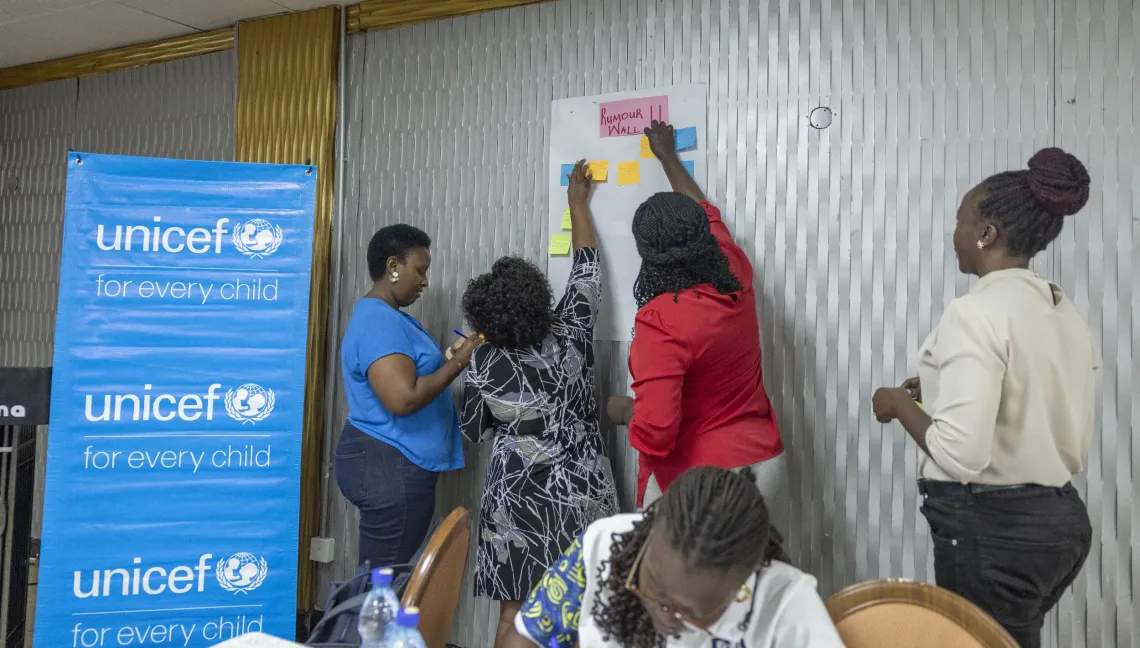
This training challenged that assumption. Communication was no longer the final step in an emergency response. It was becoming one of the first.
Edward Muganga, the Ministry of Health's specialist responsible for Risk Communication and Community Engagement, said the answer begins with understanding people before trying to change their behaviour.
To illustrate the gap between knowledge and behaviour, Muganga recalled an initiative by the Ministry of Health to make condoms more accessible. Dispensers were installed in washrooms, ensuring people had easy access and clear information about their use. But officials noticed an unexpected pattern. The dispensers emptied mainly on Fridays.
The observation, Muganga said, carried an important lesson. Access to information and services does not automatically change behaviour.
"Providing information alone is not enough," he said. "We must understand people's beliefs, motivations, fears and social influences before we can expect them to adopt healthier behaviours."
For years, public communication during emergencies has often been understood as a one-way exercise: experts gather evidence, officials make decisions and communicators pass those decisions to the public.
Communities, Muganga said, are not empty vessels waiting to receive instructions. They observe. They question. They interpret events through their own experiences. They also possess information that government may never see unless someone takes the time to listen.
"It is not simply government talking to communities," he said. "Communities also provide information back to government."
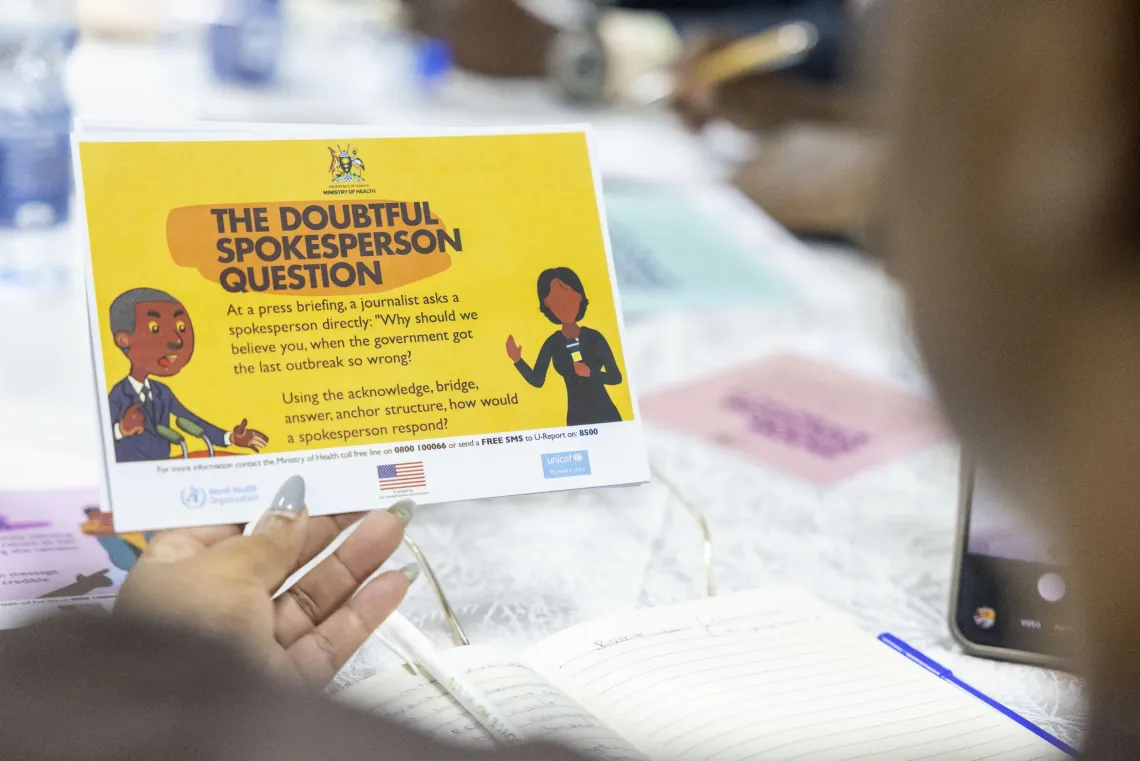
That exchange is what health specialists call risk communication and community engagement. Stripped of the technical language, it simply means having an honest conversation with people about a threat, listening carefully to their concerns and working with them to reduce the danger together.
Sometimes that conversation reveals why families delay taking sick relatives to hospital. Muganga walked participants through UNICEF's Risk Communication and Community Engagement framework, which encourages communicators to begin by understanding the risk itself, identifying the audiences most affected and listening carefully to community concerns before deciding how to communicate. The approach recognises that no two audiences are the same. A border trader faces different risks from a nurse in a treatment unit, a schoolteacher, a religious leader or a family caring for a sick relative at home. Each requires information that reflects their reality.
He reminded the officers that every message they share has consequences.
"The success of every public health emergency response depends not only on laboratories, treatment centres and surveillance teams but also on trusted communication that helps communities understand risks, reject misinformation and take action to protect themselves."
Muganga said decisions within the Ministry of Health are increasingly guided by evidence gathered directly from communities.
That philosophy underpins what the ministry describes as its 'Theory of Change': when people receive timely and accurate information, participate in decisions affecting their communities and feel empowered to act, they are more likely to adopt behaviours that reduce disease transmission.
As the training progressed, many participants began to see their profession differently.
For Gilbert Kadilo, Associate Consultant and Media and Communication Specialist at the Uganda Management Institute, one lesson stood out.
"At the beginning of the Ebola response, there appeared to be some confusion in communication between Uganda and other regional and international organisations," he said. "However, through the engagements and interactions that have taken place, I believe we are now much better positioned to handle similar situations in the future."
Even so, he believes one challenge remains.
"I still see a challenge when it comes to cross-border communication."
Mariam Yusuf, Senior Communication Officer at the Ministry of Internal Affairs, said the greatest value of the training was bringing communicators from different government institutions together.
"The biggest takeaway for me from today's engagement is the importance of stakeholder engagement," she said. "As key stakeholders and partners in government communication, having accurate and timely information helps all of us perform our roles better."
She noted that Ebola affects far more than the health sector. Immigration, security, education, transport and trade all have a role to play. Understanding both the science and the wider context, she said, enables communicators across government to respond with greater confidence and consistency.
Peace Akol, a Communication Officer at the Government Citizen Interaction Centre, shared a similar view.
"The training has been extremely valuable, and I've learned a great deal," she said.
"One of my biggest takeaways is that accuracy is essential in crisis communication."