Schools embrace feeding programmes to improve children’s learning
Undernourishment impairs a child’s concentration and ability to retain information

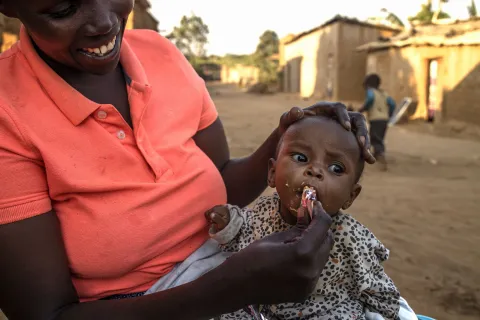
For many schoolchildren in Kole District in northern Uganda, learning on an empty stomach is an everyday reality.
Undernourishment not only impairs a child’s concentration and ability to retain information, it also starves the brain of sufficient nutrients, stunting its growth and development. When children can’t learn properly, their school journey, and their future prospects, are compromised.
When the authorities in Kole District realized the risks of an empty tummy on children’s learning, they worked with schools to start a school feeding programme.
The Kole District leadership – through district and sub-county nutrition coordination committees – are adapting knowledge on how to strengthen nutrition services in schools and communities that they acquired from trainings organized by UNICEF with funding from the European Union.
Communities and schools have been trained to establish gardens to grow food that can be eaten by family members and pupils.
“We were sensitized by the district and encouraged to start school feeding programmes. In our school, we invited parents, talked to them, and they accepted to support us to feed the pupils. As a school, we bought maize seeds and the district also provided us with seeds. Some parents bring maize or bean seeds, which we plant and harvest,” says Jolly Joe Ekwan, deputy head teacher of Okole Primary School.

Maize has been planted on an acre of land near the school. Okole says that before the COVID-19 lockdown, the entire school population – 1,374 pupils in total – was able to have meals. Candidate pupils who resumed classes on 15 October 2020 do not have to worry as the school will also provide them with meals.
“We saw how our children were behaving. In the afternoon, they would be dizzy all the time and were not concentrating in class. This prompted us to roll out this feeding programme and the learning has greatly improved,”
Through the Development Initiative for Northern Uganda (DINU), UNICEF is supporting the government to establish structures that are helping to deliver nutrition services using a multi-sectoral approach in 15 districts in this food-insecure part of the country.
The multi-sectoral approach allows districts to tackle nutrition challenges in communities and schools as cross-cutting issues that require all sectors to work together.

Abongdic Primary School in the sub-county of Balla, which is located in Kole, has this season (October) planted sunflowers, vegetables and maize. David Otim, the school head teacher, says that the school feeding programme has seen more children enroll back in school during the re-opening for candidate pupils on 15 October 2020.
“Children who had dropped out are now back. Some pupils from the surrounding schools have also joined us. In the previous season, we only planted maize and have stocked it in our store. Parents contribute too because the food we grow here is not enough,” Otim explains.
He adds that once the sunflower is sold, funds raised will be used to buy chicken and meat for the pupils, to supplement the beans that they eat more frequently.
Otim further reveals that the grades of pupils have greatly improved because they are no longer hungry and can concentrate on their lessons.
The promise of a school lunch every day, a privilege many children in Kole District go without, along with other investments in children’s education, is helping to ensure school attendance stays constant, and that children learn well.