Leaders in Kamwenge laud UNICEF’s primary health care community empowerment initiative
The initiative is contributing to the improvement of lives at the grassroots

Speaker after speaker was full of praise for UNICEF who introduced a Primary Health Care Community Empowerment Initiative (PHCCEI) in Kamwenge District in Southwestern Uganda.
In Kamwenge District, community leaders and health officials revealed that the initiative has improved coordination and convergence in nutrition, health, water, sanitation, and hygiene (WASH) leading to a reduction in cases of malnutrition and other ailments among children below five years and pregnant women.
“In our villages of Kagada 1 and 2, we have seen a lot of improvements in our health, sanitation, and livelihoods. This programme has taught us many things. Our communities are stronger because we plan, coordinate and work with the authorities to support implementation of programmes,” said Alozio Balisigala, Kagadi Local Council 1 Chairman.
The PHCCEI, introduced by UNICEF in Kamwenge District with funding from Johnson and Johnson and the ELMA foundation has seen village health teams, health workers and community leaders trained to support its implementation and continuity at the grassroot levels.

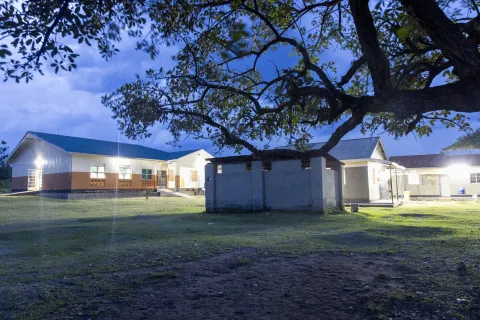
Gaston Turyayikayo, a Village Health Team (VHT) member in Kagada said, “We have mobilized ourselves in these two villages. We also collected money to construct an outreach/meeting centre where we converge to discuss pertinent issues affecting our communities including health, nutrition, domestic village and income generation. We also worked together to repair our borehole since we only have one in the village. We have also constructed a nursery school to have our children attain early education. We have been able to do all these because of the knowledge and collaboration PHCCEI has taught us to be resilient.”
Through this program, educational materials have been distributed and mass media channels utilized to promote better nutrition practices in the community.
In Kagada Villages 1 & 2, a team of journalists on a media field visit organized by UNICEF from 16-20 December 2024 to assess the impact of nutrition actions funded by Johnson and Johnson and the ELMA foundation witnessed how community engagement has improved detection of malnutrition in the two villages compromising of 189 households.
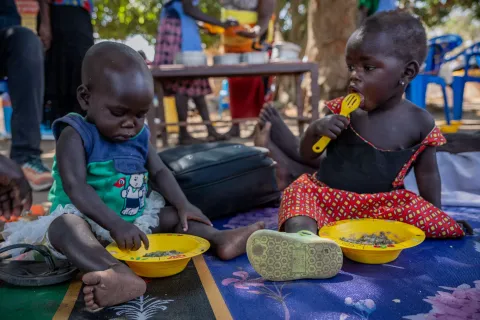
Local leaders and village health team representatives testified that all the 189 households currently do not have any malnourished children and pregnant women.

Joshua Byaruhanga, a VHT member asserted that the programme has equipped them with relevant skills including undertaking community service and utilizing the available means to better their health and lives.
“In this community, we have trained ourselves to stop being beggars. We work together through collaboration to find solutions to some of the challenges we experience. I am grateful to the district, UNICEF, and the donors of this project. We are turning into relevant communities. We know what foods to eat to stay health and build our immunity,” he explains.
The two villages have 11 cells, with each cell having a lead father and mother who act as role models and mobilize fellow community members for assessments, active screening and referral of children aged 6-59 months, pregnant and lactating women, home visits for follow up; promotion, counselling and education on recommended Maternal, Infant, Young, Child and Adolescent Nutrition (MIYCAN).
According to Alex Mokori, Nutrition Specialist UNICEF Uganda, the aim of the program is to strengthen decentralization, mobilizing communities to actively participate in planning, implementing, and monitoring developmental activities, overcoming inappropriate social norms, enhancing multi-sectorial convergence, and reducing geographical barriers. “The Initiative converges and builds upon promising practices by providing a framework and a process to strengthen the delivery of services to mothers and children at community level with the community as the main protagonist,” Mokori explained.

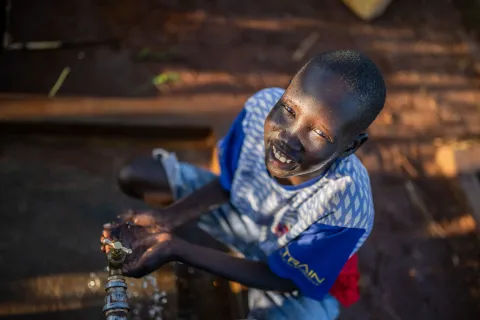
Through the programme, households in Kamwenge have constructed latrines with handwashing tippy tap facilities to improve the water, sanitation and hygiene in their homes and community. Specifically, in Kagada Villages 1 & 2, 156 households have latrines with the tippy tap facility.
Dr. Ivan Mujuni, the Principal Medical Officer of Mukunyu General Hospital in Kamwenge District said community have been sensitized to use the available resources to improve the health, nutrition, and WASH situation in their communities.
“When we started this programe five years ago, the situation in our communities was not good. Today, there is tremendous improvement because the cases of malnutrition and other sicknesses like malaria, diarrhea, pneumonia have tremendously reduced,” explained Mujuni. He lauded Johnson and Johnson and the ELMA foundation for the support extended to the hospital, the lower health units and the communities who have directly benefited from the partnership.
The Assistant District Health Officer in charge of Environment Health Virginia Komwereko mentioned that the communities in Kamwenge have benefited from the programme which has reduced the number of hospital stays when a child or expectant mother is admitted. “Those days, children admitted would stay in the hospital for one or two weeks. We usually call UNICEF our father and mother because this program was extended to the communities beyond the health facilities. Communities are more knowledgeable on the practices/actions to undertake to prevent most of the community associated diseases,” Komwereko elaborated.
All these achievements wouldn’t have been realized without the funding from the Johnson and Johnson and the ELMA foundation to the districts of Kamwenge, Isingiro, Kyegegwa and Kikuube, target refugee children and host communities below the age of 5 years. The interventions also benefit expectant mothers in the four target districts.