Knowledge and community engagement empowered learners’ voices against disease outbreak.
UNICEF was supported by the governments of Sweden and the United States to tackle the Ebola outbreak

Godwin Baluku a 16-year-old pupil at Karugutu Primary School in Ntoroko District, Western Uganda remembers the moment everything changed.
“At first, it was just whispers then rumours about a strange illness spreading in neighbouring areas. Then, the news became real: the Sudan Ebola Virus Disease (SVD) had reached our district,” Godwin narrates.
Fear crept into the community like a shadow, gripping parents, teachers, and learners alike.
For Godwin, the disease was a mystery, something spoken of in hushed tones, its dangers unclear.
Ntoroko’s bustling markets, crowded transport stages, and tight-knit villages were the lifeblood of the community, but they also made it vulnerable to rapid disease spread. When the outbreak was confirmed, government and partners swung into action.
The Ministry of Health, with UNICEF’s critical technical and financial support and funding from the governments of Sweden and the United States, launched a robust Risk Communication and Community Engagement (RCCE) initiative.
Their mission was clear: educate, empower, and protect.
A key part of this strategy was reaching learners and teachers, recognizing that schools were powerful platforms for change. Godwin’s school, along with 17 others in hotspot areas, became a centre for learning and awareness. RCCE teams worked closely with teachers, training them to be frontline messengers, and distributing Information, Education and Communication (IEC) materials in the district. In total, 130 teachers received specialized orientation on preventing SVD and mpox.

"The district technical staff supported by teams from The Ministry of Health, Ministry of Education & Sports and UNICEF came to our school, spoke to our staff, and taught our learners. They explained how Ebola spreads, its signs, and how we can protect ourselves."
For Godwin and the 6,700 students reached across the district, this knowledge was life-changing. The fear of the unknown faded as they learned the facts on how Ebola spreads through contact with infected bodily fluids, the importance of handwashing, and the dangers of sharing clothes with sick individuals.
“I paid close attention, knowing this information could save lives,” Godwin reveals.
Kemigisa Shalfat, a 14-year-old summarized it clearly during a session:
"Ebola spreads by touching an infected person’s blood, saliva, or clothes. We must be careful."
The school campaigns were interactive and engaging, using posters, discussions, and leaflets to reinforce key messages. Teachers included health messages into daily routines, ensuring learners remembered and shared what they learned. Soon, Godwin, Shalfat and their classmates became young ambassadors, taking vital information home to their families and communities.
Mr. Baluk David saw the results firsthand: "Our learners were well-informed, and we kept reinforcing the message. That’s why today, we’ve had no new cases in our school or community."

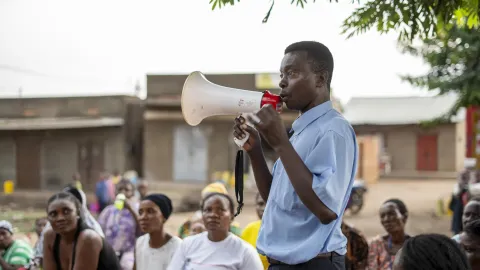
But the effort didn’t stop at school gates. Community structures like Village Health Teams (VHTs) were activated to conduct door-to-door visits in hotspot areas, reaching 47,250 people in 9,450 households. Community leaders, religious leaders, market vendors, and boda-boda riders were equipped with information and Ebola IEC materials to enhance their efforts in spreading awareness and preventive messages.
One major challenge was stigma where people who had contact with Ebola patients faced rejection. Mr.Byaruhanga Patrick, the District Health Educator, explained:
"Some were shunned because they had been near the sick. But with UNICEF’s support, we conducted psychosocial sessions and community sensitization to fight stigma."
For Godwin Baluku, the lessons were life-changing. His school, once just a place for books and exams, became a hub of health awareness and hope.
Today, he knows that an informed community is a strong one that is ready to face outbreaks, break stigma, and build a safer future, one lesson, one conversation, one handwash at a time.