Keeping Ebola messages fresh using drama
Thanks to Lake Edward Cultural Performers

A woman’s loud hysterical scream pierces the air.
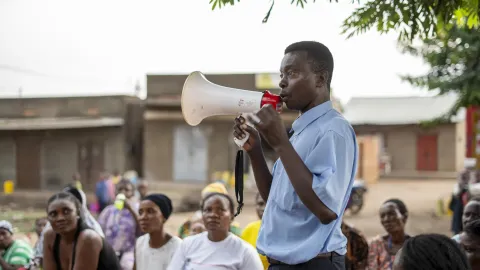
“My child is dead! Ebola has killed my child!” she says in the local dialect as she sobs uncontrollably. Two hundred on-lookers surround her, resting their hands on their cheeks in sadness.
This somberness, however, does not last long because what the people are witnessing is part of a drama scene by Lake Edward Cultural Performers (LECUP).
The group was founded in 2009 by 26 young people with the aim of using music, dance and drama to conserve the wildlife and natural environment of Rwenshama, a landing site located in the Queen Elizabeth National Park in Western Uganda. Over the years, the group’s interests have widened to addressing social ills like domestic violence and communicable diseases such as cholera and, more recently, Ebola Virus disease.
“In 2018, when we first heard about Ebola in DRC, the (LECUP) group immediately composed some songs and staged them, but the people did not take us seriously because they thought Ebola was far away,”
However, when the Ebola death toll started rising, the communities started paying attention because the landing site borders the Democratic Republic of Congo where an Ebola outbreak was declared in August 2018. During that time, the drama group received technical support from the Lutheran World Federation (LWF) with funding from UNICEF and was sensitized on Ebola signs and prevention measures.
According to Akiikih, the orientation was helpful because it enabled the team to get correct information on the disease, including educational materials that broadened their understanding of Ebola.
“Before the training, we did not know the causes of Ebola. We were just using our own knowledge. But the LWF trainers provided us with the correct information on Ebola causes and management and we gained further insights into the disease.”
“This was done in order to avoid creating monotony,” says Akiikih.
All the Ebola plays, and the songs are punctuated with humour and promote positive behavioural practices like handwashing with soap, use of personal protective equipment for health workers and also address dangerous local practices like eating wild game meat, and myths and misconceptions about Ebola being linked to witchcraft.
In each of the 20 shows that the group has staged, LECUP has captivated hundreds of people not only with the entertainment but also with life-saving information.
After the orientation, the drama group composed five songs and two drama plays on Ebola.
“When people hear the drumbeats, they come closer, get interested and do not leave until the drama is over. We recommend that they keep on using music, dance and drama because it attracts many people who do not have radios or televisions, and these are most people,”
In order to show their appreciation, over the years, some communities and individuals have showered the drama group with gifts including local music instruments and t-shirts while others have raised funds to transport the group after the shows.
“The communities have been positive about our drama shows. In 2018, the community approached the Uganda Wildlife Authority on our behalf, and we were given a music sound system that we use in our shows,” Akiikih says with a smile.
Community drama is an effective social mobilization tool that passes key messages to educate people and win their confidence in the fight against Ebola. It is not only a creative way to deliver messages, but also a way for people to enjoy the messaging, to be more attentive and be able to take home the messages to their families and friends.